The Verge Scraper for Posts, Link Items and Features

One stream holds two-line link posts and three-thousand-word features. Count them together and the volume chart describes nothing at all.

The Verge Scraper
Solutions

Managed tech media collection, run end to end by us

ScrapeIt runs the collector as a managed service. You name the sections, topics, products or companies; we build the pipeline, run it on your cadence and hand back CSV, JSON, Excel or a push into your warehouse, with item types separated, link targets captured and review scores in their own fields.

Cadence is per purpose. Launch windows justify frequent passes; the quiet baseline does not. Requests are paced within the crawl rules the site publishes.

Articles are copyrighted and the terms restrict reuse, so the dataset is metadata, entity extraction and publicly rendered text for analysis rather than material for republication. Bring the use case to your own counsel before the project starts.

The Verge fields in every export

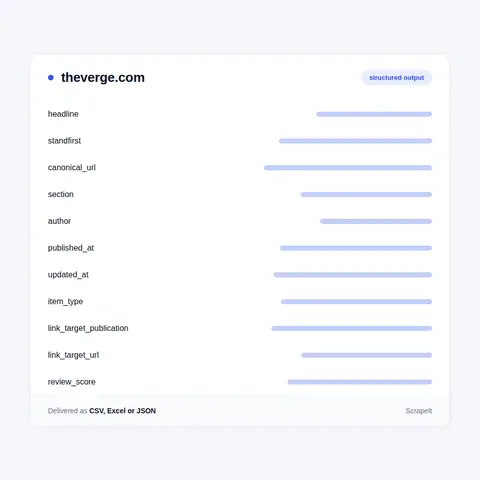
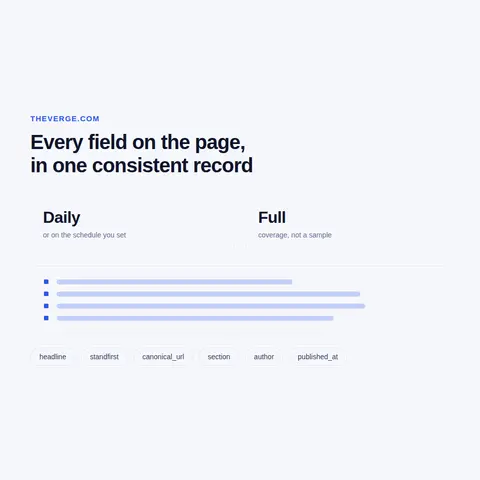
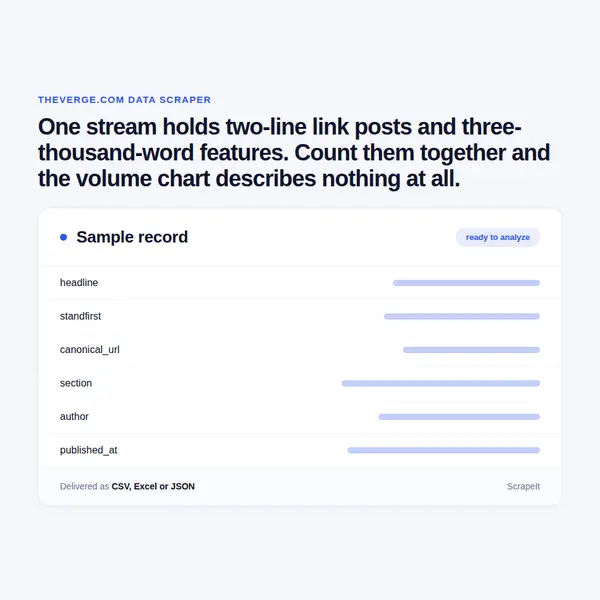
The post record covers canonical URL, headline, standfirst, section, author, publication timestamp, last updated timestamp, post identifier and item type.

Item type separates feature, review, news post and link post. That single field is what makes any volume or attention measure on this source meaningful, and it is the field most often missing from data clients arrive with.

For link posts the outbound target is captured explicitly: which publication was being pointed at and at which URL. That turns a link post from a thin item into a useful signal, because it records who this outlet considered worth amplifying.

Reviews carry the score where one is published, the product name and the verdict summary, so a review corpus can be analysed on its own without text parsing.

Then the context fields: topic tags where published, publicly rendered body text and word count, lead image URL, front position from repeated observation, and the collection timestamp on every row.

The Verge fields in every export
Reviews, launch windows and cross-outlet comparison

Reviews, launch windows and cross-outlet comparison

Review data is worth its own treatment. Scores, products and verdicts collected across time support questions a general media dataset cannot answer: how a product line has been received over successive generations, how this outlet's scoring compares with others, whether coverage sentiment tracks the score.

Launch windows need explicit handling in any time series. We keep timestamps precise and item types separate so a client can define the window and analyse it against the surrounding baseline, rather than reporting a spike as a trend.

Cross outlet comparison is the usual extension and the reason this source is rarely bought alone. The same product or company covered across several technology publications, with items typed consistently, is what produces a share of voice number worth putting in front of anyone.

Historical backfill is practical because URLs are stable and section pagination reaches back. It runs as a one time job separate from the ongoing feed.

One stream, several kinds of post

The Verge publishes technology and culture coverage in a single flow that mixes several genuinely different kinds of item: long reported features and reviews, conventional news posts, and very short link posts that point at somebody else's reporting with a line or two of comment.

They all sit in the same stream and look alike in a feed. In a dataset they are not remotely alike, and a pipeline that treats them as one type produces a volume series where a quiet week of features outranks a busy week of link posts, or the reverse, depending on how you count.

Discovery is easy: the site publishes RSS and responds normally, and section fronts carry ordered selections. Article pages carry structured markup with headline, author and timestamps. Coverage clusters hard around product launches and industry events, which is a real pattern and needs to be visible rather than smoothed away.

Reviews deserve their own handling. They carry scores and verdicts and they are the items most often cited downstream, so they are worth separating from news posts regardless of how a client treats the rest.

Get a Quote
dev_w
25

Developers

customers
500+

Customers worldwide

pages
1 500 000 000+

Pages extracted

stime
15000+

Hours saved for our clients

Plans

Airplane

€199 / one-time

setup fee - included

Data limits100,000
Frequencyone-time
Run timeup to 5 days
Data storing7 days

Helicopter

€169 / mo

setup fee €499

Data limits250,000
Frequencymonthly
Run timeup to 5 days
Data storing14 days

Glasses

€229 / mo

setup fee €499

Data limits1,000,000
Frequencyweekly
Run timeup to 5 days
Data storing30 days

DNA

€549 / mo

setup fee €799

Data limits3,000,000
Frequency3 times daily
Run timesame day
Data storing90 days

Why untyped volume on a tech blog is a meaningless number

A client asks how much coverage a product got. Untyped, the answer counts a three thousand word review and a two line link post as one each, and the number that comes back is not wrong so much as meaningless.

Typed, the same data answers properly: one review, four news posts, eleven link posts, of which nine pointed at somebody else's reporting. That is a picture of how a story travelled rather than a tally, and it is the difference between a report somebody acts on and one they quietly ignore.

The second reason is the launch cycle. Technology coverage clusters around announcements, launches and industry events, and volume outside those windows is a different baseline. Precise timestamps and typed items let a client model the launch window separately instead of letting it dominate a year long trend.

The third is the amplification signal. Because link posts record what this outlet chose to point at, they reveal which publications set the agenda in a sector. That question cannot be asked at all without the outbound target captured.

The fourth is reviews. A scored review is the item most likely to be cited, quoted and used in purchasing decisions, and it deserves to be separable from the stream rather than buried in it.

Our Blog

Reads Our Latest News & Blog

Learn how to use web scraping to solve data problems for your organization

How Artificial Intelligence Is Used In Web Scraping

How Artificial Intelligence Is Used In Web Scraping

Leveraging advances in technology, the AI-powered web scraper has skyrocketed in demand and is helping to expand capabilities by automating tedious daily tasks and speeding up data collection from thousands of websites several times over.

What is Web Scraping and What is it Used For?

What is Web Scraping and What is it Used For?

Web scraping is a method of obtaining web data by extracting it from pages of web resources with the help of a program, that is, in automatic mode. It is used to syntactically convert web pages into more usable forms.

Web Scraping for Machine Learning

Web Scraping for Machine Learning

If you specialize in machine learning, you need to feed large amounts of data to the algorithms. Web scraping is the easiest and the most efficient method of collecting the data from all over the Internet.

scrapeit logo

Who builds and keeps your tech media feed

ScrapeIt is a managed extraction company, not a tool you have to learn. Our team builds the pipeline, watches it as templates and post formats change, and repairs it before your coverage numbers develop a gap.

You see a sample first, in your format, over the products or companies you actually track, with item types already separated so you can see the mix before committing.

FAQ

Why does item type matter so much on this source?

Because the same stream holds three thousand word reviews and two line link posts. Counted together they produce a volume number that means nothing. Typed apart, the same data says one review, four news posts and eleven link posts, which is a picture of how a story travelled rather than a tally.

Do you capture what a link post points at?

Yes, the target publication and URL, explicitly. That is what turns a thin item into a signal: it records which outlets this one considered worth amplifying, and that question cannot be asked at all without the outbound target captured.

Can you collect review scores separately?

Yes, with the product name and the verdict summary where published. Reviews are the items most likely to be cited and used in purchasing decisions, so they are worth analysing as their own corpus rather than as part of the news stream.

How do you stop a product launch from distorting the trend?

By keeping timestamps precise and item types separate, so the launch window can be defined and analysed against the surrounding baseline. Technology coverage clusters hard around announcements, and an untreated series reports that cluster as a trend.

Can you compare this outlet against others?

That is the usual shape of the project, and this source is rarely bought alone. Several technology publications collected together with items typed consistently is what produces a share of voice number worth showing anyone. Delivery is CSV, Excel, JSON, JSONLines or XML over FTP, SFTP, Amazon S3, Google Cloud Storage, Dropbox, Google Drive or email, or written straight into your database.

How does it Work?

Step 1 - Make a Request

You share your needs, expectations, and desired timeframe. We’ll suggest the best solution based on your request and budget.

Step 2 - Configuring Custom Web Crawlers

Our specialists configure the crawlers and extract a sample dataset for your review before proceeding with the full-scale extraction.

Step 3 - Collect and Deliver

Once you approve the sample, we launch the project and start full data collection. We gather, filter, and structure the data for easy use, delivering it on time in your preferred format.

Step 4 - Maintain and Support

Our team manages ongoing processes, monitors website changes, and supports all data extraction cycles. We can also help integrate data into your systems or create dashboards to simplify analysis.

Request a Quote

Tell us more about you and your project information.
Which sites, which fields, how often. A couple of lines is enough.

We reply within 1 business day. No obligation.

scrapiet

Scrapeit Sp. z o.o.
10/208 Legionowa str., 15-099, Bialystok, Poland
NIP: 5423457175
REGON: 523384582