Business Wire Press Release Data From the Right Copies

A press release is written to be copied. The wire is one place it lives, and rarely the most useful one to collect it from.

Plans from €169 a month · Free project assessment · Reply within 1 business day

CSV · Excel · JSON · XML · FTP · SFTP · Amazon S3 · Google Cloud

businesswire.com
Business Wire Press Release Data From the Right Copies
businesswire.comwhat you get
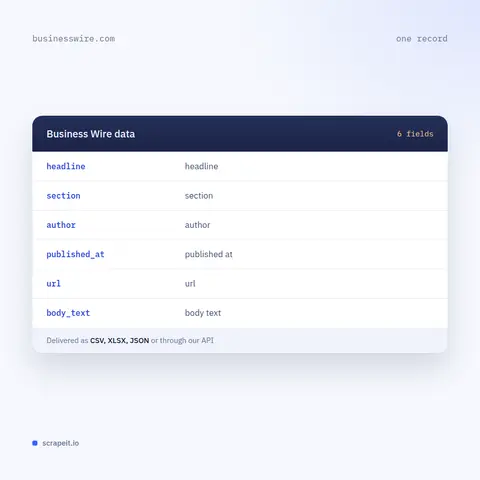
Typical fields for news sites
headlinesectionauthorpublished_aturlbody_text
Delivery

API, JSON feed or CSV, XLSX and JSON files

Schedule

One-time, monthly, weekly, daily or 3 times a day

Managed press release data, run end to end by us

  1. You send

    Business Wire pages, filters, fields and a schedule

  2. We run the scrapers

    Built, monitored and repaired by our team

  3. You receive the data

    API, JSON feed or CSV, XLSX and JSON files

ScrapeIt runs the collection as a managed service. You name the issuers, sectors or subjects; we collect releases from issuer newsrooms, regulatory filings and the financial portals that carry them, link copies into one release identity, and hand back CSV, JSON, Excel or a push into your warehouse.

Collection runs continuously where timing matters, because the first copy of market-moving news is the one that counts.

We collect only publicly available data - everything a visitor can see in the public copies of each release - and we collect it legally, with personal contact details excluded by default.

Press release fields in every export

Release records carry the headline, subheadline, issuer, dateline, release timestamp, body text, industry and subject tags where published, ticker symbols mentioned, and the address of each copy found.

A release identity links copies of the same announcement across sources. Without it, one earnings release collected from four places becomes four events, and every count built on the data is inflated by however many partner sites happened to be crawled.

Copy timing is recorded per source, because which copy appeared first matters for event studies. The first public timestamp of market-moving news is the moment an analysis should measure from.

Media contact blocks are excluded by default. They contain named individuals with direct email addresses and telephone numbers, and a press release dataset needs the announcement, not a directory of communications staff.

Every row carries the collection timestamp and the source type.

Press release fields in every export
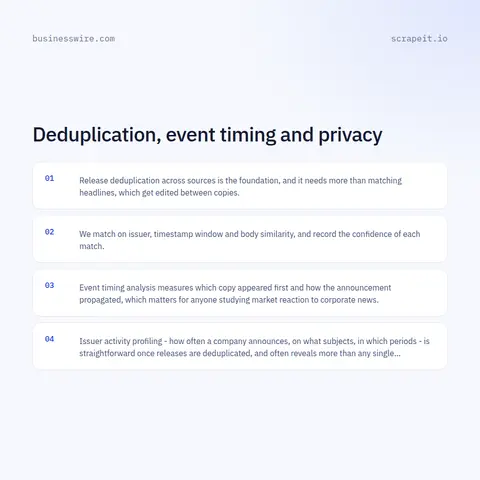
Deduplication, event timing and privacy

Deduplication, event timing and privacy

Release deduplication across sources is the foundation, and it needs more than matching headlines, which get edited between copies. We match on issuer, timestamp window and body similarity, and record the confidence of each match.

Event timing analysis measures which copy appeared first and how the announcement propagated, which matters for anyone studying market reaction to corporate news.

Issuer activity profiling - how often a company announces, on what subjects, in which periods - is straightforward once releases are deduplicated, and often reveals more than any single announcement.

On privacy we are firm: media contact blocks are excluded by default because they list named people with direct contact details. On sources we are equally plain: we collect the release from its public copies - issuer newsrooms, regulatory filings and financial portals - and link the copies into one release identity.

A distribution service for text meant to spread

Source
businesswire.com
Category
news sites
Delivery
API, JSON feed, CSV, XLSX
Plans
From €169 a month
Get a quote

Business Wire distributes press releases on behalf of companies and organisations: earnings announcements, product launches, deals, leadership changes and regulatory disclosures, sent to newsrooms, financial platforms and databases worldwide.

The defining fact about this data is that it is designed to be redistributed. The same release appears on the wire, on the issuer's own newsroom, on financial portals and, for listed companies making material announcements, in regulatory filings as well.

That matters because the release does not have to be read on the wire alone: it is available from every copy that is published to be read and collected.

The practical question is therefore not how to collect Business Wire, but which copy of each release to collect, and how to recognise that several copies are the same release.

25Developers
500+Customers
1.5BPages extracted
15,000+Hours saved for our clients

Business Wire scraping plans and pricing

Airplane

€199one-time

Setup fee included

100,000
One-time
Up to 5 days
7 days

Helicopter

€169/ mo

Setup fee €499

250,000
Monthly
Up to 5 days
14 days

Glasses

€229/ mo

Setup fee €499

1,000,000
Weekly
Up to 5 days
30 days

Microscope popular

€349/ mo

Setup fee €499

2,000,000
Daily
Same day
60 days

DNA

€549/ mo

Setup fee €799

3,000,000
3 times daily
Same day
90 days

Delivery: CSV, JSON or XLSX files, our API or a JSON feed. MCP server on request.

Full plan details

Why the copy you collect matters more than the wire

Most press release projects fail in one of two ways: counting the same release many times, or collecting from a source that is harder and less authoritative than the obvious alternative.

The duplication problem is structural. A release goes to many destinations by design, and a collector that treats each page as an event produces volumes that measure distribution reach rather than corporate activity. Linking copies into one release identity is the core of the work.

The source problem is about authority. For listed companies, material announcements also go to regulators, and the regulatory filing is the version with legal standing. For everything else, the issuer's own newsroom is the original and usually the most stable copy. The wire is a distribution channel, valuable for breadth and timing, but not the only or the best place to read the text.

The third point is timing. For announcements that move prices, the gap between the first public copy and the rest is analytically important and has to be measured across sources rather than assumed.

Who builds and keeps your press release feed

ScrapeIt is a managed extraction company, not a tool you have to learn. Our team maintains the matching that links copies of a release, follows issuer newsrooms as they change, and repairs collection before an announcement goes missing.

You see a sample first, in your format, over the issuers you actually track, with copies linked so you can see how many duplicates a naive collection would have counted.

FAQ

Still unsure? Write to info@scrapeit.io

Where do you collect Business Wire releases from?

From the public copies of the release: issuer newsrooms, regulatory filings and the financial portals that carry it. The copies are linked into one release identity with the timing of each recorded, so an announcement counts once and you can still see which copy appeared first.

Why link copies of a release?

Because one release is published in many places by design. Without linking, an earnings announcement collected from four sources becomes four events, and every count measures distribution reach instead of corporate activity.

Which copy is the authoritative one?

For material announcements by listed companies, the regulatory filing has legal standing. Otherwise the issuer's own newsroom is the original. The wire is a distribution channel - valuable for breadth and timing, not the only place to read the text.

Do you collect media contact details?

No, not by default. Contact blocks list named people with direct email addresses and telephone numbers. A press release dataset needs the announcement, not a directory of communications staff.

Can you tell which copy was first?

Yes - timing is recorded per source. For announcements that move prices, the first public timestamp is the moment an analysis should measure from, and it has to be observed across sources rather than assumed.

How it works

  1. 1

    Make a request

    You share your needs, expectations, and desired timeframe. We'll suggest the best solution based on your request and budget.

  2. 2

    We configure the crawlers

    Our specialists configure the crawlers and extract a sample dataset for your review before proceeding with the full-scale extraction.

  3. 3

    Collect and deliver

    Once you approve the sample, we launch the project and start full data collection. We gather, filter, and structure the data for easy use, delivering it on time in your preferred format.

  4. 4

    Maintain and support

    Our team manages ongoing processes, monitors website changes, and supports all data extraction cycles. We can also help integrate data into your systems or create dashboards to simplify analysis.

Request a quote

Tell us which sites, which fields and how often. A couple of lines is enough to start.

  • We reply within 1 business day
  • A sample dataset before the full run
  • We sign an NDA on request
  • Delivery by API, JSON feed or files
Which sites, which fields, how often. A couple of lines is enough.

This form is protected by Google reCAPTCHA, which loads when you start filling it in. If you prefer not to use it, email us at info@scrapeit.io. Privacy & Cookie Policy

We reply within 1 business day. No obligation.

Business Wire data from €169/month. Free project assessment, reply within 1 business day.