Sahibinden Land Listings: 226K Plots for Sale, Plus 86K from HepsiEmlak
Land for sale across Turkey from Sahibinden and HepsiEmlak for a land investor: 226,000 plots in the first file and 86,200 HepsiEmlak rows.
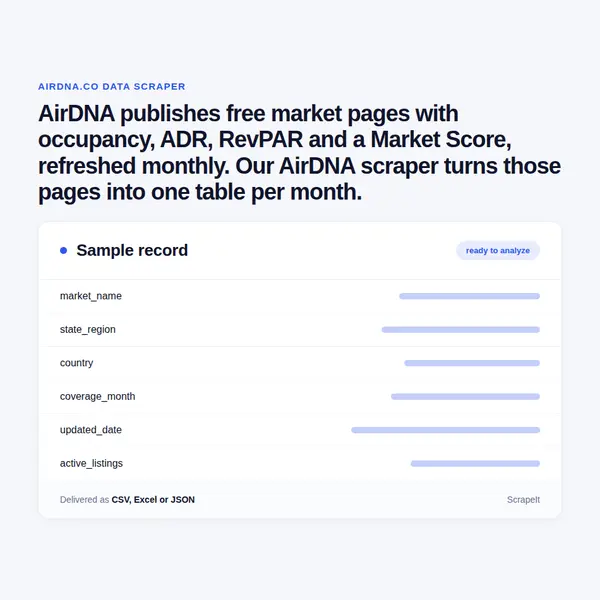
AirDNA publishes free market pages with occupancy, ADR, RevPAR and a Market Score, refreshed monthly. Our AirDNA scraper turns those pages into one table per month.
Plans from €169 a month · Free project assessment · Reply within 1 business day
CSV · Excel · JSON · XML · FTP · SFTP · Amazon S3 · Google Cloud
API, JSON feed or CSV, XLSX and JSON files
ScheduleOne-time, monthly, weekly, daily or 3 times a day
AirDNA pages, filters, fields and a schedule
Built, monitored and repaired by our team
API, JSON feed or CSV, XLSX and JSON files
You pick the countries, states or individual markets, and we map them to AirDNA's public market pages, collect every headline figure and subscore, and repeat the run after each monthly refresh. Rendering, CAPTCHA handling, pacing and proxy rotation stay with us, and so does repairing the crawler when AirDNA changes a page.
What we collect stops where the AirDNA app starts. Neighbourhood figures, comp sets, Rentalizer reports and the for-sale search live there, behind an account, and we do not offer them. When a project needs property-level numbers, we collect the underlying listings from Airbnb and Vrbo directly - nightly rates, calendar availability, bedrooms, ratings and review counts - so you can run the same kind of analysis on your own terms.
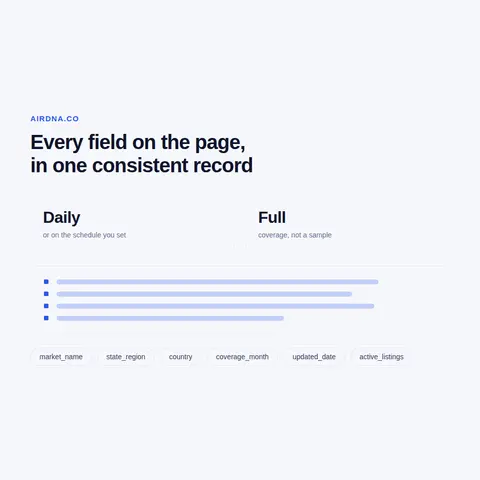
Each market page has a path made of the country code, the state or region and the market name - /vacation-rental-data/app/us/florida/orlando/overview is one - and states its own Updated date and the month of data behind it. We key rows on that path plus the coverage month, so a market's figures line up from one refresh to the next.
Country and state hub pages add the number of markets and regions per country and the list of market pages inside each, which is how a complete crawl is planned. Abbreviated amounts are expanded to full numbers with their currency, and the field documentation repeats AirDNA's own definition of every metric, so occupancy means booked nights over available nights in every row.
Market pages are the core, but AirDNA publishes several public rankings that belong in the same dataset. The Best Property Managers list ranks US companies operating 100 or more active listings by aggregate guest review score across Airbnb, Vrbo and Booking.com, with each company's primary market, states, listing count and review count. The Best Places to Invest report scores markets on demand, revenue growth and investability, then breaks results out by purchase budget and by demand driver - beaches, ski resorts, national parks, universities, wineries - ranked by yield. The home page adds a Trending markets board with rank, score, RevPAR change, listings, supply change and a Hotness figure.
Because each market page reflects a trailing window and refreshes monthly, one crawl is a snapshot. Monthly runs build the history the free pages do not keep: how a market's occupancy, ADR and Market Score moved across a year of refreshes. Pair that series with listing-level Airbnb and Vrbo data and you can see which property types drive the change.
AirDNA is a short-term rental analytics company headquartered in Denver, Colorado, with a European office in Barcelona; its team has tracked the market since 2015. Its products are aimed at hosts, investors, property managers, lenders, hotels and tourism boards, and alongside its app it runs a public site of market data that anyone can read without an account.
That public site is organised by country, then by state or region, then by market. Each market page summarises a trailing twelve-month window: how many homes were active on Airbnb, Vrbo and Booking.com, what a typical one earned, how often it was booked and at what nightly rate. AirDNA counts a home listed on several channels once, and it explains on the page how each metric is calculated.
The free layer stops at market level. Neighbourhood data, individual listing performance, Rentalizer address reports and comp sets are app features. Besides English, the main site has German, Spanish, French, Italian, Dutch and Brazilian Portuguese versions, and its research - the Outlook Report and the monthly US and EU market reviews - is published beside the market pages.
Delivery: CSV, JSON or XLSX files, our API or a JSON feed. MCP server on request.
Full plan detailsMarket-level numbers answer where-to-look questions; they rarely settle a single deal on their own.
When the question narrows to one street or one property type, the work continues on listing data we collect from Airbnb and Vrbo for the same markets.
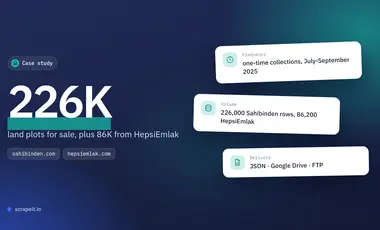
Land for sale across Turkey from Sahibinden and HepsiEmlak for a land investor: 226,000 plots in the first file and 86,200 HepsiEmlak rows.
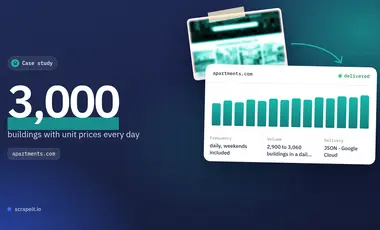
A daily apartments.com feed for a US apartment locator: about 3,000 buildings from the client's own list, down to each unit's rent and floor plan.
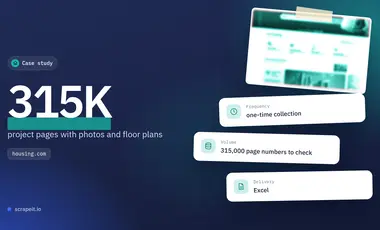
A one-time Housing.com collection for a real-estate company in India: project cards plus every photo and floor plan, uploaded straight to its cloud drive.
Learn how to use web scraping to solve data problems for your organization
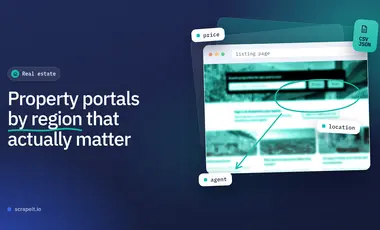
Real estate teams work in a fragmented data landscape. The sites that drive demand in Boston look nothing like the ones that matter in Berlin, São Paulo, Dubai, or Mumbai.
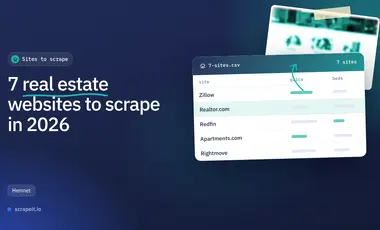
Real estate teams are operating in a data environment that is bigger, faster, and more fragmented than ever. Listings go live and disappear in hours, price cuts happen quietly, and the portals that matter most in each country are rarely the same global “top 5.”
Six jobs that scraped property data does, each backed by a ScrapeIt project: seller leads, listing monitoring, image datasets, weekly market supply, sold records and unit-level rentals. For every use case - the fields it needs and how often to refresh them.

ScrapeIt collects data from travel and property platforms for analysts who need it inside their own systems rather than in someone else's dashboard. For AirDNA that means a market table you own, refreshed monthly, with definitions attached; for deeper work it means Airbnb and Vrbo listings collected directly. Host names and reviewer details stay out by default, personal data is handled under GDPR, and delivery goes to Amazon S3, Google Cloud Storage, a JSON feed or your database.
Still unsure? Write to info@scrapeit.io
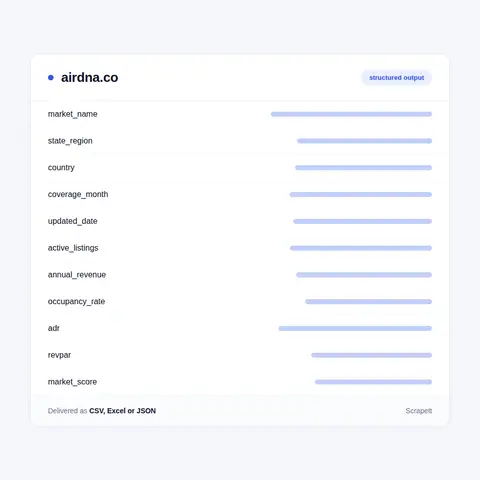
Yes. The ScrapeIt AirDNA API returns each market's active listings, annual revenue, occupancy, ADR, RevPAR and Market Score as JSON via an endpoint we run, refreshed after each monthly update or on any schedule you set. The same table is available as CSV or XLSX files, or as a direct load into your database.
Yes. The market pages, country and state hubs and rankings we collect are published for anyone to read, with no account needed. We take only publicly available data - the figures AirDNA shows every visitor - and we take it legally.
Market-level figures: active listings, annual revenue, occupancy, ADR, RevPAR, the Market Score with its five subscores, year-over-year changes and the listing mix for every market AirDNA publishes, plus country and state hubs and the public rankings. Neighbourhood data, listing-level performance and Rentalizer reports belong to the AirDNA app, and we leave them out.
AirDNA says it tracks listings on Airbnb, Vrbo and Booking.com, supplemented by partner properties from property management systems, channel managers and direct host integrations. We go to the first two directly: Airbnb and Vrbo listings with nightly prices, availability calendars, bedrooms, ratings and review counts, collected for exactly the markets you name.
AirDNA refreshes its market pages monthly, and every headline metric covers the trailing twelve months, so figures shift gradually rather than overnight. We schedule the crawl just after the refresh, stamp each row with the Updated date and coverage month, and keep earlier months, so you get a time series instead of an overwritten table.
You share your needs, expectations, and desired timeframe. We'll suggest the best solution based on your request and budget.
Our specialists configure the crawlers and extract a sample dataset for your review before proceeding with the full-scale extraction.
Once you approve the sample, we launch the project and start full data collection. We gather, filter, and structure the data for easy use, delivering it on time in your preferred format.
Our team manages ongoing processes, monitors website changes, and supports all data extraction cycles. We can also help integrate data into your systems or create dashboards to simplify analysis.
Tell us which sites, which fields and how often. A couple of lines is enough to start.
AirDNA data from €169/month. Free project assessment, reply within 1 business day.