230,000 Daily Rows Standardized Across 5 EU Property Sites
Monitoring of real estate listings on funda.nl, pararius.com, rentberry.com, rentola.com, and zimmo.be to support the growth of a European property portal.
Learn More
Scrape Homestay.com listing, room and rate data across the cities you choose. Nightly, weekly and monthly prices, meal options, minimum stays and availability, delivered as files.
Plans from €169/month · Free project assessment · Reply within 1 business day
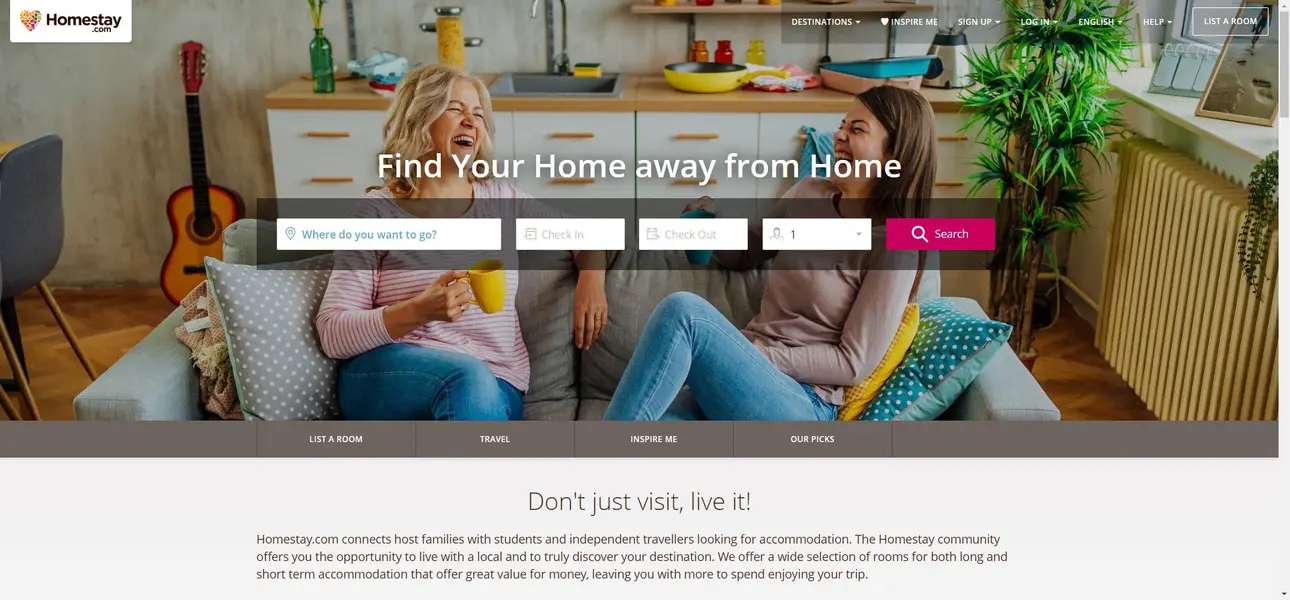
We build and run the crawler, watch it, and repair it when the markup moves. You receive files, not a repository.
Homestay scraping jobs tend to take one of these shapes: a single snapshot of every homestay in a set of cities; a homes table joined to a rooms table with nightly, weekly and monthly rates; a weekly refresh running through an intake season; or a watch list of listing IDs with rate, meal and minimum-stay changes flagged between runs. Delivery is CSV, JSON, XLSX or an API endpoint, pushed to S3, Google Drive, an SFTP drop or your warehouse on the schedule you set. Send the cities and the fields you need, and we will confirm what the page actually carries before any work starts.
Homestay data sits on two levels of one page. The home level carries the description and the house; the room level carries what is bookable. A Homestay scraper that flattens the two loses the bed and bathroom detail buyers use.
What we leave out is fixed, not negotiable. Every host is a private individual, the listing shows a first name and a photograph of a real person, and the address is somebody's home. Host names, photographs and contact details are excluded by default rather than on request, and precise addresses are not collected. Reviews name a guest and give their country and age band, so we keep only the count and score. The GDPR applies to personal data taken from these pages, and not holding any is the plain way past the question.
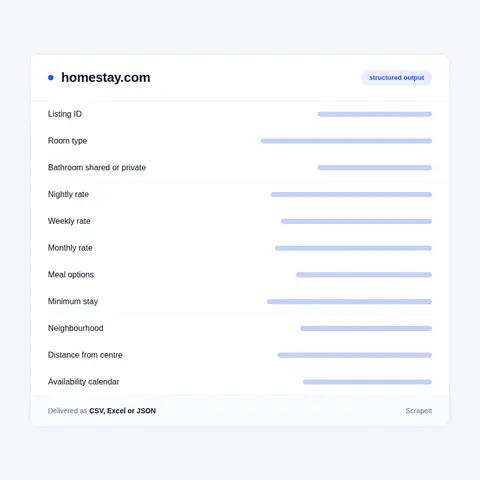
Do not build a Homestay price series by multiplying the nightly figure. Listing 158645 in Drumcondra, Dublin, published a nightly rate of EUR 28, a weekly rate of EUR 160 and a monthly rate of EUR 600. Seven nights at EUR 28 is EUR 196, and thirty is EUR 840. Hosts enter these separately and not every listing sets a monthly figure, and each listing carries a seasonal pricing flag, so any figure is only true for the dates it was read.
Board is the second trap. The meal rows say what a host offers, not what it costs. The site's own help page, archived 19 April 2025, answers the question of whether meals can be booked and paid for on Homestay.com with "Not at the moment", and states that everything beyond the complimentary light breakfast is arranged and paid directly with the host. Half board is a flag, never a price. Minimum stays are host-set too: Dublin cards showed a 15 night minimum where London cards the next day showed 2 and 3 nights.
Pages sit behind Cloudflare with reCAPTCHA Enterprise on the account forms, and automated clients are refused, so CAPTCHA solving is part of the job. We crawl the public country, city and listing paths at a modest rate and collect the per-listing rates, availability calendars, room blocks, meal rows, review counts and review scores they show.
Homestay.com is operated by Homestay Technologies Limited, a company with registered offices at 77 Camden Street Lower, Dublin 2, Ireland. Its about page states the site was founded in 2013 by Tom Kennedy, a co-founder of Hostelworld.com, and Debbie Flynn of Irish Education Partners.
This is not a whole-property let. A guest books a room inside a home the host still lives in. Each listing page opens with a host block headed "Meet" and the host first name, followed by lines such as "On a typical day... I'm mostly at home/work from home" and "When I host guests...". The audience follows from that. Students, language learners, interns and professionals take a room with a resident local, and the archived about page puts the average length of stay at 12 nights.
The point that matters for a data model is that a listing is a home, and a home can hold several separately bookable rooms. On the London city page archived 7 December 2025 the results header read "Found 405 homestays" while the intro paragraph on the same page offered 689 rooms to rent. The Dublin page archived a day earlier showed the same split: "Found 332 homestays" under a title of "564 Affordable Rooms to Rent in Dublin". Treat a row as a room and a home at once and you double count. We model the two levels separately and join them on the listing ID.
Get a Quote
Developers

Customers worldwide

Pages extracted

Hours saved for our clients
€199 / one-time
setup fee - included
€169 / mo
setup fee €499
€229 / mo
setup fee €499
€349 / mo
setup fee €499
€549 / mo
setup fee €799
Delivery: CSV, JSON or XLSX files, our API or a JSON feed. MCP server on request.
Full plan details →The buyers here are rarely travel price analysts. They are university accommodation offices, language school groups, student housing operators, relocation firms and co-living developers who need to know what host-family supply costs in a city before they set their own rents.
Weekly and monthly rates are the useful series. A room let by the month to a language student is a different market from a hotel night and moves on a different clock: the September and January intakes rather than public holidays. Reading the same listing IDs across those windows shows which hosts lift the monthly figure ahead of term, which tighten their minimum stay, and how many new homes appear in a district once courses start.
Supply mapping is the second use. Homestay.com publishes no university or language-school filter, and the only distance on a card is from the city centre. Proximity to a campus has to be built from what the site does publish: the city slug, the neighbourhood string in the listing title, and that distance value. Geocode them and you can answer how many host rooms sit within walking range of a given campus, which no control on the site will answer for you.

Monitoring of real estate listings on funda.nl, pararius.com, rentberry.com, rentola.com, and zimmo.be to support the growth of a European property portal.
Learn More
Daily detection of new private property listings in Switzerland on Homegate.ch and ImmoScout24.ch, giving the agency first access to high-value leads.
Learn More
Scraping residential listings from Immobilienscout24.de in Germany and Mallorca, including complete data and resized images.
Learn MoreLearn how to use web scraping to solve data problems for your organization

Real estate teams work in a fragmented data landscape. The sites that drive demand in Boston look nothing like the ones that matter in Berlin, São Paulo, Dubai, or Mumbai.

Real estate teams are operating in a data environment that is bigger, faster, and more fragmented than ever. Listings go live and disappear in hours, price cuts happen quietly, and the portals that matter most in each country are rarely the same global “top 5.”

Six jobs that scraped property data does, each backed by a ScrapeIt project: seller leads, listing monitoring, image datasets, weekly market supply, sold records and unit-level rentals. For every use case - the fields it needs and how often to refresh them.
ScrapeIt is a managed web scraping agency. We are not selling a library or a proxy plan. We scope the job with you, write the crawler, run it on our own infrastructure and hand over clean, deduplicated data on a schedule you choose. When a site changes its markup, fixing it is our work rather than yours. If a field you have asked for is not on the page, we say so before the project starts instead of filling the column with guesses.
Yes. The ScrapeIt Homestay API returns listing IDs, room types and bed configuration, nightly, weekly and monthly rates, meal options and minimum stays as JSON from an endpoint we host, refreshed on the schedule you set. The same data also comes as CSV or XLSX files or straight into your database.
Yes, and it matters more here than on a nightly platform. Each room block publishes a nightly and a weekly figure, plus a monthly one where the host has set it, each entered separately rather than derived. On listing 158645 in Dublin, captured 22 July 2024, they were EUR 28, EUR 160 and EUR 600, so the weekly figure sits well below seven nightly rates and the monthly well below thirty. We collect all three, plus the seasonal pricing flag, the booking fee line, and the minimum and maximum nights, and we stamp every row with the date it was read.
No. Host first names, photographs and any contact detail are excluded by default rather than on request, and precise addresses are never collected. Location stays at the level the site itself publishes: country, city, neighbourhood name and distance from the city centre. Individual reviews carry a guest first name, home country and age band, so we keep the review count and score and drop the rest. Every host is a private individual and the property is their own home, so data protection law treats that material as personal data, and the simplest way to stay clear of the question is not to hold any. We collect only publicly available data - the listing, room, rate and meal fields a visitor can see on Homestay.com - and we collect it legally.
Counts move, and the site's own figures disagree with each other, so treat any number as measured on a stated date. The about page archived 3 February 2026 says over 63,000 rooms in over 176 countries in its prose, while the summary panel on the same page says 37K+ homestays in 170+ countries. City pages are firmer per run: 405 homestays in London on 7 December 2025 and 332 in Dublin on 6 December 2025, both from archived captures, with results paged 32 at a time. We count from the index on every run and report the figure with its date. Refresh cadence is yours to set - daily, weekly, or once around an intake.
Yes to the first. City pages sit at /country/city, neighbourhoods frequently get their own path, and a run can be scoped to any list of them. Campus proximity is a different job: the site carries no university or language-school filter, and the only distance it prints is from the city centre. We derive proximity by geocoding the neighbourhood string and city, then measuring against the campus or school coordinates you supply. That is a computed field and we label it as one, separate from anything read off the page.
Step 1 - Make a Request
You share your needs, expectations, and desired timeframe. We’ll suggest the best solution based on your request and budget.
Step 2 - Configuring Custom Web Crawlers
Our specialists configure the crawlers and extract a sample dataset for your review before proceeding with the full-scale extraction.
Step 3 - Collect and Deliver
Once you approve the sample, we launch the project and start full data collection. We gather, filter, and structure the data for easy use, delivering it on time in your preferred format.
Step 4 - Maintain and Support
Our team manages ongoing processes, monitors website changes, and supports all data extraction cycles. We can also help integrate data into your systems or create dashboards to simplify analysis.
Homestay data from €169/month. Free project assessment, reply within 1 business day.

Scrapeit Sp. z o.o.
10/208 Legionowa str., 15-099, Bialystok, Poland
NIP: 5423457175
REGON: 523384582