Apartments.com Data: Unit Prices for 3,000 Buildings Every Day
A daily apartments.com feed for a US apartment locator: about 3,000 buildings from the client's own list, down to each unit's rent and floor plan.
Learn More
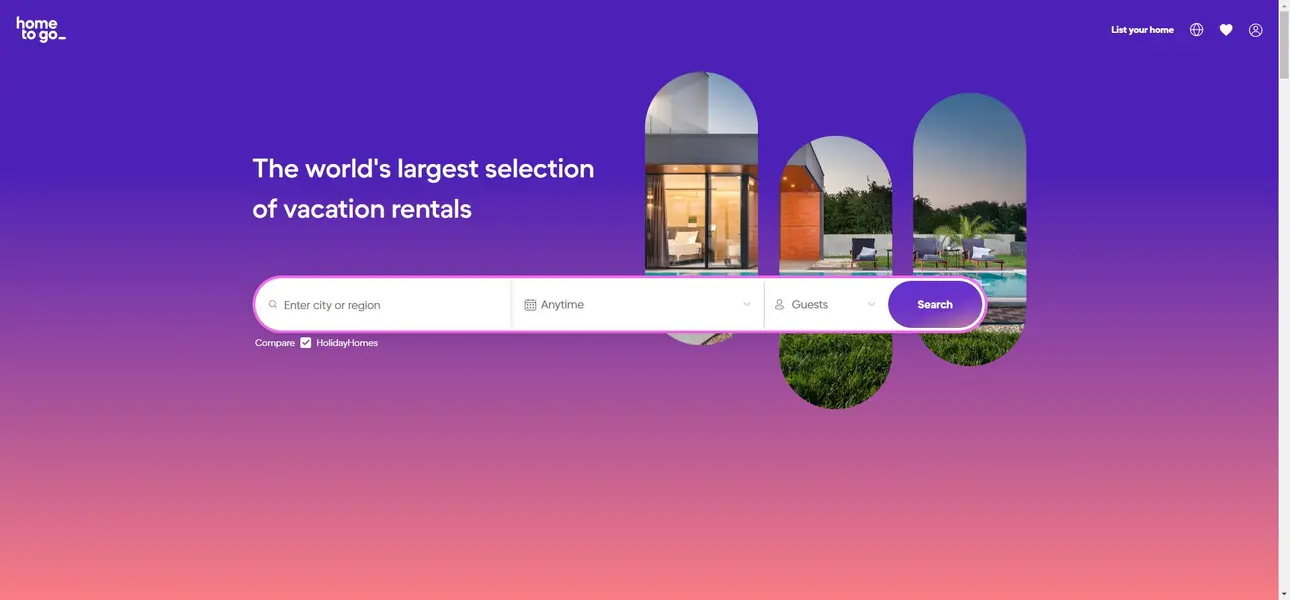
HomeToGo owns no homes. It lines up other people's offers for the same house and ranks them, so one HomeToGo scrape returns the same property priced several different ways on the same night.
Plans from €169/month · Free project assessment · Reply within 1 business day
You get CSV, JSON, XLSX or an endpoint of ours, on whatever cadence the question needs. Nightly rate comparison runs daily or weekly against a fixed grid of dates, stay lengths and party sizes so the series stays comparable; catalogue fields, amenities and review history move slowly and a monthly pass covers them. One schema serves every storefront, because the identifiers are shared, so adding Germany, Japan or Brazil costs a locale setting rather than a second build.
The site is defended against automated clients, and a price only appears once a live query is made, so anti-bot handling, proxy rotation and CAPTCHA solving are part of the service. We run at a polite rate, work from pages any visitor can open, never sign in and never enter a checkout. When HomeToGo changes its markup we repair the scraper before the gap reaches your dashboard.
One row per offer, plus the object key that ties competing offers for the same home together. Rate and availability come from a dated search: HomeToGo holds no price until you name dates and party size.
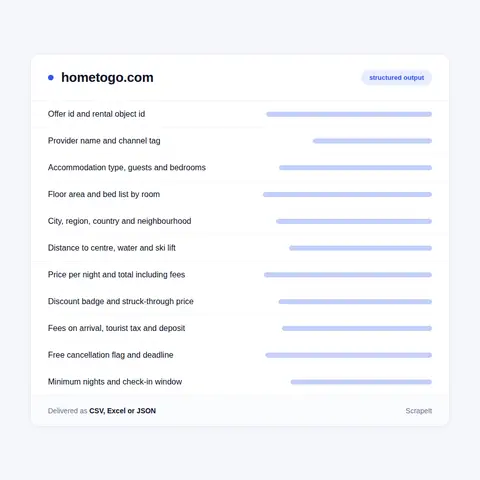
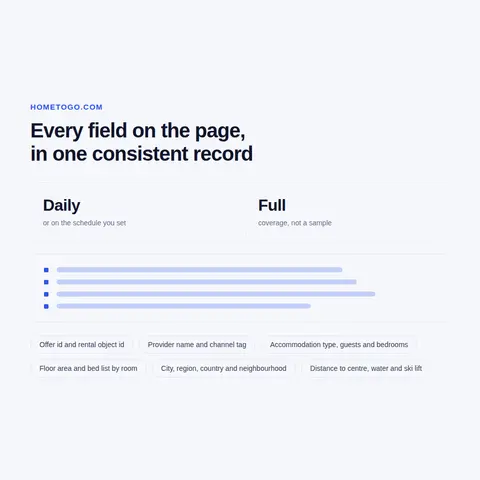
Two keys, because one home can be many listings. A house pushed out by three channels arrives as three records with their own ids, text and photos. HomeToGo folds them onto one object using position, capacity, layout, imagery and wording, then compares the providers holding it. That match is HomeToGo's judgement, so we ship both keys and every provider field: if your rules disagree, re-run them on our rows.
The headline number is not the number. A card shows a nightly figure or a total including fees, and the two are not interchangeable. Utility charges and tourist tax are often collected on arrival, deposits sit outside the total, and the currency follows the storefront. HomeToGo warns that price accuracy is the provider's responsibility, and its ranking notice says commission may influence result order. Each component gets its own column, and every row carries its dates, guests and currency.
Coverage is a grid, not a crawl. The dated search returns a bounded slice and relaxes filters once it runs out, so a large market has to be cut by sub-area, dates, party size, type and price band, then reconciled on object id. The sitemap gives geography, not inventory: roughly 9,000 addresses, about 2,581 of them city pages and almost no rentals.
Legality and personal data. We collect only publicly available data - the offers, rates, fees and ratings a visitor can see on HomeToGo - and we collect it legally. Host names and the names of review authors are left out; scores, dates and text stay.
HomeToGo does not own, manage or let a single home. It keeps a database of accommodation offers supplied by other people - booking sites, agencies, property management systems and individual hosts - and hands the traveller on to whoever is actually selling the stay. HomeToGo publishes no offers of its own and works as the technical layer between provider and guest, with providers feeding fresh prices and availability through an interface at least once a day. That is what makes a HomeToGo scraper different from every other short-term rental source. Airbnb, Vrbo or a management company each show you one seller's asking price. HomeToGo shows you several sellers quoting the same house for the same week.
The company started in Berlin in 2014 and currently trades as HomeToGo GmbH from Pappelallee in Prenzlauer Berg. It runs in two halves: HomeToGo_PRO, the supply-side software and services arm, and the consumer-facing HomeToGo Marketplace. The group has absorbed a long list of European rental brands - Interhome, atraveo, Casamundo, e-domizil, Wimdu, Tripping.com, EscapadaRural, Agriturismo.it, CaseVacanza.it, Ferienhaus.de, AMIVAC, Kurzurlaub, Tourist-online.de, secra bookings and Smoobu among them - which is why so much of the supply arrives down a channel rather than from a host directly.
The consumer side runs as local sites in more than 30 countries, from hometogo.de and hometogo.co.uk through hometogo.com.br, hometogo.jp and hometogo.co.kr, with 35 language settings and 29 selectable currencies. The catalogue behind them is one pool: the same offer identifier resolves on the German storefront and the American one, so language, currency, ranking and marketing change while the underlying stay does not.
Get a Quote
Developers

Customers worldwide

Pages extracted

Hours saved for our clients
€199 / one-time
setup fee - included
€169 / mo
setup fee €499
€229 / mo
setup fee €499
€349 / mo
setup fee €499
€549 / mo
setup fee €799
Delivery: CSV, JSON or XLSX files, our API or a JSON feed. MCP server on request.
Full plan details →Rate spread between channels, measured instead of assumed. The same house reaches HomeToGo from more than one seller, each with its own offer id, its own fee stack and its own number. Group the offers by object id and you have the gap between channels for one home on one date - the rate parity question every revenue manager argues about and almost nobody has evidence for.
Who really controls the supply. The provider tag names the channel or the property management system behind a listing, so a market can be split by operator: how much of a resort town moves through a single system, which manager prices highest, which channel holds stock nobody else has.
Market size and seasonality in one sweep. Every destination page publishes its own supply count and the number of partners feeding it - currently about 11,548 homes across 42 partners in Orlando, roughly 49,468 homes across 172 partners on Mallorca - alongside a week-by-week price and availability index for the year ahead. One pass returns supply, price level and the shape of the season for a whole country.
Distribution audit. Managers and hotel groups use it to see where their own units surface, under whose brand, at what price, and whether a partner is undercutting the direct rate.
Travel data feeds and underwriting. Short-term rental market data joined on object id gives analysts a clean panel: nightly rate, fee load, cancellation terms and review history for the same asset across several sellers over time.
A daily apartments.com feed for a US apartment locator: about 3,000 buildings from the client's own list, down to each unit's rent and floor plan.
Learn More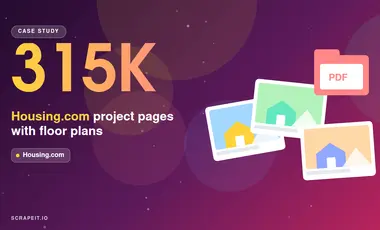
A one-time Housing.com collection for a real-estate company in India: project cards plus every photo and floor plan, uploaded straight to its cloud drive.
Learn More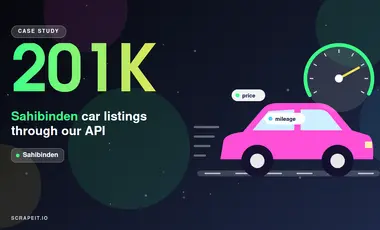
A one-time 30-day history of Sahibinden car and SUV listings for a startup building an AI deal finder, delivered as JSON through our API.
Learn MoreLearn how to use web scraping to solve data problems for your organization
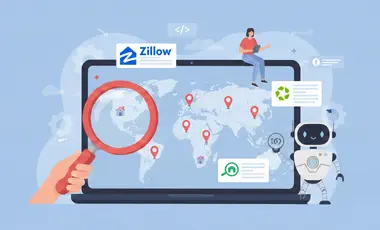
Real estate teams work in a fragmented data landscape. The sites that drive demand in Boston look nothing like the ones that matter in Berlin, São Paulo, Dubai, or Mumbai.

Real estate teams are operating in a data environment that is bigger, faster, and more fragmented than ever. Listings go live and disappear in hours, price cuts happen quietly, and the portals that matter most in each country are rarely the same global “top 5.”

Six jobs that scraped property data does, each backed by a ScrapeIt project: seller leads, listing monitoring, image datasets, weekly market supply, sold records and unit-level rentals. For every use case - the fields it needs and how often to refresh them.
ScrapeIt is a managed web scraping agency. We are independent of HomeToGo and of every provider behind it. We scope the job, build the crawler, run it on your schedule, watch it when the site shifts and fix it before you notice.
You never touch the pipeline. What lands is a file or an endpoint with the columns agreed at the start, in the same shape every run. Send us the destinations, the date grid and the party sizes you care about and we will come back with a field list, a sample extract and a schedule.
Yes. The ScrapeIt HomeToGo API returns offer and rental object ids, the provider tag, nightly rate and stay total with fees, availability and ratings as JSON from an endpoint we host, refreshed on the schedule you set. Offers come keyed by object id, so the spread between providers for one home is ready to read. The same data also comes as CSV or XLSX files or straight into your database.
That is the main reason to use this source. Every offer carries a provider tag and its own offer id, and HomeToGo also assigns a rental object id to the physical home, which is what lets its interface show a price comparison across the providers holding that object. We keep both keys, so you can group by object and read the spread between channels for the same dates, or keep the offers apart and follow one seller. Where the same home reaches HomeToGo from a channel and from HomeToGo's own booking flow, both rows arrive with their own fee breakdown and cancellation terms.
The marketplace runs local sites in more than 30 countries across Europe, North and South America, Asia and Australia, with 35 language settings and 29 currencies to choose from. The inventory behind them is shared rather than split by market: an offer id opened on hometogo.de resolves to the same object as on hometogo.com, and only the language, the currency, the fee presentation and the ranking differ. In practice we pick the storefront whose currency and locale you want reported and run one schema against it, then add a second storefront when you need the same stay priced in another currency.
Providers deliver prices and offers to HomeToGo at least once a day, so the catalogue behind the site turns over on a daily rhythm. Availability and the quoted total, though, are resolved per query: nothing is priced until the arrival date, the departure date and the guest count are fixed, and the same home returns different numbers for different weeks. So we agree a query grid with you first - which destinations, which arrival dates, which stay lengths, how many guests - and run it daily or weekly, stamping each row with the exact parameters that produced it.
Yes. We collect only publicly available data - everything a visitor can see on HomeToGo - and we collect it legally, from public pages only, with no sign-in, no checkout and a polite request rate. On personal data we default to leaving it out - host names and the names of review authors are dropped, while ratings, review text, dates and trip type are kept.
Step 1 - Make a Request
You share your needs, expectations, and desired timeframe. We’ll suggest the best solution based on your request and budget.
Step 2 - Configuring Custom Web Crawlers
Our specialists configure the crawlers and extract a sample dataset for your review before proceeding with the full-scale extraction.
Step 3 - Collect and Deliver
Once you approve the sample, we launch the project and start full data collection. We gather, filter, and structure the data for easy use, delivering it on time in your preferred format.
Step 4 - Maintain and Support
Our team manages ongoing processes, monitors website changes, and supports all data extraction cycles. We can also help integrate data into your systems or create dashboards to simplify analysis.
HomeToGo data from €169/month. Free project assessment, reply within 1 business day.

Scrapeit Sp. z o.o.
10/208 Legionowa str., 15-099, Bialystok, Poland
KRS: 0000996672
NIP: 5423457175
REGON: 523384582