Homegate Data: A Daily Snapshot of Two Cantons with 46K Photos
Every day, a full snapshot of all active Homegate listings in one Swiss region, with photos and PDFs, for a company's own listing-history database.
Learn More
Houzz holds three separate datasets on one domain: a directory of home improvement professionals, a shop selling furniture and fittings, and a library of tagged project photos.
Plans from €169/month · Free project assessment · Reply within 1 business day
You describe the slice: which of the three objects, which trades, which metros or countries, which fields, and how often it should refresh. We build the crawler, run it on our own infrastructure and hand back the result. Nothing is installed on your side.
Output is CSV, JSON, XLSX or an API endpoint you poll. Delivery can go to S3, an SFTP drop or straight into your database. A directory build is normally a one-off with an optional refresh; a product price feed is normally daily or weekly. We watch for layout changes on Houzz and repair the crawler when one breaks, inside the fee rather than as a change request.
What a Houzz scraper returns depends entirely on which of the three objects you point it at. These are the fields that appear on public pages.
Professional profiles
Products in the shop
Project photos
Fields a profile leaves blank come back empty rather than guessed. Licence numbers, cost ranges and awards are optional on Houzz, so coverage varies sharply by trade and by country, and we report that coverage on the sample before you commit to a full run. Houzz products behave differently again: the specification block is dense on some listings and thin on others, since sellers supply it themselves. Scraping a mixed catalogue therefore yields a wide, sparse table rather than a tidy one, so we normalise the columns you name and leave the rest in a raw field.
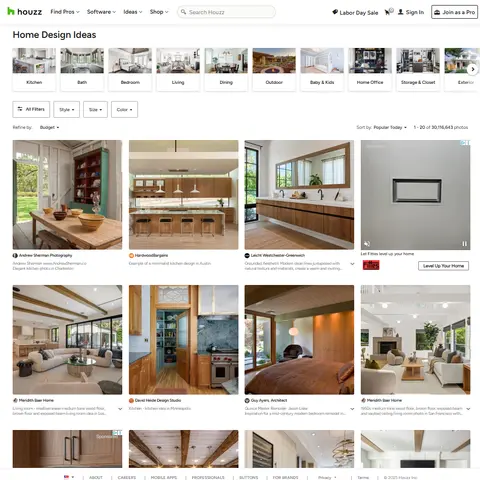
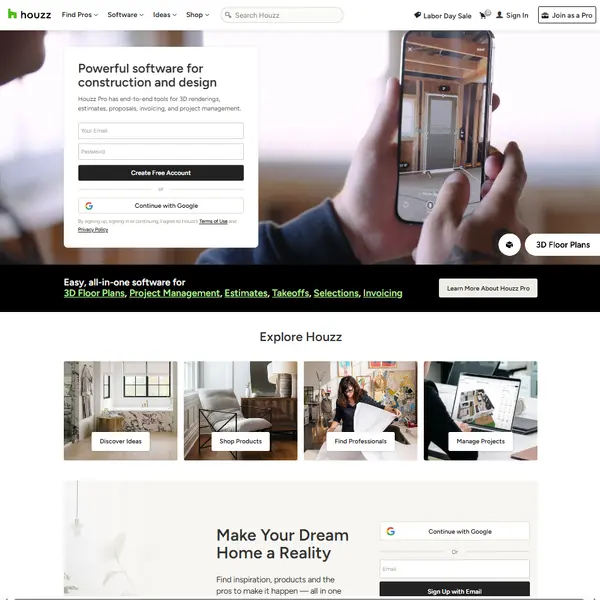
Houzz does not serve automated clients. The refusal covers the home page, /photos, /products and professional directory URLs alike. Anything that reads Houzz has to render pages the way a browser does, at a pace the site tolerates. Rendering, pacing, proxy rotation and CAPTCHA handling are part of the service.
Directory listings paginate, and deep pagination on a large metro is where the crawl time goes. We partition by trade and region rather than firing one broad query, using the t_ and r_ tokens as the split, which also keeps each slice re-runnable on its own.
Personal data. A Houzz professional is often a sole trader, so the business name is a person's name and the registered address may be a home. Our default output is business listing data: trading name, trade, service area, business contact details, licence number, aggregate rating and review count. Reviewer names, reviewer profile links and review text that identifies a private individual are excluded by default. We do not assemble person-level records and we do not enrich profiles from other sources. Where an intended use touches personal data of people in the EU or UK, the GDPR applies to you as the controller, and we set the extraction scope to match the use you describe.
Houzz runs a directory of home improvement professionals, a shop that sells furniture and fittings, and a library of tagged project photos. The three sit on the same domain and cross-link in the interface, but they are separate record sets with separate addressing. A buyer almost always wants one of them rather than all three.
The directory lists contractors, architects, interior designers, kitchen and bath specialists and other trades, organised by trade and by metro area. Directory pages are addressed as /professionals/general-contractor/new-york-ny-us-probr0-bo~t_11786~r_5128581, where the token after t_ identifies the trade and the token after r_ identifies the region. Those region numbers are GeoNames identifiers: 5128581 is New York City, 6167865 is Toronto, 6252001 is the United States as a whole. Drop the trade and you get a region-only page such as /professionals/usa-probr0-bo~r_6252001. An individual profile lives at /pro/ followed by a username slug rather than a number.
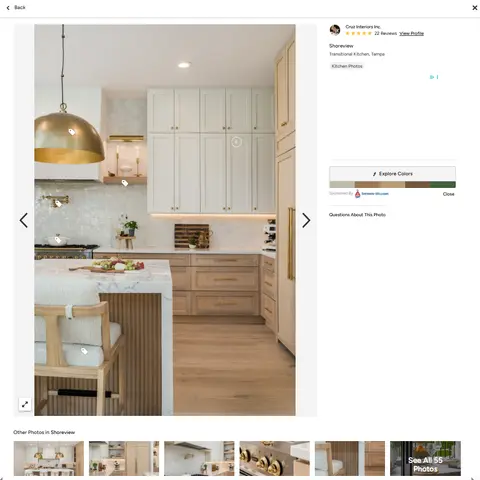
Product pages are addressed as /products/ plus a slug ending in prvw-vr~ and a numeric product id. Photo pages end in phvw-vp~ and a numeric photo id, with the room, the style and the metro area written into the slug ahead of it. The three id spaces do not overlap, and no shared key joins a professional to the products tagged in a photo they uploaded. That is the first thing to settle when you scope a job here.
Get a Quote
Developers

Customers worldwide

Pages extracted

Hours saved for our clients
€199 / one-time
setup fee - included
€169 / mo
setup fee €499
€229 / mo
setup fee €499
€349 / mo
setup fee €499
€549 / mo
setup fee €799
Delivery: CSV, JSON or XLSX files, our API or a JSON feed. MCP server on request.
Full plan details →Most buyers who ask us to scrape Houzz want the directory. It is a list of small businesses sorted by trade and by city, with a review count, a rating, and often a phone number and a licence number attached. Building materials suppliers use it to size a territory before hiring a rep there. Software vendors selling to contractors use it to build a prospect list by trade. Researchers use it to count how many kitchen remodellers work a given metro and how their ratings distribute across it.
The shop is a different job with different economics. It is retail catalogue work: prices, sellers, shipping terms and specifications, usually run on a repeat schedule so that price movement becomes visible. Brands use it to see how their own items are listed and priced by the third-party sellers carrying them.
The photo library draws the least commercial demand of the three and is the hardest to turn into something useful. The tags are the value, not the pixels. Counting how often a style tag appears against a room type and a metro area produces a trend series worth having. Image URLs come with every photo record, so each tag stays linked to its picture.
Scoping the wrong object is the common failure here. Ask for Houzz data without naming the layer, and half the budget goes on records nobody needed.
Every day, a full snapshot of all active Homegate listings in one Swiss region, with photos and PDFs, for a company's own listing-history database.
Learn More
A real-estate analytics company got two portals archived listing by listing: the saved page, a JSON file and every photo, 420K+ listings in all.
Learn More
US real-estate investors get agent lists for their markets from MLS portals under their own 2FA logins, plus realtor.com and Zillow directories.
Learn MoreLearn how to use web scraping to solve data problems for your organization

Real estate teams work in a fragmented data landscape. The sites that drive demand in Boston look nothing like the ones that matter in Berlin, São Paulo, Dubai, or Mumbai.

Real estate teams are operating in a data environment that is bigger, faster, and more fragmented than ever. Listings go live and disappear in hours, price cuts happen quietly, and the portals that matter most in each country are rarely the same global “top 5.”

Six jobs that scraped property data does, each backed by a ScrapeIt project: seller leads, listing monitoring, image datasets, weekly market supply, sold records and unit-level rentals. For every use case - the fields it needs and how often to refresh them.
ScrapeIt is a managed scraping agency. We write the crawlers, run them, monitor them and deliver the files. You get a named engineer rather than a dashboard and a ticket queue. Before any Houzz work starts we agree in writing which object we are reading, which fields land in the output and which are dropped, so the deliverable is settled before the first run. A sample extract comes first, so you can check the shape against your own schema and say what is missing.
Yes. The ScrapeIt Houzz API returns professional profiles with trade, service area, review count and star rating, shop products with price, seller and specifications, and photo records with room, style and metro tags as JSON from an endpoint we host, refreshed on the schedule you set. The same data also comes as CSV or XLSX files or straight into your database.
Yes. The directory is already partitioned by trade and region, and the region in the URL is a GeoNames identifier, so a request such as general contractors in New York City maps onto one addressable set of pages. We filter output to a ZIP or postcode where the profile publishes one, and to a stated service area where it publishes that instead. National and multi-city runs are built as a list of trade and region pairs, which keeps each slice independently re-runnable.
No. Houzz profiles do not publish hourly rates or consultation fees. Some carry a typical job cost range instead, shown as a low figure and a high figure with a currency, and it is an optional field, so many profiles have none at all. We return the range where it is present and leave the field empty where it is not, rather than estimating. Prices in the Houzz shop are a separate matter: those are listed on product pages and we return them as shown.
We return the business contact details a profile publishes, along with the review count and the aggregate star rating. Individual review text and reviewer names are not in the default output, because reviewers are private individuals rather than businesses. If you have a documented lawful basis for processing review text, tell us what it is and we will scope to it. We do not build records about named consumers under any scope.
By rendering pages properly and pacing the crawl. Houzz refuses automated clients, so the crawler behaves like a browser and paces itself against the site, with proxy rotation and CAPTCHA handling as part of the service. That makes a large directory run take days rather than hours, and we schedule around it from the start. When Houzz changes its layout or its defences, we repair the crawler inside the fee.
Step 1 - Make a Request
You share your needs, expectations, and desired timeframe. We’ll suggest the best solution based on your request and budget.
Step 2 - Configuring Custom Web Crawlers
Our specialists configure the crawlers and extract a sample dataset for your review before proceeding with the full-scale extraction.
Step 3 - Collect and Deliver
Once you approve the sample, we launch the project and start full data collection. We gather, filter, and structure the data for easy use, delivering it on time in your preferred format.
Step 4 - Maintain and Support
Our team manages ongoing processes, monitors website changes, and supports all data extraction cycles. We can also help integrate data into your systems or create dashboards to simplify analysis.
Houzz data from €169/month. Free project assessment, reply within 1 business day.

Scrapeit Sp. z o.o.
10/208 Legionowa str., 15-099, Bialystok, Poland
NIP: 5423457175
REGON: 523384582