Homegate Data: A Daily Snapshot of Two Cantons with 46K Photos
Every day, a full snapshot of all active Homegate listings in one Swiss region, with photos and PDFs, for a company's own listing-history database.
Learn More
remax.com is a franchise network site, not a portal: stock arrives from MLS feeds through independently owned offices, so the listing office and the brand are separate fields.
Plans from €169/month · Free project assessment · Reply within 1 business day
You set the scope: which states, cities or ZIP codes, and whether you want active stock, the sold view, the office directory, the agent directory or a combination. We build the crawler, run it on your schedule and deliver CSV, JSON, XLSX or an API endpoint. Field names, deduplication rules and the brand filter on the office field are agreed before the first run.
Anti-bot handling is our side of the job. remax.com sits behind CloudFront and turns automated clients away before they see any content, and reCAPTCHA Enterprise guards the interactive parts of the site. Proxy rotation, CAPTCHA solving and adaptive request pacing are part of the managed service. We work only on pages a signed-out visitor can reach. We collect only publicly available data - everything a visitor can see on RE/MAX - and we collect it legally.
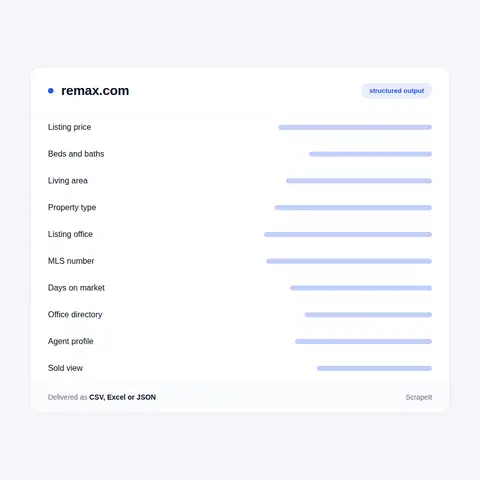
Listing detail pages are rendered on the server, so the record arrives complete in the first response. Each page carries JSON-LD of type RealEstateListing next to a larger React payload. These are the fields we normally extract:
The listing agent name and phone number sit in the same payload. We leave them out by default, for the reasons set out further down this page.
Agent and office pages behave differently from listings, and that changes the engineering. A listing page returns roughly a megabyte of server-rendered markup. The agent page returned about 78 KB, had no title element, and mentioned the agent's name only inside the URL slug; the profile itself loads after JavaScript runs. Office pages behave the same way. A crawler tuned on listings will return empty rows across the directory unless it renders the page.
The URL shapes are stable and readable. An agent sits under /real-estate-agents/ with a name-city-state slug and a numeric id, an office under /real-estate-offices/ in the same pattern, and the numeric id survives a slug change. Older office URLs ending in -id followed by a number and.html still turn up in archived copies, so historical links need normalising before they join a current set.
Country coverage is not one site. global.remax.com now redirects into remax.com under a country and language path, RE/MAX Canada runs on its own domain at remax.ca, and worldwide search is treated as a separate destination in the footer. A multi-country brief is therefore several crawlers against different layouts, not one job with a locale switch.
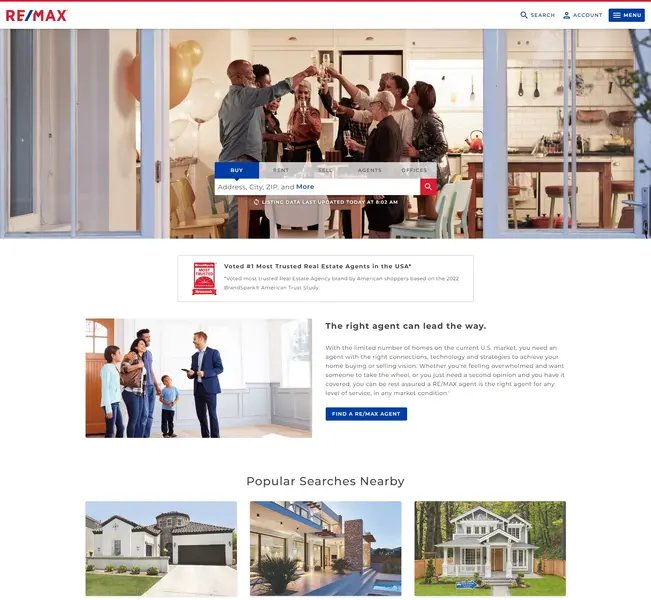
RE/MAX is a franchisor. The site describes itself as covering a global real estate system of independently owned and operated affiliates and their network of independent sales professionals, and the footer repeats the line: each office independently owned and operated. That structure decides what the data looks like. The inventory on the site is not held by one company. It is aggregated from offices that are separate businesses, and in the United States the underlying records reach the site from MLSs.
The consequence catches most buyers out. A listing detail page names the listing office in a listOfficeName field and repeats it in a courtesyOfStatement. On a Wasilla, Alaska page, those fields held brokerage names such as Century 21 Realty Solutions - Eagle River, Better Homes And Gardens Real Estate Dream Makers and Alaska Statewide Realty Co. remax.com therefore carries stock listed by competing brokerages. Asking for RE/MAX listings and pointing a crawler at remax.com are not the same request, and filtering to the offices that carry the brand is a separate step we run on the office field rather than on the domain.
One small detail is worth knowing before you plan keywords or QA rules. Buyers type Remax as one word about as often as they type the slashed form, and the site's own markup carries both: the schema.org organisation name is REMAX with RE/MAX recorded as an alternateName, and page titles end in REMAX.
Get a Quote
Developers

Customers worldwide

Pages extracted

Hours saved for our clients
€199 / one-time
setup fee - included
€169 / mo
setup fee €499
€229 / mo
setup fee €499
€349 / mo
setup fee €499
€549 / mo
setup fee €799
Delivery: CSV, JSON or XLSX files, our API or a JSON feed. MCP server on request.
Full plan details →Much of the demand we see is not about the properties. It is about the network. The site publishes an office directory and an agent directory that map a franchise footprint city by city, and on 2026-09-04 its own sitemaps listed 2,997 office pages and 49,987 agent profile pages. For a mortgage lender, a title company, a photography vendor, a CRM or a proptech tool selling into brokerages, that office layer is the addressable market, and it is already published in a structured form.
The listing side answers different questions. Because every record names both its originating MLS and its listing office, a panel built from remax.com supports comparisons a single MLS does not: how inventory is spread across offices in one metro, which MLS regions a franchise footprint touches, and how asking prices and days on market move inside a defined set of offices. A sold view stays addressable under the same city path, so a time series survives after a listing leaves the active set.
The two layers are worth joining. Office and agent pages list the properties attached to them, and listing pages point back at the office that took the instruction, so a single crawl produces an office table, an inventory table and the link between them. Franchise development and competitive research teams tend to use that join more than the raw price feed, because it shows where a network is thin, where it overlaps, and which local markets a given office is actually working.

Every day, a full snapshot of all active Homegate listings in one Swiss region, with photos and PDFs, for a company's own listing-history database.
Learn More
A real-estate analytics company got two portals archived listing by listing: the saved page, a JSON file and every photo, 420K+ listings in all.
Learn More
US real-estate investors get agent lists for their markets from MLS portals under their own 2FA logins, plus realtor.com and Zillow directories.
Learn MoreLearn how to use web scraping to solve data problems for your organization

Real estate teams work in a fragmented data landscape. The sites that drive demand in Boston look nothing like the ones that matter in Berlin, São Paulo, Dubai, or Mumbai.

Real estate teams are operating in a data environment that is bigger, faster, and more fragmented than ever. Listings go live and disappear in hours, price cuts happen quietly, and the portals that matter most in each country are rarely the same global “top 5.”

Six jobs that scraped property data does, each backed by a ScrapeIt project: seller leads, listing monitoring, image datasets, weekly market supply, sold records and unit-level rentals. For every use case - the fields it needs and how often to refresh them.
ScrapeIt is a managed scraping team. We have no affiliation with RE/MAX, LLC or with any of its franchisees, and we do not resell a stored dataset. You get a crawler built for your brief, monitored when the site changes, and clean files or an API on a schedule you set. Layout changes on remax.com are handled as maintenance, not as a new project. Start with a sample for one metro, check the fields against what you need, then scale.
Yes. The ScrapeIt RE/MAX API returns listPrice, beds, baths, livingArea, listOfficeName and daysOnMarket as JSON from an endpoint we host, refreshed on the schedule you set. The same data also comes as CSV or XLSX files or straight into your database.
No. Every listing page names its listing office in a listOfficeName field and repeats it in a courtesy-of line, and those fields can carry competing brokerage names. US inventory reaches the site from MLSs, which is why stock from other brokerages appears. If your brief is brand-specific we filter on the office field and label every row with its listing office, so the split stays auditable rather than assumed.
Not as a standard deliverable. Agent profiles are pages about named individuals, carrying a photograph, phone numbers and a licence number. Our output is limited to business listing and office data. Agent photographs and direct contact details are excluded by default rather than on request, and we do not build person-level records or ranked agent lists for recruitment. Where any data on identifiable people is in scope at all, the buyer needs a lawful basis under the GDPR to process it for people in the EU or UK, and we ask about that before scoping the work.
Scope is set by geography rather than by a hard result cap. Search pages carry a total result count in their payload, and a Denver, Colorado city page reported 5,180 results on 2026-09-04. The site also publishes sitemap indexes for homes for sale, new listings, rentals, land, condos, townhomes, mobile homes, open houses, agents, offices, ZIP codes and neighbourhoods, which give a full address list without paging through search; the for-sale index alone pointed to 99 sitemap files that day. Daily, weekly and monthly runs are all normal. The sitemap filenames are date-stamped and regenerate, so each run re-reads the index instead of caching file names.
Yes. Every public listing page shows the price, size, address and listing office, plus a line stating the information is deemed reliable but is not guaranteed and should be independently verified for accuracy, followed by a copyright notice naming the originating MLS, for example Alaska Multiple Listing Service, Inc. on Alaska records. We deliver both lines as fields and keep the MLS name on every row so provenance stays visible. We collect only publicly available data - everything a visitor can see on RE/MAX - and we collect it legally.
Step 1 - Make a Request
You share your needs, expectations, and desired timeframe. We’ll suggest the best solution based on your request and budget.
Step 2 - Configuring Custom Web Crawlers
Our specialists configure the crawlers and extract a sample dataset for your review before proceeding with the full-scale extraction.
Step 3 - Collect and Deliver
Once you approve the sample, we launch the project and start full data collection. We gather, filter, and structure the data for easy use, delivering it on time in your preferred format.
Step 4 - Maintain and Support
Our team manages ongoing processes, monitors website changes, and supports all data extraction cycles. We can also help integrate data into your systems or create dashboards to simplify analysis.
RE/MAX data from €169/month. Free project assessment, reply within 1 business day.

Scrapeit Sp. z o.o.
10/208 Legionowa str., 15-099, Bialystok, Poland
NIP: 5423457175
REGON: 523384582