230,000 Daily Rows Standardized Across 5 EU Property Sites
Monitoring of real estate listings on funda.nl, pararius.com, rentberry.com, rentola.com, and zimmo.be to support the growth of a European property portal.
Learn More
Naver Pay Real Estate organises Korean homes by apartment complex, not by street address. We model that structure and hand over clean listing data on a schedule.
Plans from €169/month · Free project assessment · Reply within 1 business day
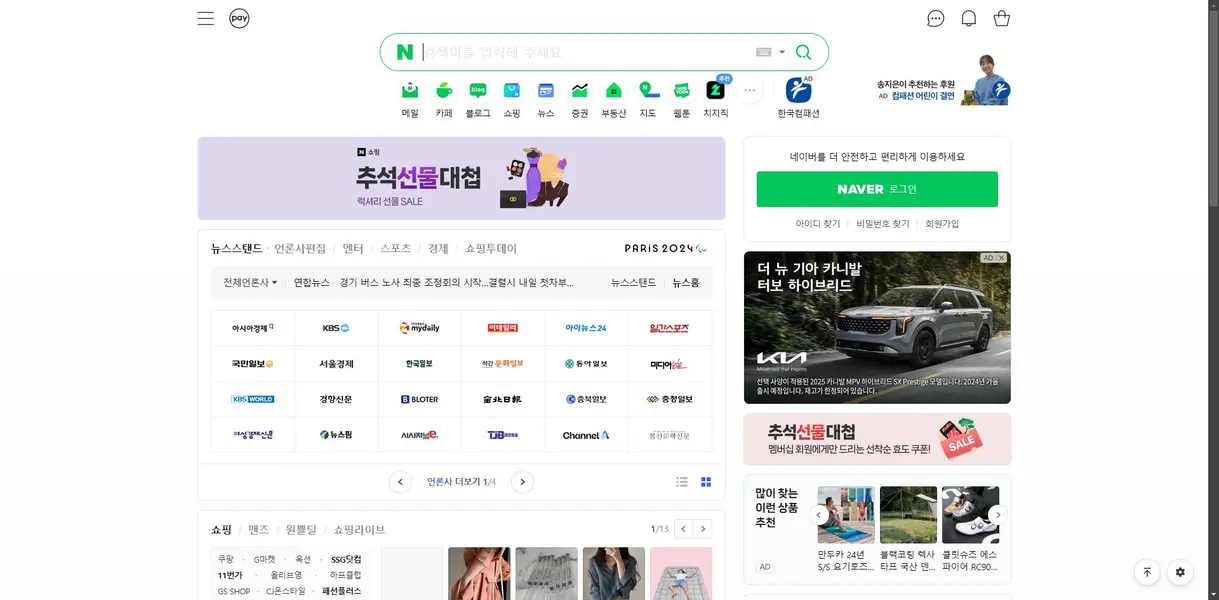
ScrapeIt runs the Naver scraper as a managed service. You describe the scope in market terms, meaning a list of districts, a set of complexes, the tenures that matter and the fields you need, and we handle the crawler, the schedule and the repair work when the site changes. Output arrives as CSV, JSON, XLSX or an API endpoint at the cadence you set.
Typical scopes are a fixed watchlist of complexes refreshed daily, a district-wide sweep refreshed weekly, or a single extract for a one-off study. Rows are deduplicated using the same-address counters, Naver prices are normalised out of the Korean notation into plain numbers, and areas ship in both square metres and pyeong so nothing has to be converted twice.
Every field below appears in the production JavaScript new.land.naver.com serves browsers. We map them to columns and keep the raw identifiers so rows join across runs.
Listings load page by page with no total count shown, so a crawler keeps paging until the list runs out.
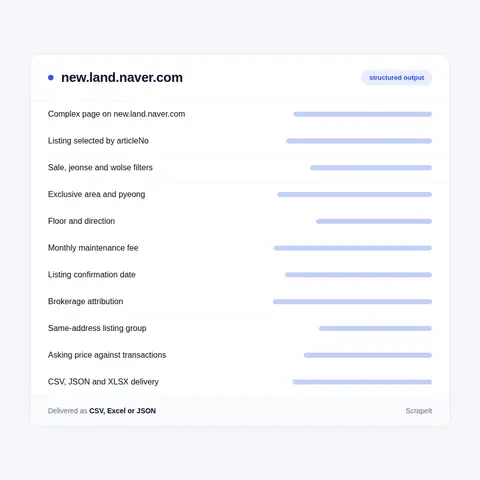
An asking price and a settled price are different numbers, and Naver says so itself. Beside a listing's confirmation date the interface prints a caution that the figure is an asking price (호가) and not an amount confirmed as an actual transaction price (실거래가). The complex price view then offers a basis switch labelled as the Ministry of Land, Infrastructure and Transport actual transaction price standard, so the portal carries both series and the distinction is the portal's own, not ours.
The two answer different questions. Korean sales and leases must be reported to the local authority within 30 days of the contract, and those reported figures make up the ministry series that Naver's complex price view switches to. That series is settled, lagging and authoritative. The portal shows what sellers are asking today. We capture the asking side on a schedule and, where you want both, line it up against the official series for the same complex and the same floor area.
What moves between runs is worth planning for. Asking prices are edited in place, listings appear and vanish as units go under contract, the confirmation date advances when an agent re-verifies, and complex-level averages drift. Snapshot dating is the whole point, so every row carries its run date rather than being overwritten.
Naver runs Korea's dominant web portal, and its property section is now branded Naver Pay Real Estate (네이버페이 부동산). The listings do not sit on the portal root. The land.naver.com address serves a hub page, while the working listing application runs on new.land.naver.com. That is the host this page is about, and it is the host we crawl.
On that host a complex is addressed as new.land.naver.com/complexes/ followed by a numeric complexNo, and an individual listing is selected by adding an articleNo parameter to the same complex URL. Separate roots exist for houses, offices and rooms, new-build sales sit on isale.land.naver.com, and a newer front end at fin.land.naver.com serves the map view and the mobile experience, with m.land.naver.com redirecting there.
The HTML alone carries almost nothing. Fetching a complex URL on 27 August 2026 returned roughly 41 KB of HTML whose title and description were both the generic service name, with no listing content in the body. The listing content is assembled in the browser, so the page has to be rendered before a single field can be read. Anyone planning to scrape Naver has to work with the three identifiers that key the listings: cortarNo for the administrative district, complexNo for the complex, and articleNo for the listing.
Get a Quote
Developers

Customers worldwide

Pages extracted

Hours saved for our clients
€199 / one-time
setup fee - included
€169 / mo
setup fee €499
€229 / mo
setup fee €499
€349 / mo
setup fee €499
€549 / mo
setup fee €799
Delivery: CSV, JSON or XLSX files, our API or a JSON feed. MCP server on request.
Full plan details →The Korean apartment market is organised by danji (단지), the apartment complex, rather than by street address. One danji holds many buildings and hundreds or thousands of units, and inside it a floor plan repeats: the same exclusive area and the same layout, on different floors and in different buildings. That is the single most important modelling fact about this source. Two listings in the same complex at the same area are close substitutes, and their prices compare directly in a way that two houses on one street never do.
It also decides the shape of your table. Keying on address produces noise. Keying on complexNo plus floor plan area produces a unit of analysis that supports a real price series, such as the lowest asking price for an 84 square metre unit in one complex tracked week by week. Naver's own interface works the same way, and its price chart carries a legend for transactions at the same area.
Tenure then splits each complex into three markets. A sale (매매) transfers ownership. Jeonse (전세) is a lease with no monthly rent, where the tenant places a large refundable deposit with the landlord for a fixed term and receives it back at the end. Wolse (월세) is a smaller deposit plus a monthly payment. Naver's own front end codes these as A1, B1 and B2, with B3 for a short-term lease. A complex can be tight on jeonse and slack on sale in the same week, so the three have to be stored and read apart.

Monitoring of real estate listings on funda.nl, pararius.com, rentberry.com, rentola.com, and zimmo.be to support the growth of a European property portal.
Learn More
Daily detection of new private property listings in Switzerland on Homegate.ch and ImmoScout24.ch, giving the agency first access to high-value leads.
Learn More
Scraping residential listings from Immobilienscout24.de in Germany and Mallorca, including complete data and resized images.
Learn MoreLearn how to use web scraping to solve data problems for your organization

Real estate teams work in a fragmented data landscape. The sites that drive demand in Boston look nothing like the ones that matter in Berlin, São Paulo, Dubai, or Mumbai.

Real estate teams are operating in a data environment that is bigger, faster, and more fragmented than ever. Listings go live and disappear in hours, price cuts happen quietly, and the portals that matter most in each country are rarely the same global “top 5.”

Six jobs that scraped property data does, each backed by a ScrapeIt project: seller leads, listing monitoring, image datasets, weekly market supply, sold records and unit-level rentals. For every use case - the fields it needs and how often to refresh them.
ScrapeIt is a managed web scraping agency. We build the crawler, run it on your schedule, monitor it and fix it when the source changes. You receive data, not a repository to maintain.
Scoping, a sample file and a written field list come before any commitment, so you can check the Naver data against your own expectations before the first full run. We collect only publicly available data - everything a visitor can see on Naver Real Estate - and we collect it legally, at a measured request rate.
Yes. The ScrapeIt Naver API returns complexNo, articleNo, tenure and price, exclusive area in square metres and pyeong, floor and the monthly maintenance fee as JSON from an endpoint we host, refreshed on the schedule you set. The same data also comes as CSV or XLSX files or straight into your database. When the site changes, repairing the crawler is ordinary maintenance on our side.
Both. The source is scoped by cortarNo, the administrative district code, so a district, a borough or a city can be walked complex by complex and then listing by listing. A city-wide sweep is a longer run at a lower frequency; a named watchlist of complexes is a short run that can go daily. We size the schedule to the scope rather than promising a fixed volume, and we tell you what a first run actually returned before you settle on a cadence.
As separate rows with separate columns. A sale carries one price. A jeonse listing, the Korean lease paid as a single large refundable deposit with no monthly rent, carries a deposit only. A wolse listing, the monthly rent model, carries a deposit and a monthly amount, which the source keeps in two different fields. We never collapse these into one price column, because a deposit and a monthly payment are not comparable quantities. The tenure code stays on the row so you can filter without parsing text.
Listings on this source name the brokerage and the licensed agent, the gongin junggaesa (공인중개사), whose office is registered with the local authority. Our output is limited to listing and commercial data. Personal contact details can be excluded from the deliverable on request, and we will do that by default if you ask. Korea's Personal Information Protection Act, known as PIPA, governs personal information about people in Korea.
That depends on the scope. We run at a measured request rate, and anti-bot handling, proxy rotation and rendering are part of the service. The practical cadence is set during scoping against a real trial run rather than quoted up front. Daily refresh is realistic for a defined watchlist of complexes.
Step 1 - Make a Request
You share your needs, expectations, and desired timeframe. We’ll suggest the best solution based on your request and budget.
Step 2 - Configuring Custom Web Crawlers
Our specialists configure the crawlers and extract a sample dataset for your review before proceeding with the full-scale extraction.
Step 3 - Collect and Deliver
Once you approve the sample, we launch the project and start full data collection. We gather, filter, and structure the data for easy use, delivering it on time in your preferred format.
Step 4 - Maintain and Support
Our team manages ongoing processes, monitors website changes, and supports all data extraction cycles. We can also help integrate data into your systems or create dashboards to simplify analysis.
Naver data from €169/month. Free project assessment, reply within 1 business day.

Scrapeit Sp. z o.o.
10/208 Legionowa str., 15-099, Bialystok, Poland
NIP: 5423457175
REGON: 523384582