Apartments.com Data: Unit Prices for 3,000 Buildings Every Day
A daily apartments.com feed for a US apartment locator: about 3,000 buildings from the client's own list, down to each unit's rent and floor plan.
Learn More
Vacasa sets the rate on every home it manages, so a Vacasa price scrape reads as one operator's revenue decisions repeated across tens of thousands of units, not as a crowd of owner asks.
Plans from €169/month · Free project assessment · Reply within 1 business day
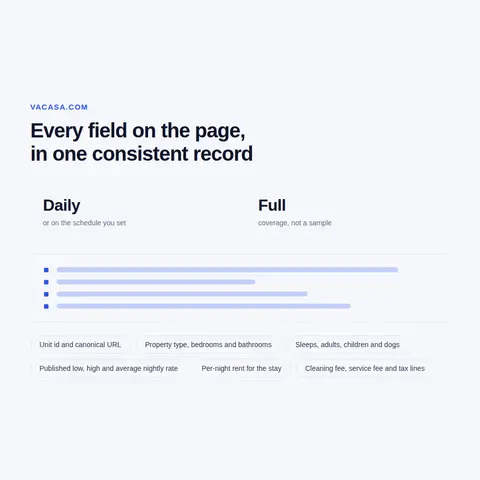
You get CSV, JSON, XLSX or an API endpoint of ours, on whatever cadence the question needs. Rate and calendar work usually runs daily or weekly against a fixed query grid so the series stays comparable. Catalogue fields, amenities and review history move slowly, so a monthly pass covers them.
The site is defended, and the price quote in particular is guarded by an enterprise CAPTCHA. Anti-bot handling, proxy rotation and CAPTCHA solving are part of the service, run at a polite rate rather than a brute-force one. The Canadian domain shares the same unit numbering, so one schema covers both markets without a second build.
One row per unit, keyed to the integer id in the unit path. Catalogue fields sit in the page markup; dated rates and the calendar are collected for the arrival dates and party sizes you set, and reviews in full. The schema:
Column names are ours and hold steady between runs. Need a field that is on the page and not listed here? We add it.
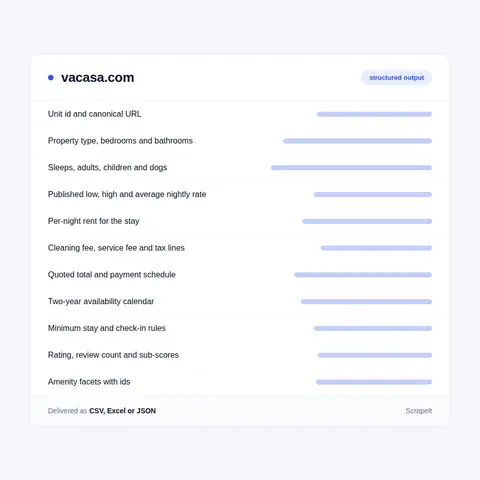
A Vacasa rate is a decision, and it moves. The search card shows an average per night that excludes fees and taxes. The unit page publishes a low, a high and a base average for the same home. The dated quote returns a different figure again, and an off-season midweek night sits far below the yearly average. All three are real and none stands in for the others, so we fix the query grid with you first - arrival dates, stay lengths, party sizes - and stamp every row. A rate without its dates is not a rate.
The total is not the rent. Cleaning is a flat charge per stay, so its per-night weight falls as the stay lengthens. Lodging taxes stack by state, county and city, each on its own named line. The service fee is a percentage of rent and fees. On short stays in high-tax counties the load on top of the rent runs well into double digits as a share, so we keep every component in its own column, not one blended figure.
Coverage has to be sliced. The result set is capped, so a large market is broken down by destination, amenity facet, bedroom count and price band, then reconciled on unit id. The unit sitemap is the backbone: roughly 41,000 addresses in early September 2026.
Public data and personal data. We collect only publicly available data - everything a visitor can see on Vacasa - and we collect it legally. We work from public pages only, never log in and never touch checkout. Guest first names and initials from reviews are dropped; scores and text are kept.
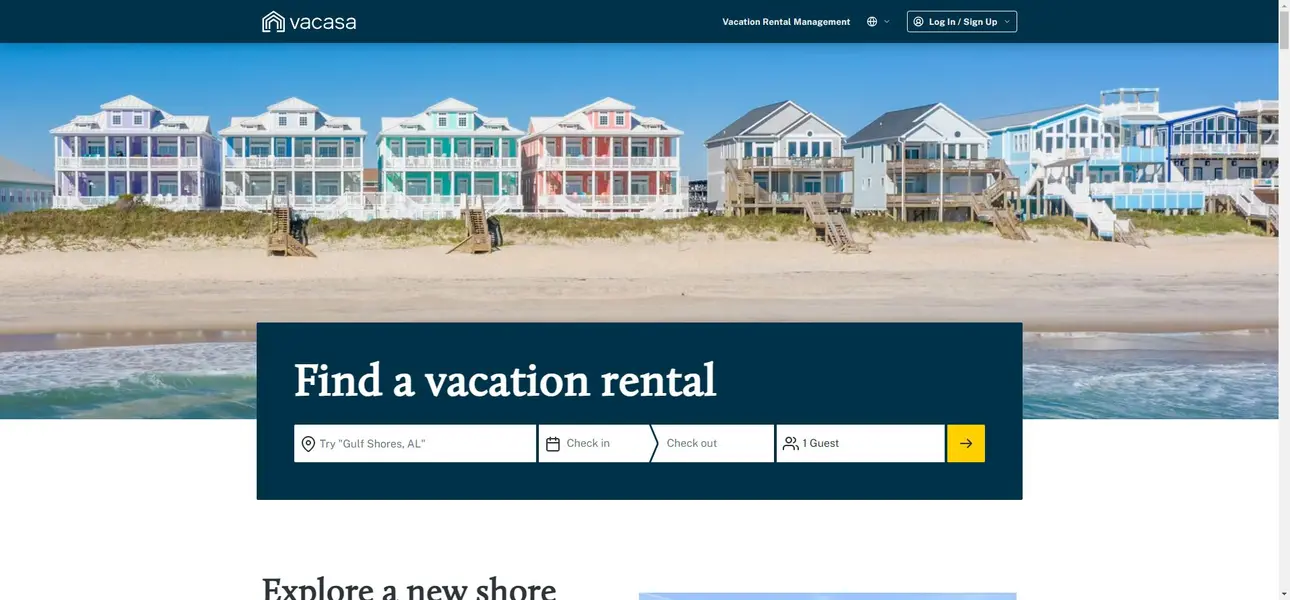
Vacasa manages vacation homes on behalf of their owners. It does not carry third-party classifieds. Every home on vacasa.com sits under a management contract: Vacasa photographs it, writes the description, sets the nightly rate, runs the calendar, cleans between stays and answers the guest at three in the morning. That single fact changes what a Vacasa scraper collects. On an open marketplace you harvest thousands of independent asking prices from strangers. On Vacasa you harvest the pricing decisions of one professional operator, applied consistently across a whole portfolio.
Founded in Portland, Oregon in 2009, Vacasa listed on Nasdaq as VCSA through a 2021 SPAC combination with TPG Pace Solutions. Casago, a Phoenix-based manager founded in 2001, agreed on 30 December 2024 to buy out the public shares at USD 5.02 each, subject to adjustment, and closed on 1 May 2025, at which point Vacasa stock stopped trading and left the exchange. Proptech firm Roofstock invested alongside Casago and now appears as the contracting party in the rental agreement text served with a booking quote. The brand line in the page markup reads Vacasa, a Casago Company, and at closing the combined business was put at more than 40,000 managed homes.
Coverage follows that management footprint rather than a map of demand. City pages exist under the usa prefix for 49 states plus the District of Columbia, alongside separate pages for named resorts and condo communities such as Shipyard on Hilton Head. Outside the United States the published places sit under a vacation-rentals prefix for Mexico, Belize, Costa Rica and Aruba, and Canada runs on its own domain, vacasa.ca, sharing the same unit numbering.
Get a Quote
Developers

Customers worldwide

Pages extracted

Hours saved for our clients
€199 / one-time
setup fee - included
€169 / mo
setup fee €499
€229 / mo
setup fee €499
€349 / mo
setup fee €499
€549 / mo
setup fee €799
Delivery: CSV, JSON or XLSX files, our API or a JSON feed. MCP server on request.
Full plan details →Benchmarking against a professional pricer. A Vacasa rate is not an owner's guess. It is what a manager with a revenue team decided to charge for a specific home on a specific night, and it moves when demand moves. For anyone pricing their own units, that is a reference series rather than noise.
Occupancy and pickup. Calendar flags say which nights have already gone. Run the same units week after week and the pickup curve appears: how far ahead a market fills, which weekends sell first, how thin the shoulder season really is. Nightly rate data next to calendar state is the closest a public source gets to an occupancy series.
Market sizing and supply tracking. Every destination page publishes its own home count and its low-to-high nightly band, so one sweep across the destination set returns supply and price spread by market, and a repeat sweep shows where managed stock is growing or thinning.
Acquisition and underwriting. Buyers of vacation homes, and buyers of management books, put rent, fee load, calendar fill and review history together to model revenue per home, then test it against the asking price of comparable stock.
Competitor watch for other managers. Units carry a local operating brand and a manager id, so a market can be grouped by operator to see who prices how, whose minimum stays run longest and what guests actually score them on.

A daily apartments.com feed for a US apartment locator: about 3,000 buildings from the client's own list, down to each unit's rent and floor plan.
Learn More
A one-time Housing.com collection for a real-estate company in India: project cards plus every photo and floor plan, uploaded straight to its cloud drive.
Learn More
A one-time 30-day history of Sahibinden car and SUV listings for a startup building an AI deal finder, delivered as JSON through our API.
Learn MoreLearn how to use web scraping to solve data problems for your organization

Real estate teams work in a fragmented data landscape. The sites that drive demand in Boston look nothing like the ones that matter in Berlin, São Paulo, Dubai, or Mumbai.

Real estate teams are operating in a data environment that is bigger, faster, and more fragmented than ever. Listings go live and disappear in hours, price cuts happen quietly, and the portals that matter most in each country are rarely the same global “top 5.”

Six jobs that scraped property data does, each backed by a ScrapeIt project: seller leads, listing monitoring, image datasets, weekly market supply, sold records and unit-level rentals. For every use case - the fields it needs and how often to refresh them.
ScrapeIt is a managed web scraping agency. We are independent of Vacasa and of Casago. We scope the job, build the crawler, run it on your schedule, watch it when the site changes and repair it before you have to file a ticket.
You never touch the pipeline. What arrives is a file or an endpoint with the columns agreed at the start, in the same shape every run. Send us the markets and the date grid you care about and we will come back with a field list, a sample extract and a schedule.
Yes. The ScrapeIt Vacasa API returns unit id, rent for each night of a stated stay, the cleaning fee and tax lines, quoted total, calendar flags and review scores as JSON from an endpoint we host, refreshed on the schedule you set. The same data also comes as CSV or XLSX files or straight into your database, and our schema holds still when the site does not.
Yes, and separated rather than blended. For a stated arrival date, departure date and party size we capture the rent for each individual night, the rent subtotal, the cleaning fee and any other named fee, fees payable on arrival, security deposits, trip protection, the service fee, every tax line under its own name, and the quoted total. The payment schedule comes with it, so you can see what is due at booking and what is due later. Ask only for the headline nightly figure and you will get a number no guest ever pays, because on a short stay a flat cleaning charge and local lodging taxes move the effective nightly cost sharply.
Yes, at night-level granularity across a two-year forward horizon. Each date carries three flags: whether check-in is allowed, whether check-out is allowed, and whether the night is bookable at all. Read the caveat honestly, though: a night can be closed because it is sold, because the owner blocked it for personal use, or because a minimum-stay rule makes it unreachable from any legal arrival date. A single snapshot cannot always tell those apart. Repeated runs on a fixed schedule can, because a sold night behaves differently from a blocked one over time, and that is why occupancy work is sold as a series rather than a one-off pull.
The published inventory runs across 49 US states plus the District of Columbia, with city pages, named resort pages and condo-community pages sitting side by side under the same prefix, plus Mexico, Belize, Costa Rica and Aruba, and Canada on the vacasa.ca domain with matching unit numbering. In early September 2026 the unit sitemap listed roughly 41,000 addresses. Because the search result set is capped, we do not scrape a big market in one query; we slice it by destination, by amenity facet such as oceanfront, hot tub, pool, dog-friendly, lakefront or ski-in-ski-out, and by bedroom and price band, then reconcile everything on the unit id.
Yes. We collect only publicly available data - everything a visitor can see on Vacasa, from unit details and nightly rates to fees, calendars, stay rules and reviews - and we collect it legally. We do not log in and we do not go through checkout. On personal data we default to leaving it out: guest first names and last initials from reviews are dropped, homeowner details are not collected, and exact street addresses are not published before booking in any case.
Step 1 - Make a Request
You share your needs, expectations, and desired timeframe. We’ll suggest the best solution based on your request and budget.
Step 2 - Configuring Custom Web Crawlers
Our specialists configure the crawlers and extract a sample dataset for your review before proceeding with the full-scale extraction.
Step 3 - Collect and Deliver
Once you approve the sample, we launch the project and start full data collection. We gather, filter, and structure the data for easy use, delivering it on time in your preferred format.
Step 4 - Maintain and Support
Our team manages ongoing processes, monitors website changes, and supports all data extraction cycles. We can also help integrate data into your systems or create dashboards to simplify analysis.
Vacasa data from €169/month. Free project assessment, reply within 1 business day.

Scrapeit Sp. z o.o.
10/208 Legionowa str., 15-099, Bialystok, Poland
KRS: 0000996672
NIP: 5423457175
REGON: 523384582