eBay Data: 1.9M Auto Parts Listings from eBay.de, Specs Translated
About 1.9 million auto parts listings from eBay.de with brand, OEM, EAN and fitment, plus titles and specs machine-translated for the client's team.
Learn More
One refurbished model, many sellers, four condition grades and a different price on each rung. We turn that mess into a clean Back Market feed you can join on, market by market.
Plans from €169/month · Free project assessment · Reply within 1 business day
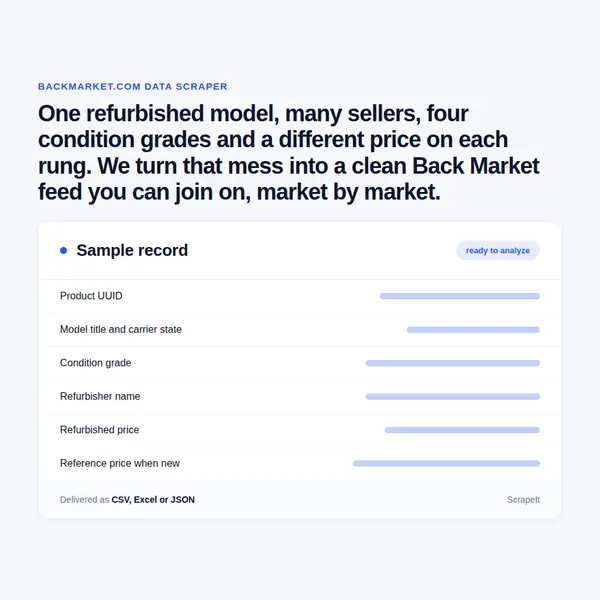
Back Market listing and product pages block plain automated clients, so a Back Market scraping project that begins with a simple fetch stops on the first request. Ours does not: anti-bot handling, proxy rotation and CAPTCHA solving are part of the service, and every storefront is opened in a real browser session with the right locale, currency and grade parameter.
You name the models, categories, grades and countries; we return normalised rows on a stable schema, keyed on the configuration UUID, with prices kept in the storefront's own currency next to a converted column. Delivery runs on your schedule - hourly, daily or weekly - as CSV, JSON, JSONL or Parquet, dropped to S3, GCS, FTP, a webhook or a private endpoint. Anything behind a login stays out of scope.
One model, sold many times over - that is the shape of Back Market product data. A single iPhone or MacBook exists as dozens of sellable rows, priced by grade, seller and configuration rather than by model. Titles keep one shape: a model line with the carrier state above an attribute subtitle, so "iPhone 11 - Unlocked" sits over "Black - 128 GB - Physical SIM + eSIM". Extract Back Market data at that granularity and every row is unambiguous.
The condition ladder has four rungs and grades cosmetics only, since all four sell as fully functional: Fair (visible scratches and dents), Good (light micro-scratches, unscratched screen), Excellent (almost no wear) and Premium (flawless screen, tiny micro-scratches at most). Each rung is usually stocked by a different shop, so the ladder is not monotonic: a Fair unit can list above a Good one, and that inversion is the signal to catch.
The rungs are localised while the ladder is not: the German storefront names its bottom rung Gut and its middle rung Sehr gut, so matching on "good" across markets quietly merges two grades.
Each picker option carries a price and a stock flag: storage, colour, carrier compatibility (unlocked, or locked to Verizon or T-Mobile), SIM type, battery option (standard from 80%, a 90-99% tier, or a new 100% battery), keyboard layout on laptops, an optional trade-in credit and, in some markets, a bundled mobile plan. Sold-out combinations keep their place, flagged.
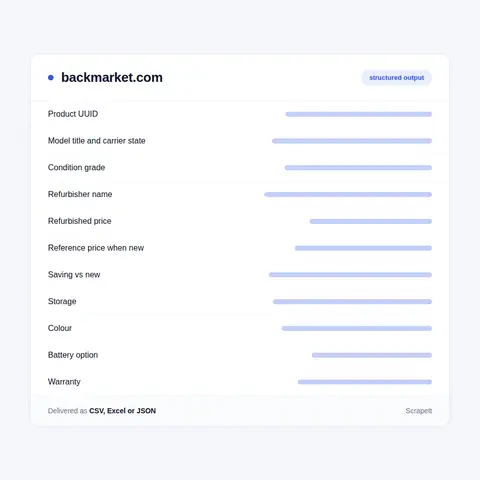
Around the buy box sit the fields a Back Market price feed lives on: the refurbisher, the warranty, free and express delivery windows with dates, what ships in the box and what is left out, the reference price when new, the saving against it, the total before trade-in credit, and a 30-day lowest-price line stamped with the day it was computed and the day it refreshes.
Ratings are per model and per storefront: an average, a verified review count and sub-scores for performance, appearance, accessories, battery, camera, packaging and shipping. Specifications arrive as named fields: mpn, screen_size, memory, main_camera, serie, sim_lock, dual_sim, resolution, foldable, connector, screen_type, os, last_os_compatibility, storage, network and year_date_release, plus SAR head and body figures.
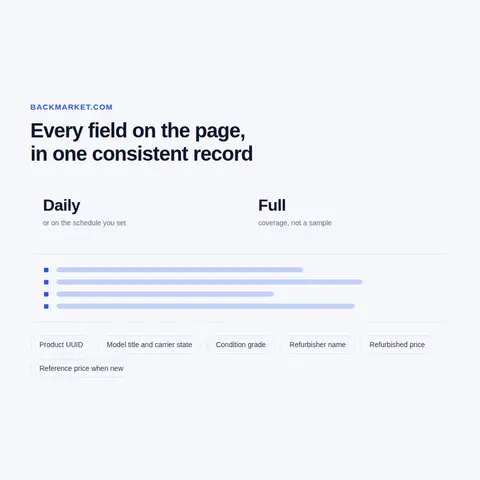
Seller pages are a dataset in their own right. Each shop at /s/{seller}/{uuid} shows an Approved seller badge, a star rating, years traded on the platform, home country, a verified review count and the same seven sub-scores as a product. Reviews filter by grade and star band and sort by relevance, helpfulness, recency or score, each naming the exact device, its grade and the purchase date. The About tab publishes the legal identity a compliance team asks for: legal name, legal address, country of origin, SIREN and VAT number.
Price guide pages publish a storage-by-condition matrix for a model beside its new-price reference, so a whole ladder lands in one request. Compare pages line up two models with a starting price per colour and per storage, sold-out markers, a community rating and a spec table of release year, operating system, last OS compatibility and foldable status.
Trade-in - BuyBack in the platform's own wording - has model pages at /buyback/m/{category}/{model} for iPhone, other phones, tablets, MacBook, game consoles and audio. The quality promise page spells out the inspection behind every grade: up to 100 checkpoints covering buttons, card readers, data deletion, cameras, biometric and external sensors, IMEI blacklist status, oxidation, carrier lock and parts compatibility, with minimum 80% battery health, a one-year warranty and 30-day free returns.
Buyer reviews carry a first name and an initial; personal data stays out of the feed.
Back Market lists almost nothing of its own: the devices on backmarket.com belong to vetted professional refurbishers, and the shopper buys renewed hardware with a warranty instead of new stock. In September 2026 the marketplace counted about 1,800 professional sellers, 200+ categories and 15 million customers across 17 countries, and the catalogue runs across smartphones, laptops, tablets, consoles, smartwatches, audio, small and large home appliances, desktops, TV, electric transportation and retro tech.
Those 17 storefronts run on their own domains. backmarket.com covers the United States in English and Spanish; backmarket.fr, .de, .co.uk, .es, .it, .nl, .be, .at, .ie, .pt, .gr, .fi, .se, .sk, .com.au and .co.jp cover the rest. Every path opens with a language-country prefix such as en-us, de-de or ja-jp. Prices land in six currencies - USD, EUR, GBP, SEK, AUD and JPY - and the assortment, the seller roster and the review totals are local rather than shared.
Addresses follow a strict grammar, which is what makes a Back Market scraper cheap to run and easy to keep alive: /l/{category}/{uuid} is a listing page, /p/{slug}/{uuid} is one exact configuration, /p/{series} is a model hub, /s/{seller}/{uuid} is a shop, /price-guide/{model} is a price table, /compare/{model-a}/{model-b} is a spec duel, /buyback/m/{category}/{model} is a trade-in quote page and /e/{campaign} is a deal event.
The sitemap index splits the site into products, landings, model hubs, comparisons, price guides, sellers, trade-in, events, facet listing pages and articles, and that split is market-specific: the Japanese storefront publishes no price-guide or trade-in section at all, while the US publishes facet listing pages that France, Germany and the UK do not.
Get a Quote
Developers

Customers worldwide

Pages extracted

Hours saved for our clients
€199 / one-time
setup fee - included
€169 / mo
setup fee €499
€229 / mo
setup fee €499
€349 / mo
setup fee €499
€549 / mo
setup fee €799
Delivery: CSV, JSON or XLSX files, our API or a JSON feed. MCP server on request.
Full plan details →Refurbished pricing is a live auction. Independent sellers reprice against each other inside the same configuration, which is why Back Market price monitoring only works when it runs per grade and runs often.
What teams build on the feed:
About 1.9 million auto parts listings from eBay.de with brand, OEM, EAN and fitment, plus titles and specs machine-translated for the client's team.
Learn More
A one-off Takealot product list for an entrepreneur choosing niches: only products rated 4 stars or higher with at least 50 reviews.
Learn More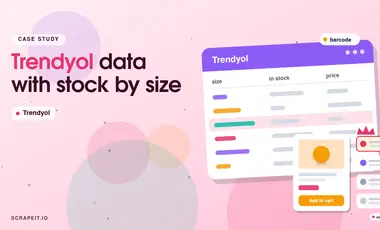
Trendyol product data for an e-commerce startup reselling Turkish fashion: 27 categories in JSON on FTP, with in-stock status for every size.
Learn MoreLearn how to use web scraping to solve data problems for your organization
If you sell online, run a marketplace, or advise e-commerce clients, you already know why eBay matters: it’s one of the few places where big retailers compete side by side with thousands of small merchants and private sellers.

E-commerce teams do not just need “some” competitor data anymore. They need a continuous stream of real prices, discounts, stock levels, reviews, and seller behavior from the platforms that actually shape their markets.
Amazon provides valuable information gathered in one place: products, reviews, ratings, exclusive offers, news, etc. So scraping data from Amazon will help solve the problems of the time-consuming process of extracting data from e-commerce.
ScrapeIt is a managed web scraping agency. You do not maintain selectors, rotate proxies or debug a dead parser at midnight: we own the pipeline end to end, monitor field-level fill rates and raise an alert when a source changes shape. Start with a sample built from your own target list, check the columns against what your model actually needs, and move to a scheduled feed only once the data holds up.
Yes. The ScrapeIt Back Market API returns the configuration UUID, condition grade, refurbisher name, price, reference price when new and the 30-day lowest-price reference as JSON from an endpoint we host, refreshed on the schedule you set. The same data also comes as CSV, JSONL or Parquet files or straight into your database, keyed on the configuration so competing refurbishers sit side by side.
The configuration UUID and slug, model title and carrier state, condition grade, refurbisher name, price, currency, reference price when new and the saving, storage, colour, SIM type, battery option, warranty, free and express delivery windows, what is in the box, availability, the 30-day lowest-price reference, model rating with review count and seven sub-scores, and the specification block: mpn, screen_size, memory, cameras, resolution, connector, os, last_os_compatibility, network, weight, release year and SAR figures.
Yes. Seventeen storefronts across six currencies are in scope, from backmarket.com to backmarket.co.jp. Each one is crawled in its own locale, because the differences are real: assortment and seller rosters differ market by market, condition labels are translated (the German bottom rung reads Gut, the middle one Sehr gut), some markets publish price guides and trade-in pages while others do not, and review totals for the same model are counted locally. We deliver a market column so nothing is silently merged.
As often as the plan needs. Fast-moving configurations are usually refreshed hourly or several times a day; broad catalogue sweeps run daily or weekly. Output comes as CSV, JSON, JSONL or Parquet, delivered to S3, GCS, FTP, a webhook or a private endpoint, with a stable column set so downstream jobs do not break. Change-only deltas are available when you only care about repricing and stock flips rather than the full snapshot.
Yes. We collect only publicly available data - listings, product configurations, seller profiles, price guides, comparisons and trade-in model pages, everything a visitor can see on Back Market - and we collect it legally. We do not create accounts and we do not touch anything behind a login or a checkout. Reviewer names are personal data and are not part of the delivery. Product, price and seller-business facts are.
Step 1 - Make a Request
You share your needs, expectations, and desired timeframe. We’ll suggest the best solution based on your request and budget.
Step 2 - Configuring Custom Web Crawlers
Our specialists configure the crawlers and extract a sample dataset for your review before proceeding with the full-scale extraction.
Step 3 - Collect and Deliver
Once you approve the sample, we launch the project and start full data collection. We gather, filter, and structure the data for easy use, delivering it on time in your preferred format.
Step 4 - Maintain and Support
Our team manages ongoing processes, monitors website changes, and supports all data extraction cycles. We can also help integrate data into your systems or create dashboards to simplify analysis.
Back Market data from €169/month. Free project assessment, reply within 1 business day.

Scrapeit Sp. z o.o.
10/208 Legionowa str., 15-099, Bialystok, Poland
KRS: 0000996672
NIP: 5423457175
REGON: 523384582