eBay Data: 1.9M Auto Parts Listings from eBay.de, Specs Translated
About 1.9 million auto parts listings from eBay.de with brand, OEM, EAN and fitment, plus titles and specs machine-translated for the client's team.
Learn More
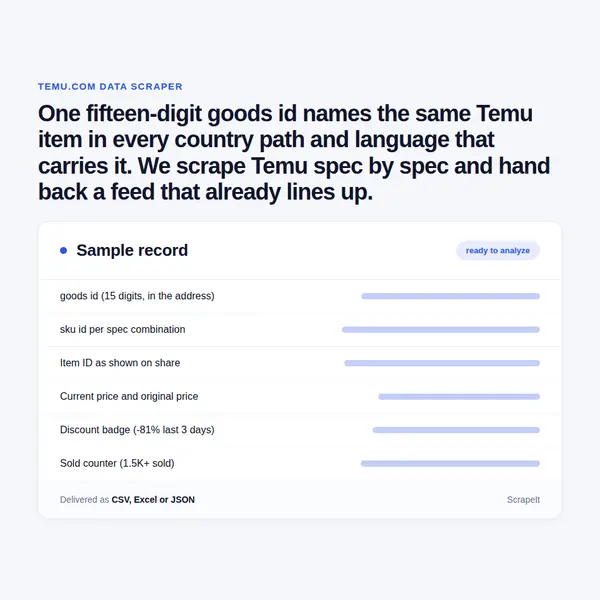
One fifteen-digit goods id names the same Temu item in every country path and language that carries it. We scrape Temu spec by spec and hand back a feed that already lines up.
Plans from €169/month · Free project assessment · Reply within 1 business day
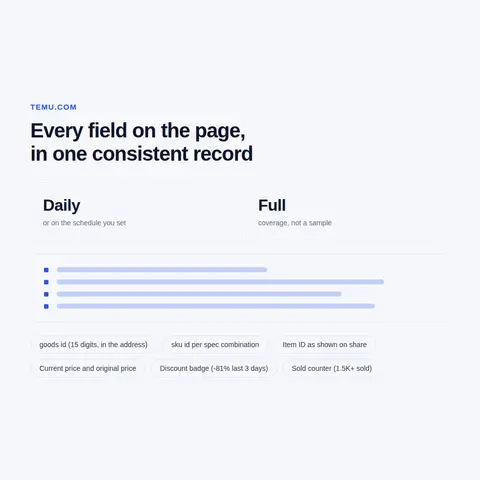
This runs as a managed service, not a script handover. Temu turns automated clients away, so a crawl has to arrive the way a shopper does: anti-bot handling, proxy rotation and CAPTCHA solving are part of the service, along with the pacing and retries that keep a sku sweep consistent. Coverage is planned from the opt id tree, the channel shelves and store pages, because the sitemap index does not answer and search is rebuilt per session. The crawl key is the goods id with the sku id under it, so a feed survives every retitling and slug change. Output arrives as CSV, JSON, JSONL or Parquet over S3, GCS, SFTP or a webhook, daily or hourly, with a change feed so you read only what moved. The same feed is also served as a Temu API endpoint we host, with access by key.
A Temu item is two identifiers deep, and that is most of the work in any extract Temu product data job.
Fill rates are uneven and we report them: review blocks are empty on fresh listings, the brand line is missing on unbranded goods, size charts live on apparel, not hardware.
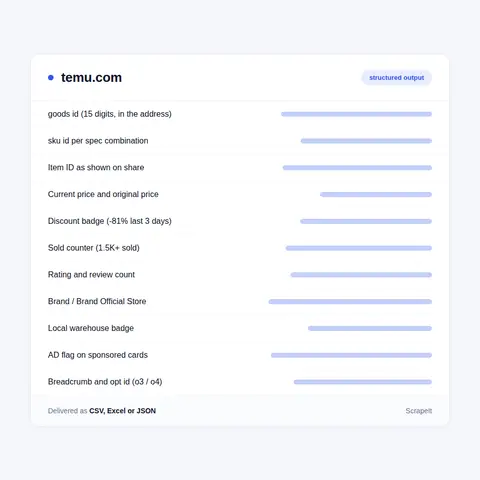
The deal machinery is where Temu moves fastest. The Lightning Deals page is split into Lightning deals, Limited time offer, Exclusive offer and a price-floor rail whose threshold is written into the shelf name, as in All under $2.99. Every card there fuses a discount with a clock: -81% last 3 days, -46% last 3 days, -13% limited time, last day. The countdown then narrows in the shop's own words, from LAST DAY and FINAL DAY down to LAST MINUTES and FINAL MINUTE. Two snapshots a day apart are two different shelves, so a Temu product feed sampled once a day will describe promotions it never watched start.
Around the clocks sit mechanics with rules of their own: a free gift unlocked by an order threshold, coupon bundles handed to new shoppers and new storefronts, a stated limit of one coupon per purchase that cannot be applied to shipping or tax, Temu Credit, points redeemed against an item, price-drop alerts and low-stock alerts. Sponsored cards are marked AD on the shelf, and a feed that ignores that flag will read paid placement as popularity.
Supply behaves the same way. Listings arrive from many independent providers, an item can be delisted or restocked without notice, and a sold-out spec is quietly swapped for a neighbour. Two things we leave alone: reviewer names, avatars and review photographs are personal data, and so are the body measurements shoppers hand to the size recommender, so we keep score, date, purchased item and text and drop the person. Anything behind a sign-in stays out of scope.
Temu is a cross-border marketplace operated by Whaleco Inc., and it behaves like one shop stretched across a separate path for every market it opens. The top navigation carries Featured plus thirty-four channels, from Women's Curve Clothing and Men's Big and Tall to Business, Industry and Science, Books and Media and Beachwear. Plan to scrape Temu and you plan against all of it at once.
The tree underneath is numeric, and Temu calls its nodes opt ids. A shelf sits at pet-supplies-o3-320.html, and the same node is published again behind a /c/ prefix as pet-supplies-o4-320.html, so one category owns two addresses; o1-0.html indexes the lot. The query string spells out position: opt_level separates a top channel from a child, leaf_type marks siblings or children. Slugs drift while the id holds - one node has been mens-top and mens-tops, another keyboards- and keyboards-midis - so a Temu scraper keys on the opt id and treats the slug as decoration.
Above the tree sit merchandised shelves with addresses of their own: channel/lightning-deals.html, channel/best-sellers.html, channel/new-in.html, channel/full-star.html for 5-Star Rated and channel/local-warehouse.html for stock already in the country. Search answers at search_result.html behind a search_key parameter.
The last leg is supply. The product markup stamps the brand as Temu even where a third-party shop is selling, and the shops themselves are called providers and merchandise partners; each gets a store page addressed with an -m- id. A Seller Center serves sellers holding local stock, a Seller Central serves the agent model and a separate provider system serves logistics partners, so the assortment reads as a flow from many suppliers, not a fixed shelf.
Get a Quote
Developers

Customers worldwide

Pages extracted

Hours saved for our clients
€199 / one-time
setup fee - included
€169 / mo
setup fee €499
€229 / mo
setup fee €499
€349 / mo
setup fee €499
€549 / mo
setup fee €799
Delivery: CSV, JSON or XLSX files, our API or a JSON feed. MCP server on request.
Full plan details →Temu addresses a storefront as a country path with an optional language suffix, and the same goods id runs through all of them. The United States sits at the root with /us-es, /us-fr, /us-pt and /us-ru beside it; Britain is /uk with /uk-pl, /uk-ro and /uk-ru; Belgium splits into /be, /be-fr, /be-nl and /be-tr; Germany alone runs ten language paths, from German and English to Arabic, Croatian, Russian and Ukrainian. Category ids survive the crossing too - pet-supplies-o3-320.html in English is mascotas-o3-320.html in Spanish - so a Temu scraping run across countries joins on ids, never on titles.
What changes is the slug and the offer. Product slugs are translated and percent-encoded, so one item is a long English phrase in one market and Arabic or Cyrillic in another while the id in the middle never moves. The alternates a product publishes cover only the markets where it is actually sold, which makes them the cheapest signal of where an item exists at all. Temu itself states that the English version prevails and translations are for reference, so a multi-market Temu data pull treats the English copy as the source and the rest as renderings of it.
Region and currency are separate switches, and the storefront decides the price explanation, the promotional labels and the legal blocks bolted to a listing. Search results are described by the shop as updating in real time against stock and the regional market, so coverage of a category is planned as slices - shelf, price band and sort order - rather than as one long list.
About 1.9 million auto parts listings from eBay.de with brand, OEM, EAN and fitment, plus titles and specs machine-translated for the client's team.
Learn More
A one-off Takealot product list for an entrepreneur choosing niches: only products rated 4 stars or higher with at least 50 reviews.
Learn More
Trendyol product data for an e-commerce startup reselling Turkish fashion: 27 categories in JSON on FTP, with in-stock status for every size.
Learn MoreLearn how to use web scraping to solve data problems for your organization

If you sell online, run a marketplace, or advise e-commerce clients, you already know why eBay matters: it’s one of the few places where big retailers compete side by side with thousands of small merchants and private sellers.

E-commerce teams do not just need “some” competitor data anymore. They need a continuous stream of real prices, discounts, stock levels, reviews, and seller behavior from the platforms that actually shape their markets.
Amazon provides valuable information gathered in one place: products, reviews, ratings, exclusive offers, news, etc. So scraping data from Amazon will help solve the problems of the time-consuming process of extracting data from e-commerce.
ScrapeIt is a managed web scraping agency. We build the crawler, run it on our own infrastructure, watch it when the shop changes shape, and hand over data instead of code. Marketplaces that keep their catalogue behind a challenge and rebuild their shelves every hour are a shape we know well, and the same care goes into every site we cover. Scope, sample and schema come before any invoice, and the sample is real rows pulled from the live storefront, never a mock.
Yes. The ScrapeIt Temu API returns the goods id and sku id, current and original price, sold counter, rating and seller as JSON from an endpoint we host, refreshed on the schedule you set. The same data also comes as CSV, JSONL or Parquet files or straight into your database. Our crawler reads the same public pages a shopper sees and returns a versioned feed with a fixed schema, so no field renames itself under your pipeline.
Any of them, and the join is cheap because an item keeps the same goods id everywhere. Storefronts are country paths with an optional language suffix, so the root, /us-es and /us-fr are three views of one market, while Belgium answers in English, French, Dutch and Turkish. We return one row per storefront with its own price, currency and promotional labels. Assortment differs sharply between countries, and the alternates a product publishes are the honest signal of where it is sold, so we size a project on that rather than on a global headline number.
Linked the way the shop stores them. A style is one goods id; each combination of options is a spec with its own sku id, price and stock state. We return a group keyed on the goods id with the sku rows nested, or one flat row per sku, whichever suits your pipeline. Where a size guide exists we return it as rows - the size, then the named body or product measurements - and we keep the shop's own note that those numbers are taken by hand. Sold-out specs are marked rather than dropped, so you can see what stopped selling.
Daily is the normal cadence for a full sweep, and a watchlist of goods ids can run hourly or tighter. Frequency matters more here than on a slow catalogue: Lightning Deals carry countdowns that fall to a final minute, the price-floor rails rotate, and a listing can be delisted between two passes. Cost tracks sku count rather than style count, since one item in four colours and three sizes is twelve price points. We usually pair a nightly full pass with frequent passes over chosen shelves or a seller list, and ship a change feed so you process only what moved.
We stay on public pages and take nothing that needs an account: no sign-in, no cart, no checkout, and none of the account, order and coupon pages. Reviewer names, avatars, review photographs and the body measurements shoppers give the size recommender are personal data and are dropped by default, leaving score, date, purchased item and text. We agree the scope and the volumes with you up front. We collect only publicly available data - everything a visitor can see on Temu - and we collect it legally.
Step 1 - Make a Request
You share your needs, expectations, and desired timeframe. We’ll suggest the best solution based on your request and budget.
Step 2 - Configuring Custom Web Crawlers
Our specialists configure the crawlers and extract a sample dataset for your review before proceeding with the full-scale extraction.
Step 3 - Collect and Deliver
Once you approve the sample, we launch the project and start full data collection. We gather, filter, and structure the data for easy use, delivering it on time in your preferred format.
Step 4 - Maintain and Support
Our team manages ongoing processes, monitors website changes, and supports all data extraction cycles. We can also help integrate data into your systems or create dashboards to simplify analysis.
Temu data from €169/month. Free project assessment, reply within 1 business day.

Scrapeit Sp. z o.o.
10/208 Legionowa str., 15-099, Bialystok, Poland
KRS: 0000996672
NIP: 5423457175
REGON: 523384582