The Entire Iherb Supplements Catalog, Captured End-to-End in 3 Days
Scraping supplement products from iHerb.com with full details, including descriptions and packaging variations.
Learn More
Plans from €169/month · Free project assessment · Reply within 1 business day
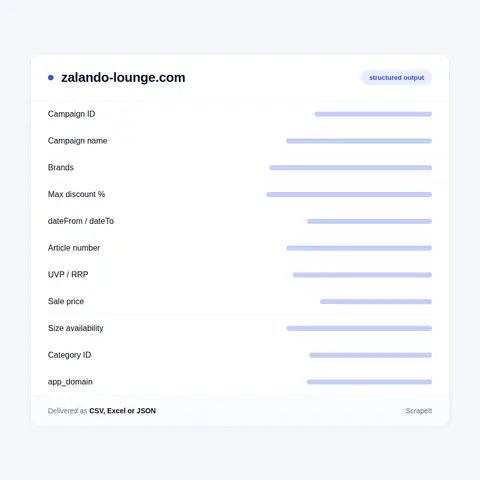
You receive files or an endpoint, not a codebase. Output ships as CSV, JSON, XLSX or a REST API, on a schema agreed before the first run and kept stable afterwards.
Scheduling is matched to the platform rather than to a generic nightly job. Because campaigns open in the early morning UTC band and close at 21:59:59Z, runs are normally pinned to capture the opening line-up and then repeated through the day for price and size changes. Country sites can arrive as separate feeds or as one merged table with app_domain, delivery country and currency on every row.
Delivery goes to S3, SFTP, Google Drive, a webhook or straight into your warehouse. We monitor the crawlers, repair them when the frontend changes, and tell you when a run comes back short instead of leaving you to find the gap.
Extraction follows the platform's own hierarchy - campaign first, then the articles inside it - and keeps native field names so every row maps back to what the site renders.
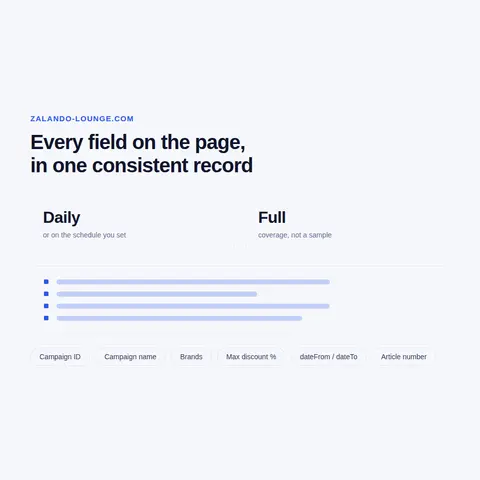
A single snapshot of a flash sale site is close to worthless. The model is built on things disappearing.
Campaigns run for a few days and then vanish, taking their article URLs with them. A crawl that misses the window cannot recover that event later, because there is no archive page to return to. Repeated runs turn the site into a history: which brand ran, when it opened, how deep the reduction went, what was inside it, and when it closed.
Repetition also exposes movement inside a live campaign. Sizes drop out of availability while the sale is still open, and the speed at which they go is a usable read on how a brand and a price point are selling. The public counters move as well: on 2026-08-25 the logged-out German homepage reported filterCounts of 70,214 Damen, 30,261 Herren, 8,985 Mädchen, 5,983 Jungen and 7,378 Wohnen articles, and live campaign counts of 163 on DE, 165 on UK, 162 on FR and 160 on CH. Figures like those only mean anything as a series.
Cross-market divergence needs the same treatment. On one day, campaign ZZO4G5C for COACH showed a maximum discount of -71% on DE, -68% on UK, -71% on FR, -71% on PL and -73% on CH, while the surrounding line-ups differed outright: ALDO, Dickies, Camper and Volcom on the UK site against adidas Performance on the German one. Only repeated rounds show whether that gap is structural or specific to one event.
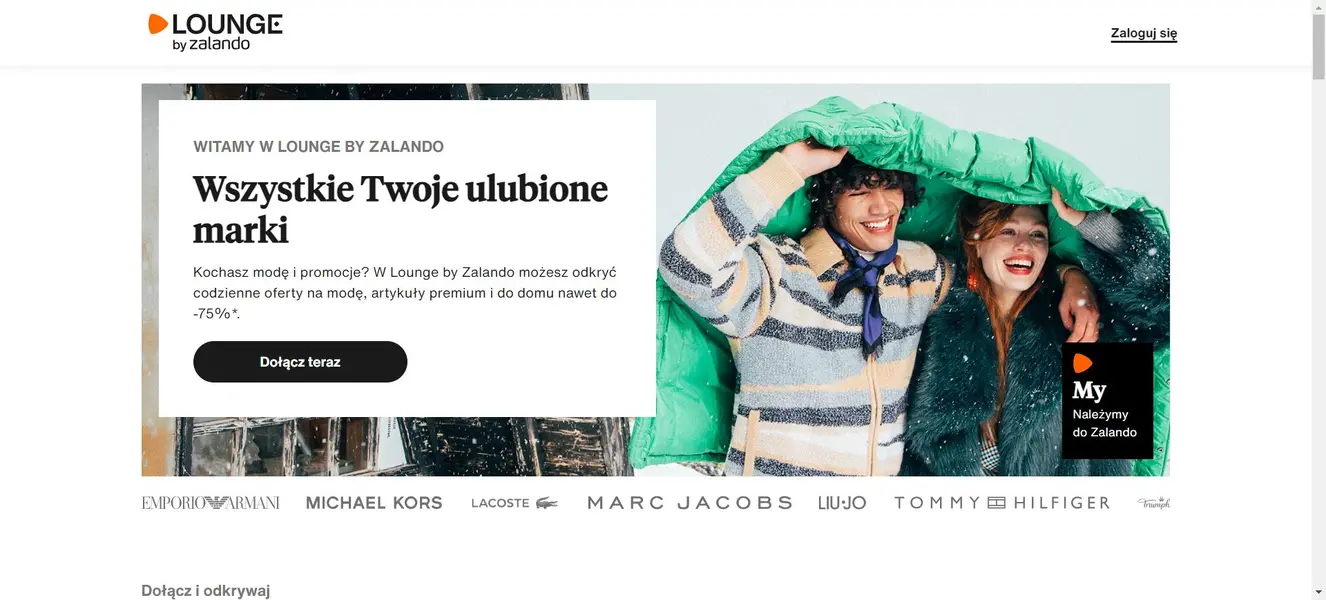
Lounge by Zalando is a members-only flash sale outlet operated by Zalando. The same operation trades under different names by market: zalando-lounge.de in Germany, zalando-lounge.co.uk in the UK, and Privé by Zalando on zalando-prive.fr, .it and .es. www.zalando-lounge.com carries no catalogue and redirects to a /selectcountry chooser.
The unit of the site is a campaign, not a category. Every URL is campaign-first: /campaigns/{campaignId}, /campaigns/{campaignId}/all, /campaigns/{campaignId}/{pageNumber}, /campaigns/{campaignId}/categories/{categoryId}, and the product page /campaigns/{campaignId}/categories/{categoryId}/articles/{articleNumber}. Campaign identifiers are short uppercase codes starting with ZZ - historic six-character ones such as ZZLG9P and current seven-character ones such as ZZO4FU0 - and the same ID is reused across country sites for the same brand event.
Articles are identified by Zalando config SKUs: nine alphanumeric characters, a hyphen, then a three-character colour code, as in EA851M01H-D11. Goods sourced by Lounge itself reuse the campaign prefix instead, so a single campaign (Kampagne in German) mixes main-catalogue SKUs with Lounge-only ones such as ZZO11K317-C00. Inventory is deliberately perishable: each campaign carries UTC dateFrom and dateTo values, observed runs lasted three to five days, and once dateTo passes the campaign and every article URL beneath it are gone.
Rendering is Zalando's Mosaic engine with Octopus A/B assignments injected per request, and Zalando Plus members get early access to campaigns, so the same URL can return different variants and different visible campaign sets depending on bucket and account tier.
Get a Quote
Developers

Customers worldwide

Pages extracted

Hours saved for our clients
€199 / one-time
setup fee - included
€169 / mo
setup fee €499
€229 / mo
setup fee €499
€349 / mo
setup fee €499
€549 / mo
setup fee €799
Delivery: CSV, JSON or XLSX files, our API or a JSON feed. MCP server on request.
Full plan details →Lounge is a separate property from the main Zalando store and from Outlet by Zalando, and it is the one where reductions run as timed events - a Sale, or Kampagne on the German site. Off-price is where surplus inventory becomes visible. When a brand appears in a Lounge campaign at a deep reduction against UVP, that is a public statement about its season, and the campaign line-up is the earliest record of it.
Brand and distribution control. Apparel brands watch when their own articles surface on a shopping club, in which markets, at what price, and whether the reduction against UVP goes past what was agreed with the channel. Because Lounge article numbers are Zalando config SKUs, rows join directly onto main-store catalogue data and onto internal masters keyed on the same SKU.
Competitive pricing. Rival outlets and private sale (ventes privées) operators, and the full-price retailers exposed to them, track which brands run, for how long, and how deep, then position their own clearance against it.
Sourcing and resale. Buyers and marketplace sellers follow campaigns by brand and category to find stock worth acquiring and to price listings against the live off-price floor rather than against RRP.
European market research. Analysts covering apparel read campaign frequency, brand mix and discount depth as a signal of inventory pressure, split across the Damen, Herren, Mädchen, Jungen and Wohnen categories.

Scraping supplement products from iHerb.com with full details, including descriptions and packaging variations.
Learn More
Daily scraping of lowest prices for 150K products on Allegro.pl to support marketplace pricing and margin optimization.
Learn More
Regular monitoring of Ralph Lauren clothing, footwear, and accessories sold across Amazon subdomains: AE, DE, ES, FR, IT, NL, PL, UK.
Learn MoreLearn how to use web scraping to solve data problems for your organization
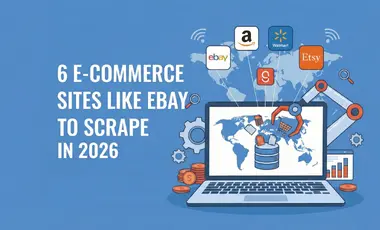
If you sell online, run a marketplace, or advise e-commerce clients, you already know why eBay matters: it’s one of the few places where big retailers compete side by side with thousands of small merchants and private sellers.
E-commerce teams do not just need “some” competitor data anymore. They need a continuous stream of real prices, discounts, stock levels, reviews, and seller behavior from the platforms that actually shape their markets.
Amazon provides valuable information gathered in one place: products, reviews, ratings, exclusive offers, news, etc. So scraping data from Amazon will help solve the problems of the time-consuming process of extracting data from e-commerce.
ScrapeIt is a managed scraping agency. You give us the target and the fields; we build, host and maintain the crawlers, so there is nothing for your team to install or supervise. Members-only European retail is routine work here: in-market egress, real browser sessions, server-rendered hydration blobs, and frontends that get rebuilt without notice. You approve a sample, then the data arrives on schedule.
Yes. Membership is free, but everything past the homepage requires it. Logged out, the site renders only a twelve-item live campaign carousel. We run authenticated sessions with credentials agreed with you, maintain the frsx and frsx_csrf tokens that expire on a one hour Max-Age, carry zcid, Zalando-Client-Id and the isSSOFlow single sign-on path, and hold one session per market so detected_country stays consistent. We collect factual catalogue data only - no account or personal data.
Yes. The ScrapeIt Zalando Lounge API returns campaign IDs, brands, dateFrom and dateTo, article numbers, sale prices against UVP and size availability as JSON from an endpoint we host, refreshed on the schedule you set. The same data also comes as CSV or XLSX files or straight into your database. Akamai fronts the platform, so in-market egress, a genuine browser fingerprint, session continuity and a request rate the site tolerates are part of the service.
Campaign objects carry dateFrom and dateTo in UTC, observed runs lasted three to five days, and once dateTo passes the campaign and its article URLs are gone. Scheduling is therefore built around the calendar, not around a fixed hour: a run at the daily open captures new campaigns and their line-ups while they exist, and repeat runs during the day capture price movement and size availability inside campaigns that are already live. Sizes can be tracked per article across runs, so you see which options sold out and roughly when.
You can have one merged feed, and you should assume the markets differ. There are 24 country sites and 27 hreflang alternates. France, Italy and Spain run on separate zalando-prive domains under the Privé by Zalando brand, Belgium, Switzerland and Luxembourg use language subdomains such as fr.zalando-lounge.be and de.zalando-lounge.lu, and Slovenia is emitted with the non-standard hreflang value si-SI. Each market is its own sales channel with a numeric app_domain, a UUID and exactly one delivery country. The same campaign ID can show a different maximum discount in every market, and the campaign line-up itself differs, so one market cannot be used to infer another. Every row is stamped with its channel.
Yes. We collect publicly listed commercial facts - campaign names, brands, article numbers, prices, reductions against UVP, sizes - and never personal data. We collect only publicly available data - everything a visitor can see on Zalando Lounge - and we collect it legally. Pricing is per project and driven by the number of markets, the refresh frequency and the field set, not by a per-request meter. A scoping call and a sample extract come first, so you see real rows for your markets before committing to a schedule.
Step 1 - Make a Request
You share your needs, expectations, and desired timeframe. We’ll suggest the best solution based on your request and budget.
Step 2 - Configuring Custom Web Crawlers
Our specialists configure the crawlers and extract a sample dataset for your review before proceeding with the full-scale extraction.
Step 3 - Collect and Deliver
Once you approve the sample, we launch the project and start full data collection. We gather, filter, and structure the data for easy use, delivering it on time in your preferred format.
Step 4 - Maintain and Support
Our team manages ongoing processes, monitors website changes, and supports all data extraction cycles. We can also help integrate data into your systems or create dashboards to simplify analysis.
Zalando Lounge data from €169/month. Free project assessment, reply within 1 business day.

Scrapeit Sp. z o.o.
10/208 Legionowa str., 15-099, Bialystok, Poland
NIP: 5423457175
REGON: 523384582