The Entire Iherb Supplements Catalog, Captured End-to-End in 3 Days
Scraping supplement products from iHerb.com with full details, including descriptions and packaging variations.
Learn More
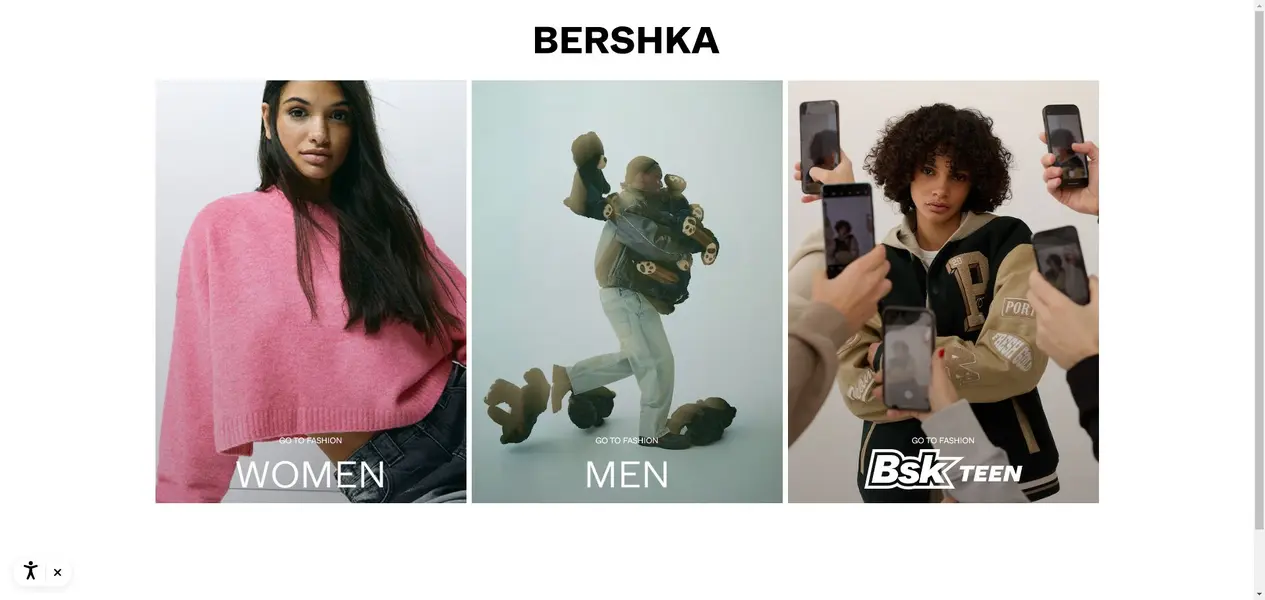
Bershka runs on the Inditex storefront platform, and every product URL ends in -c0p plus a nine digit id. We collect that catalogue for you, market by market.
Plans from €169/month · Free project assessment · Reply within 1 business day
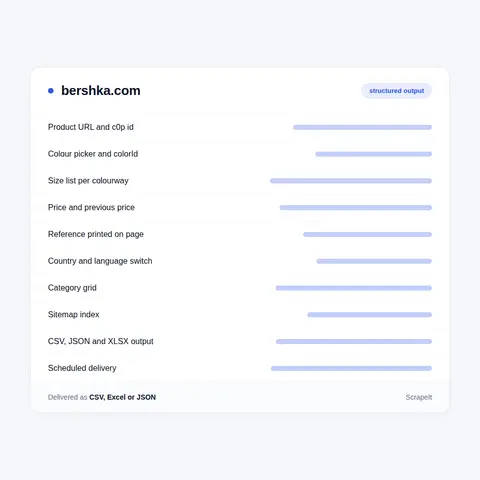
Tell us the markets, the categories and the refresh you need. We build the crawler, run the scraping on a schedule and hand back CSV, JSON, XLSX or an API endpoint with a fixed schema, so your loader does not break between runs. Full catalogue snapshots, a watchlist of ids or a single category feed - the shape follows the job.
We watch the runs, not just the code. When Bershka renames a field, restructures a category or moves a market, we repair the parser and backfill the gap. We collect only publicly available data - everything a visitor can see on Bershka - and we collect it legally. No accounts, no checkout, no personal data.
One Bershka page is a style holding several colourways, and each colourway holds a set of sizes. We flatten that into one row per purchasable combination and keep the parent identifiers so you can roll it back up.
One id, many storefronts. The hreflang block on a product sitemap entry lists the same nine digit id under a translated slug for every market that sells it; the Spanish women sitemap carries 84 distinct locale codes, and the alternate set differs per product rather than being global. Currency, price and size labels come from whichever store you point us at. Products are withdrawn per market, so coverage is not uniform.
Variants expand in two steps. A style holds colourways, each with its own catentry id, its own image set and, in practice, its own fibre mix - the khaki of one wool blend coat is 74% polyester where the navy is 68%. Each colourway then holds sizes, each with a sku and a partnumber. That is where stock lives: per colour and size, never at the style level.
What moves. Price and discount move daily through markdown periods, size level availability moves faster than that, and the collection rotates so ids retire and new ones appear. Reference codes carry a season suffix, I2025 for the autumn and winter drop, which is a clean way to separate carryover from new intake.
Bershka opened in 1998 and sits inside Inditex next to Zara, Pull&Bear, Stradivarius, Massimo Dutti and Oysho. The storefront is one front end served per market: a country segment first, then an optional language segment for secondary languages. Spain is /es/, Catalan is /es/ca/, and the same pattern produces /ae/ar/ for Arabic in the Emirates or /sa/en/ for English in Saudi Arabia.
Product pages carry the identifier in the path. A Bershka product URL ends in -c0p followed by a nine digit number and then.html, as in /es/bermuda-denim-bajo-vuelta-c0p196946479.html. The same page also answers to a category scoped form, -c1010193172p201854844.html, where the digits between c and p are the category the shopper came through. That variant carries a canonical link back to the c0p form, so both resolve to one page and one row in your file.
That grammar is Bershka's own. Pull&Bear, Stradivarius, Oysho and Massimo Dutti end product URLs in -l plus an eight digit reference with no.html at all. Zara uses -p plus a reference and always carries a language segment. The brands share an Inditex front end and sitemap conventions, but a crawler written for a sibling site has to be rewritten before it will scrape Bershka.
Get a Quote
Developers

Customers worldwide

Pages extracted

Hours saved for our clients
€199 / one-time
setup fee - included
€169 / mo
setup fee €499
€229 / mo
setup fee €499
€349 / mo
setup fee €499
€549 / mo
setup fee €799
Delivery: CSV, JSON or XLSX files, our API or a JSON feed. MCP server on request.
Full plan details →Bershka prices young fashion at high turnover, which makes it the reference merchandising and pricing teams check first. Three uses come up again and again.
Price and markdown tracking. A daily Bershka price series shows when a style moves from full price to reduced, how deep the cut goes and whether it holds. The previous price and the discount percentage sit in the same record, so the markdown ladder is readable without rebuilding it from history. In Spain the January and July rebajas (sale periods) reprice a large part of the catalogue at once, and a weekly cadence will miss the first cut.
Assortment work. The product sitemaps split into men and women, and the taxonomy carries numeric family and subFamily codes, so you can measure how a buying team weights denim against knitwear, how wide the size curve runs and how many colourways a style ships in.
Sell through signal. Sizes going unbuyable inside a colourway is the closest public proxy for what is selling. Tracked daily, the pattern separates the shapes that clear from the ones that sit until markdown.

Scraping supplement products from iHerb.com with full details, including descriptions and packaging variations.
Learn More
Daily scraping of lowest prices for 150K products on Allegro.pl to support marketplace pricing and margin optimization.
Learn More
Regular monitoring of Ralph Lauren clothing, footwear, and accessories sold across Amazon subdomains: AE, DE, ES, FR, IT, NL, PL, UK.
Learn MoreLearn how to use web scraping to solve data problems for your organization
If you sell online, run a marketplace, or advise e-commerce clients, you already know why eBay matters: it’s one of the few places where big retailers compete side by side with thousands of small merchants and private sellers.

E-commerce teams do not just need “some” competitor data anymore. They need a continuous stream of real prices, discounts, stock levels, reviews, and seller behavior from the platforms that actually shape their markets.
Amazon provides valuable information gathered in one place: products, reviews, ratings, exclusive offers, news, etc. So scraping data from Amazon will help solve the problems of the time-consuming process of extracting data from e-commerce.
ScrapeIt is a managed web scraping agency. We are not selling a library or a proxy pool. We take the requirement, build the crawler, run it on your schedule and stay responsible for what lands in your file. Retail catalogue extraction is most of what we do, so the awkward parts of a site built like this one are familiar ground.
Start with a sample. Send a handful of Bershka URLs or name a category and the markets, and we return a filled file so you can check every field against the site before anything is signed.
Yes. The ScrapeIt Bershka API returns the nine digit id, the partnumber, colour, size, current and previous price and buyability per size as JSON from an endpoint we host, refreshed on the schedule you set. The same data also comes as CSV or XLSX files or straight into your database, keyed on country plus id.
Yes. The nine digit id in the URL resolves in every market that sells the product, so we crawl the same id per market and key each row on country plus id. Price, currency, discount and size labels come from that market's store, and the slug is translated while the id stays fixed. Coverage is not universal: products are withdrawn per market, so we report the markets a given id actually resolves in rather than assuming a full grid.
Yes. Each row is one colour and size combination, with the sku, the partnumber, the size label, the price and whether it is buyable. Stock never sits at the style level on Bershka, only per colour and size. Worth knowing: the size list in the server rendered HTML arrives with stock marked unknown, so a scraper that only parses the first response reports nothing useful about availability. Those values have to be resolved per market, which is part of what we run.
That is your choice and it is set in the contract, not left to a default. Daily is the usual cadence for price and availability. A watchlist of ids can run more often; a full catalogue snapshot across many markets usually runs weekly. Match the cadence to what you are watching: price and discount are worth a daily series, size level availability moves faster, and category composition can be sampled weekly without losing the trend.
Two reasons. First, bershka.com sits behind Akamai bot management: the first response is a small verification page with a redirect rather than the product, so that check has to be cleared before any product data appears. Second, category pages ship no product URLs in their server HTML at all; the grid is fetched client side after load. Anti-bot handling, proxy rotation and rendering are part of the service, and where a page will not serve we report the gap instead of guessing at it.
Step 1 - Make a Request
You share your needs, expectations, and desired timeframe. We’ll suggest the best solution based on your request and budget.
Step 2 - Configuring Custom Web Crawlers
Our specialists configure the crawlers and extract a sample dataset for your review before proceeding with the full-scale extraction.
Step 3 - Collect and Deliver
Once you approve the sample, we launch the project and start full data collection. We gather, filter, and structure the data for easy use, delivering it on time in your preferred format.
Step 4 - Maintain and Support
Our team manages ongoing processes, monitors website changes, and supports all data extraction cycles. We can also help integrate data into your systems or create dashboards to simplify analysis.
Bershka data from €169/month. Free project assessment, reply within 1 business day.

Scrapeit Sp. z o.o.
10/208 Legionowa str., 15-099, Bialystok, Poland
NIP: 5423457175
REGON: 523384582