Amazon, Walmart and CVS Price Monitoring for 3,800 SKUs, Matched Weekly
A US health and personal care retailer gets weekly prices for its 3,800 SKUs on Amazon, Walmart and CVS, matched to the exact product and pack size.
Learn More
Every CVS Pharmacy price hangs on a store id, a price zone and a ZIP code. We pull the catalog with the pharmacy attached, so each row means something on the shelf you actually sell against.
Plans from €169/month · Free project assessment · Reply within 1 business day
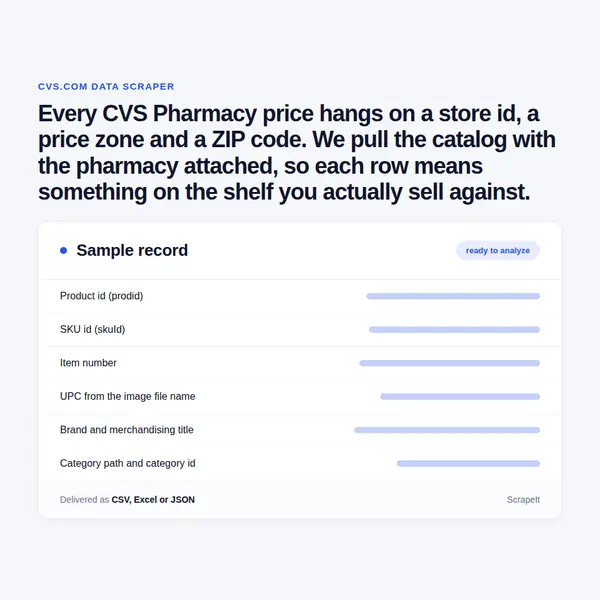
A CVS Pharmacy scraping project starts with two answers. Which locations should price and stock be resolved against - one pharmacy, a metro panel, or a national grid named by store number or ZIP. And which layer you want in each row: the parent product, or every SKU with its own pack size, per-unit price and stock line.
Scope follows from there: a whole department, a category subtree, a facet cut such as brand, key ingredient or dosage form, a deal page keyed by ad block id, the store and clinic network, or a watchlist of product ids, SKU ids and UPCs you already hold. Cvs.com screens automated traffic at the edge and is unavailable outside the United States, so anti-bot handling, proxy rotation and CAPTCHA solving are part of the service rather than a surcharge. Delivery is CSV, JSON, XLSX, a database drop or an API of your own, on a schedule, with the store id and the source URL stamped on every row.
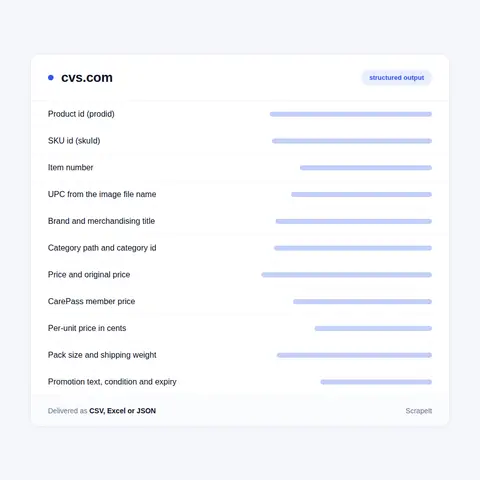
A CVS Pharmacy product record keeps the product and the SKU apart and publishes both. The parent object holds the product id, a handle, the display title, breadcrumbs carrying their own category ids, an image list, the option axes on offer - Strength, Count, Group Size - and a price block with the current value, the original price, the lowest and highest price across variants and a per-unit price range. Under it sit the variants, and the variant is where a CVS Pharmacy data extract does its real work.
Identity and packaging. Every variant carries its own SKU id, the brand, a merchandising title, the option values that define it, and a size block holding the pack size as the shelf writes it plus the shipping weight in pounds. A summary line repeats size, weight and the Item number in one string. Image file names are the item UPC, with numbered suffixes for the extra angles, so a CVS Pharmacy price feed joins a vendor catalog on UPC without a lookup table.
Money and offers. Price and original price sit on the variant beside a per-unit figure written the way the shelf writes it, in cents per unit, and a CarePass member price rides alongside with its own range at product level. Promotions arrive in the merchant's own words - Sale, Buy 1 Get 1 Free, Buy 1 Get 1 40% Off - with the qualifying condition, an expiry timestamp, a promotion id and the ad block id that names the deal page the offer lives on. Three coupon arrays hang off a single item: CVS store coupons with campaign and coupon numbers, manufacturer coupons with a redemption cap, and ExtraBucks Rewards entries carrying the reward amount and the wording of the offer.
Stock, rules and evidence. Availability arrives as a plain in stock or out of stock. Flags mark retail only and web only items, in-store pickup, same-day delivery, two-day and free shipping, SNAP eligibility, HSA and FSA eligibility, OTC benefit eligibility, and the pseudoephedrine indicator that forces a state eligibility check and an identity verification before checkout. Beside them sit the maximum order quantity, a store-brand flag, the rating and the review count, an attribute table of concern and value, and description, directions, ingredients and warnings held twice, once as paragraphs and once as bullet lists.

Store pages are a dataset of their own. A page lives at /store-locator/ plus a city and state slug, the street address with its ZIP, and storeid= with the store number. It prints the store id, address and phone, today's hours split between Store and Photo on one line and Pharmacy on another, the lunch window when the counter closes, a seven-day table of store hours and a second one for pharmacy hours, and nearby locations with their distance in miles.
Below that sits the in-store services list, and that is the attribute set worth extracting: COVID-19 vaccine, flu shots, COVID-19 testing, immunizations, in-store pickup, pharmacy drive thru, Rx delivery, photo, UPS access point, ATM inside, OTC Health Solutions and SNAP acceptance. The locator republishes those attributes as browsable indexes: a state and city page for every trading area, then city pages for drive-thru pharmacies, 24-hour pharmacies, flu shots, COVID vaccine, photo printing, greeting cards, medication disposal and UPS access points.
MinuteClinic runs a parallel tree: a clinic locator by state and city, a service catalog from sports and DOT physicals to travel health, and a posted out-of-pocket price list for the services it does not bill to insurance. On the merchandise side, CVS own brands are a heavy slice of the assortment and carry a store-brand flag in the record - CVS Health, Gold Emblem, Total Home, Well Market, Beauty 360, Live Better and Just the Basics - which makes private label share measurable per category. A brand directory, thematic /shop/content/ landing pages, an FSA shop and photo services round out what is open.
CVS Pharmacy is the retail storefront of CVS Health, and its size sets the shape of any CVS Pharmacy scraper. The company reported approximately 9,000 retail locations and more than 800 MinuteClinic sites at the close of 2025, counting pharmacy counters inside Target and Schnucks stores among them. Everything a shopper can price lives on cvs.com, and the storefront is served only to visitors inside the United States and its territories.
The addressing reads cleanly once you know it. A product page sits at /shop/ plus a readable slug ending in -prodid- and a numeric product id; append a skuId parameter and the same address resolves to one variant. Category pages stack a path under /shop/ up to four levels deep - health-medicine, then allergy-sinus, then allergy-medicine - and every category also owns an internal id that the listing request actually queries. Filters never become query strings: they append /q/ plus the value and a two-letter facet code, so a brand cut ends in /br, a color in /pc, an active ingredient in /ki, a dosage form in /fm and a fulfillment choice in /pd.
The sitemap index states what is published: separate files for products, product SKUs, review pages, ingredient pages and product images, plus category files, a filtered-category file, store locations, store detail pages, MinuteClinic, the drug information directory and thematic landing pages under /shop/content/. Merchandise splits across twelve departments, from Health and Medicine, Vitamins and Personal Care to Home Health Care, Sexual Wellness and Seasonal Shops. Every product address carries an hreflang pair, the English page on www.cvs.com and a Spanish twin on es.cvs.com.
Get a Quote
Developers

Customers worldwide

Pages extracted

Hours saved for our clients
€199 / one-time
setup fee - included
€169 / mo
setup fee €499
€229 / mo
setup fee €499
€349 / mo
setup fee €499
€549 / mo
setup fee €799
Delivery: CSV, JSON or XLSX files, our API or a JSON feed. MCP server on request.
Full plan details →One habit separates a usable CVS Pharmacy price feed from a decorative one: naming the store. A listing response from cvs.com carries a price zone id and a store id of its own, next to the page number and the result total, so money is resolved against a location instead of being published as a catalog attribute. Run CVS price monitoring against one default location and you have described a single zone and misstated the rest.
Fulfillment is keyed the same way. Every store page offers a search for products available for pickup at that pharmacy, and category listings carry a fulfillment facet, so the same category reads either as the full online assortment or as what one location actually holds. Items flagged retail only never reach a shipping basket at all, and same-day delivery is quoted against the store an address maps to, with a cut-off tied to that store's closing time and a separate rule for pharmacies that trade around the clock.
Offers move locally too. ExtraBucks Rewards, store coupons and manufacturer coupons attach to the item, expire on their own timestamps and turn over weekly, and the circular is presented as myWeekly Ad against the store a shopper has set. Deal pages are addressed by ad block id, the same id the product record carries, so a promotion can be joined to the items it covers rather than guessed at. A CVS Pharmacy scraper that drops the store id returns a national average nobody actually pays.
A US health and personal care retailer gets weekly prices for its 3,800 SKUs on Amazon, Walmart and CVS, matched to the exact product and pack size.
Learn More
About 1.9 million auto parts listings from eBay.de with brand, OEM, EAN and fitment, plus titles and specs machine-translated for the client's team.
Learn More
A one-off Takealot product list for an entrepreneur choosing niches: only products rated 4 stars or higher with at least 50 reviews.
Learn MoreLearn how to use web scraping to solve data problems for your organization
If you sell online, run a marketplace, or advise e-commerce clients, you already know why eBay matters: it’s one of the few places where big retailers compete side by side with thousands of small merchants and private sellers.
E-commerce teams do not just need “some” competitor data anymore. They need a continuous stream of real prices, discounts, stock levels, reviews, and seller behavior from the platforms that actually shape their markets.
Amazon provides valuable information gathered in one place: products, reviews, ratings, exclusive offers, news, etc. So scraping data from Amazon will help solve the problems of the time-consuming process of extracting data from e-commerce.
ScrapeIt takes the whole job as a managed service. We design the crawler, run it to your schedule, watch it, and repair it when the site changes shape. Your side receives files or an endpoint and keeps no scraping engineers of its own.
We are not affiliated with CVS Health. We collect only publicly available data - everything a visitor can see on CVS Pharmacy - and we collect it legally. Prescription medicines and anything attached to a person's health - patient records, prescriptions, insurance - sit outside our scope entirely, and reviewer nicknames are left out by default.
Yes. The ScrapeIt CVS Pharmacy API returns product and SKU ids, the UPC, store price, per-unit price, ExtraCare coupons and stock state as JSON from an endpoint we host, refreshed on the schedule you set. We build it on what is genuinely public - the sitemaps, category listings, product and SKU pages, deal pages and store pages - and hand it over as a documented endpoint with a stable schema. The same data also comes as CSV or XLSX files or straight into your database.
Yes, and that is the normal way we run it. You nominate pharmacies by store number or by ZIP - a handful, a metro panel or a national spread - and every row carries the store it was resolved against beside the price, the per-unit price, the availability state and the fulfillment routes offered there. We hold your panel fixed so a series stays comparable week over week. Adding stores multiplies volume rather than fields, so panel size is a budget decision as much as a data one.
The identifiers first - product id, SKU id, Item number and the UPC that names the image file - then brand, title, category path with category ids, canonical URL, pack size and shipping weight, price, original price, per-unit price and CarePass price, promotion text with its expiry and ad block id, coupon and ExtraBucks entries, stock state, order limits, ratings and review counts, and the ingredients, directions and warnings blocks. Join on UPC for retail comparison, on brand plus pack size against a vendor catalog, and on the product id when you need a CVS key that survives a title rewrite or a category move.
Cadence follows the question. Daily or intraday for price and stock monitoring on a defined watchlist; weekly for promotions, coupons and ExtraBucks sweeps, which turn over on the ad cycle; monthly for full assortment, ingredient and new-item audits; quarterly for the store and clinic network, which moves slowly. Delivery is CSV, JSON, XLSX, a database drop or an endpoint we host, with a fixed schema, a run timestamp and the store id on every row, so two runs can be diffed without guesswork.
Yes. We collect only publicly available data - everything a visitor can see on CVS Pharmacy, from product and SKU pages, prices, promotions and coupons to stock and store pages - and we collect it legally. Nothing behind a login is touched, so account pricing, order history and saved lists are out of scope. Prescription medicines, patient records, insurance details and any other health information about a person are never collected; reviews keep the rating, the count and the text, and reviewer nicknames are dropped by default.
Step 1 - Make a Request
You share your needs, expectations, and desired timeframe. We’ll suggest the best solution based on your request and budget.
Step 2 - Configuring Custom Web Crawlers
Our specialists configure the crawlers and extract a sample dataset for your review before proceeding with the full-scale extraction.
Step 3 - Collect and Deliver
Once you approve the sample, we launch the project and start full data collection. We gather, filter, and structure the data for easy use, delivering it on time in your preferred format.
Step 4 - Maintain and Support
Our team manages ongoing processes, monitors website changes, and supports all data extraction cycles. We can also help integrate data into your systems or create dashboards to simplify analysis.
CVS Pharmacy data from €169/month. Free project assessment, reply within 1 business day.

Scrapeit Sp. z o.o.
10/208 Legionowa str., 15-099, Bialystok, Poland
KRS: 0000996672
NIP: 5423457175
REGON: 523384582