eBay Data: 1.9M Auto Parts Listings from eBay.de, Specs Translated
About 1.9 million auto parts listings from eBay.de with brand, OEM, EAN and fitment, plus titles and specs machine-translated for the client's team.
Learn More
Every KaTom listing prints two identifiers - its own KaTom number and the manufacturer part number - and the second one is what lets a single machine be priced across two suppliers.
Plans from €169/month · Free project assessment · Reply within 1 business day
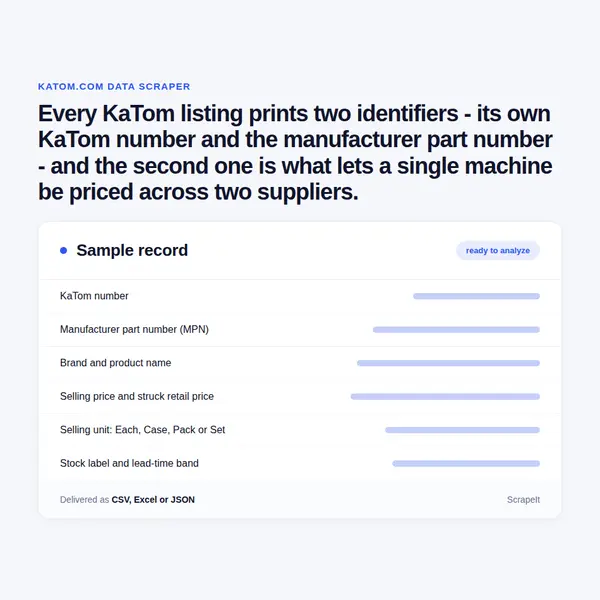
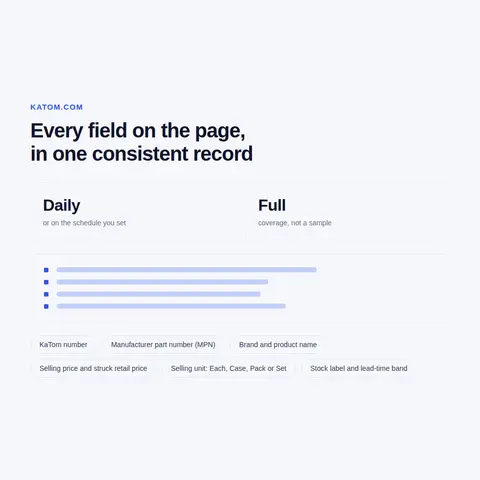
A KaTom scraping project starts with scope: a department, a list of leaf categories, a vendor list, a set of KaTom numbers, or a list of manufacturer part numbers you already hold and want priced here. Delivery is CSV, JSON, XLSX, a database drop or an endpoint of ours, on your schedule. Selling price, retail price, stock label and lead-time band are the volatile columns and usually run daily or weekly; spec tables, documents and equivalence lists move slowly, so a monthly pass covers them.
The engineering is ours. The storefront sits behind bot protection, so anti-bot handling, proxy rotation and CAPTCHA solving are part of the managed service, run at a polite rate rather than a brute-force one. Coverage is assembled from the sitemap set and the category tree instead of paging blindly until a listing comes back empty. We read only what a signed-out visitor sees, we do not log in, and we do not collect personal data.
Two identifiers on every row, and only one of them travels. A listing prints the KaTom number beside the manufacturer part number - KaTom #: 598-TUC48F, MPN: TUC-48F-HC - and the structured data repeats both as sku and mpn with the brand and category path. The KaTom number is not reversible: a three-digit vendor prefix plus a model code squeezed inconsistently, so Comark EFG120C becomes 113-EFG120C while plenty of items keep a number their model does not predict. Match KaTom price data to a rival catalog on the published MPN, not on the address.
The manufacturer number carries the configuration. Voltage and fuel are separate records, and the MPN says so: a Duke convection oven reads E101-E 240/1 with a second record at 208 volts, and a Vulcan range reads VC44GD NG for natural gas. Join on the bare model and you merge two machines that cannot be wired into the same room.
Equipment rows point at their own substitutes. An Equivalent Items block names competing models by brand - a True undercounter freezer lists Turbo Air MUF-48-N, Delfield 4548NP and Arctic Air AUC48F - and a Compare to Similar Items table sets them side by side on price, shipping, lead time, warranty and size. Where a model trades under other codes, an Also Known As row spells them out, rival distributor prefixes included.
Price is two numbers and a unit. Discounted equipment shows a struck Retail Price above the selling price, so discount depth is computable, and every figure is quoted against a unit: /Each for machines, /Case of 200 or /Case of 500 for disposables, /Set of 4 for caster kits. Beside it sit a monthly financing figure, a card cashback amount, an extended protection plan priced on its own, and add-on options such as a gas connector kit.
Stock and lead time are graded, not binary. A row reads IN STOCK: Ships in 1 Business Day, QUICK SHIP: Typically ships in 1 - 3 Business Days, or a manufacturer band such as 4 - 6 weeks, with depth shown as 5+ in Stock or Less Than 5 in Stock. Then the spec table, typed per category: Voltage, Phase, Hertz, NEMA plug, Total BTU, Gas Type of NG, LP or Convertible, Refrigerant, Cubic Feet, Sections, Pans Per Deck, Door Type, Width, Depth, Height, Weight, Series, Certifications, Warranty term and a Good, Better, Best or Spec grade.
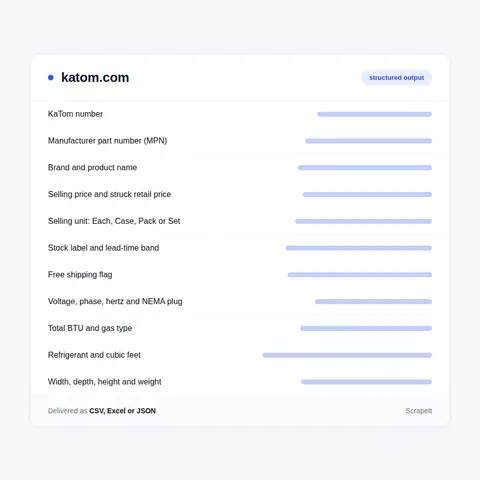
Documents hang off the item and are named after it. The Documents block links a spec sheet, warranty statement, installation guide, user manual, service manual, parts breakdown and brochure, each under a path built from the vendor prefix and item code, so the document set is predictable from the identifier. Equipment also carries a residential-use notice voiding the manufacturer warranty outside a commercial kitchen, and a California Proposition 65 warning where one applies.
Freight is a data field here, not a footnote. Anything past 150 pounds or 108 inches leaves on an LTL carrier; liftgate service is required where there is no loading dock and covers items over 75 pounds; the site zones the delivery address as commercial or residential itself, and a home-run business counts as residential. Free shipping covers the 48 contiguous states and excludes inside delivery, white glove and liftgate. Returns run 30 days with a 25 percent restocking fee, special orders and most furniture are excluded, and parts cannot be returned.
Around the catalog sit records that are not retail at all. A Design + Build practice quotes whole kitchens from drawings in Revit for hotels, casinos, hospitals, colleges and correctional facilities, with case studies naming the venues. A government services page prints the GSA contract number, CAGE code and NAICS list. Roughly 1,700 learning center articles name brands and models, and vendor review hubs aggregate ratings per manufacturer. Those reviews are signed with buyer names, so personal data stays out of the export by default.
KaTom Restaurant Supply is a Tennessee wholesaler of commercial kitchen equipment and supplies, selling to restaurants, bars, hotels, casinos, schools, hospitals, correctional kitchens, nursing homes and concession operators from about 350,000 square feet of warehouse and distribution space. Its address scheme tells you what kind of catalog this is. A product sits at a bare file name built from a three-digit vendor prefix and a squeezed model code - /598-TUC48F.html is the True TUC-48F-HC undercounter freezer - with no category path and no numeric record id in the URL. The product sitemaps carry roughly 143,000 of those addresses across fifteen files (September 2026).
The tree above them is slug-only: a leaf sits at /cat/undercounter-freezers.html, and roughly 1,560 category pages are published. A second layer of about 2,050 alias categories under /cat/a/ points search phrases at the same stock, and 66 editorial best-of pages sit under /cat/best/. Brands get their own hub - 486 vendor pages under /vendor/, each with a star rating, plus 288 brand review pages - and 549 city pages under /location/ publish a local top-seller list with live prices on it.
Ten departments run across the top: Restaurant Equipment, Commercial Refrigeration, Ice Makers, Smallwares, Tabletop, Cleaning and Janitorial, Restaurant Furniture, Disposables and Consumables, Storage and Transport, and a Business Type entry that regroups the same stock by operation, from food trucks and juice bars to correctional and movie theatre kitchens. Listings serve 50 items per page behind ?page=N and go quiet past the last page. Facets are chosen per category and each option shows its own count, so a KaTom scraper reads the filter set at every leaf instead of assuming one schema for the catalog.
Get a Quote
Developers

Customers worldwide

Pages extracted

Hours saved for our clients
€199 / one-time
setup fee - included
€169 / mo
setup fee €499
€229 / mo
setup fee €499
€349 / mo
setup fee €499
€549 / mo
setup fee €799
Delivery: CSV, JSON or XLSX files, our API or a JSON feed. MCP server on request.
Full plan details →The reason to scrape KaTom is arithmetic that only works with two suppliers in one table. Commercial kitchen equipment is built by a short list of manufacturers and resold through many distributors under different house numbers, and the model code is the only constant across them. Because the manufacturer part number is published on every item, a KaTom scraper hands you the key that joins this catalog to a competitor feed and prices the same True, Vulcan, Hobart, Manitowoc or Scotsman unit on both sides.
KaTom treats cross-supplier price as an operating fact of its own. Its price match request asks the buyer for the competing figure and the address where it was seen, and the promise is limited to an item identical in brand, model, color, size and specification, in stock, from an authorized United States dealer. Wholesale price monitoring at catalog scale is the same check the sales counter runs by hand.
Manufacturers read the feed from the other end. With 486 vendor hubs and a rating on each brand, a maker can see which of its models are listed, what they sit beside in an equivalence block, and whether resale prices hold. Distributors use KaTom product data as a reference line for assortment gaps.
Institutional buying turns on fields that decide eligibility rather than taste. KaTom holds a GSA schedule and answers public bids, so its records carry what a specification has to satisfy - certification marks, ADA compliance, energy rating, USA-made status, warranty term - and those are the columns a bid response is scored on.

About 1.9 million auto parts listings from eBay.de with brand, OEM, EAN and fitment, plus titles and specs machine-translated for the client's team.
Learn More
A one-off Takealot product list for an entrepreneur choosing niches: only products rated 4 stars or higher with at least 50 reviews.
Learn More
Trendyol product data for an e-commerce startup reselling Turkish fashion: 27 categories in JSON on FTP, with in-stock status for every size.
Learn MoreLearn how to use web scraping to solve data problems for your organization
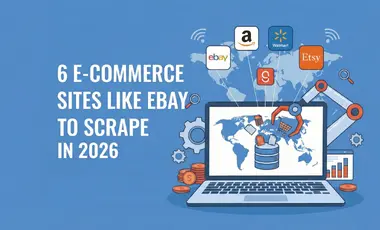
If you sell online, run a marketplace, or advise e-commerce clients, you already know why eBay matters: it’s one of the few places where big retailers compete side by side with thousands of small merchants and private sellers.

E-commerce teams do not just need “some” competitor data anymore. They need a continuous stream of real prices, discounts, stock levels, reviews, and seller behavior from the platforms that actually shape their markets.
Amazon provides valuable information gathered in one place: products, reviews, ratings, exclusive offers, news, etc. So scraping data from Amazon will help solve the problems of the time-consuming process of extracting data from e-commerce.
ScrapeIt is a managed web scraping agency with no affiliation with KaTom Restaurant Supply, Inc. We scope the job, build the crawler, run it on your schedule, watch it when the site changes and repair it before you have to report it. We collect only publicly available data - everything a visitor can see on KaTom - and we collect it legally. Start with one department, check the manufacturer numbers against your own catalog, then scale to the coverage you need.
Yes. The ScrapeIt KaTom API returns names, KaTom numbers and MPNs, selling and struck retail prices, stock and lead-time labels, and spec tables as JSON from an endpoint we host, refreshed on the schedule you set. The same data also comes as CSV or XLSX files or straight into your database.
Yes, and it is the usual reason people ask. Every item publishes the manufacturer part number, so the join runs on brand plus MPN rather than on product titles. We normalize the brand, strip punctuation and configuration suffixes such as NG, LP or a voltage tag, and keep the raw value beside the cleaned key so nothing is lost. Where a listing carries an Also Known As row of alternate model codes, or an Equivalent Items list of competing models, we keep those as their own edge table so substitutes can be priced too.
Equipment rows carry the utility attributes: voltage, phase, hertz, NEMA plug type, amperage, total BTU and gas type of natural, liquid propane or convertible. They also carry refrigerant, capacity in cubic feet, section and door counts, exterior width, depth, height, shipping weight, series name, certification marks, warranty term and a Good, Better, Best or Spec grade. Smallwares and disposables trade those for material, color, capacity, pack size and flags such as BPA free, compostable, freezer safe or dishwasher safe.
As often as the question needs. Selling price, retail price, stock label and lead-time band are the moving columns and normally run daily or weekly against a fixed list of items so the series stays comparable. Category membership, spec tables, documents and equivalence blocks change slowly, and a monthly or quarterly pass is enough for them. Delivery is CSV, JSON, XLSX, a database drop or an endpoint we host, and we can push only changed rows if you would rather not diff a whole catalog each time.
Yes. Prices, manufacturer part numbers, spec tables, stock labels and lead times are shown to any visitor. We work only on pages a signed-out visitor can reach, we do not log in and we do not gather personal data. We collect only publicly available data - everything a visitor can see on KaTom - and we collect it legally.
Step 1 - Make a Request
You share your needs, expectations, and desired timeframe. We’ll suggest the best solution based on your request and budget.
Step 2 - Configuring Custom Web Crawlers
Our specialists configure the crawlers and extract a sample dataset for your review before proceeding with the full-scale extraction.
Step 3 - Collect and Deliver
Once you approve the sample, we launch the project and start full data collection. We gather, filter, and structure the data for easy use, delivering it on time in your preferred format.
Step 4 - Maintain and Support
Our team manages ongoing processes, monitors website changes, and supports all data extraction cycles. We can also help integrate data into your systems or create dashboards to simplify analysis.
KaTom Restaurant Supply data from €169/month. Free project assessment, reply within 1 business day.

Scrapeit Sp. z o.o.
10/208 Legionowa str., 15-099, Bialystok, Poland
KRS: 0000996672
NIP: 5423457175
REGON: 523384582