Beauty Price Monitoring on Notino and Douglas in 15+ Countries, in English
A cosmetics company got monthly prices and promotions from 40+ beauty stores in 15+ countries, translated to English and fed into its existing import.
Learn More
A Depop listing shows how many people have it in their bag and how many offers it has drawn. Our Depop scraper records that demand with brand, size, condition and price.
Plans from €169/month · Free project assessment · Reply within 1 business day
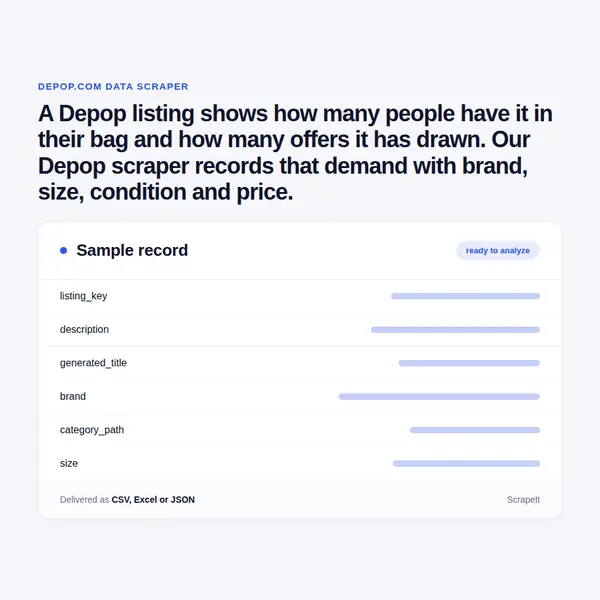
You name the slice of Depop you need - brands, departments and item types such as women's jeans or men's tops, search terms, sizes, conditions, price bands, one market or several - and the cadence. We build the crawler, run it and keep it working when Depop reshapes its pages. Listing details and the demand counters render with scripts, and the site screens automated visitors, so browser rendering, pacing, proxy rotation and CAPTCHA handling come with the service.
We never log in, so nothing from inside an account reaches the data. Usernames stay out of the files by default; a business seller trading under a shop name can be named when it is the subject. Files arrive as CSV, XLSX, JSON or XML, via our API, Dropbox, Google Drive or e-mail.
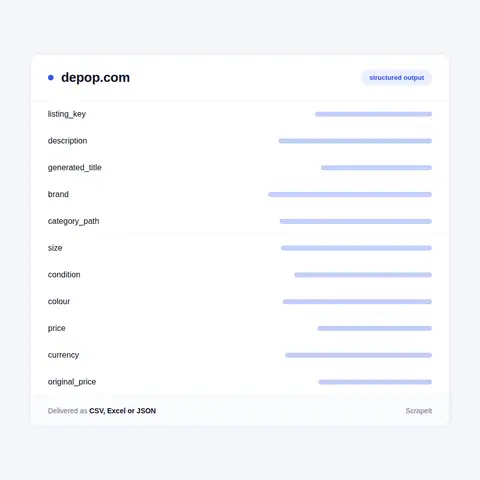
Depop builds each listing address under /products/ from a form of the seller's username, a slug of the title and a short code. Our Depop scraper keeps the slug and code as the listing key and drops the username by default. Each row describes one item the way a visitor sees it:
Search pages give brand, size and price for every card plus a result count, so a market scan can start broad and open listing pages only where condition, colour and the demand counters are needed.
Every Depop item is a single piece, and once it sells it cannot be bought again, so the useful data is built over time:
Seller reviews, usernames and profile pages mostly describe private people, so they stay out of the files by default.
Depop is a peer-to-peer marketplace for preloved and vintage fashion, founded in 2011 and based in London. It now belongs to eBay, which bought it from Etsy, and it has kept its name and its own site. The home page counts tens of millions of items for sale and more than a million new listings a day, most of them one-off pieces.
The catalogue is organised by department - Women, Men, Kids - then by group and item type, with Brands, Sports, Trending and Sale as entry points, Shop by style edits such as Detroit jackets or Lightweight knits, and Shop by price pages. A listing is written by the seller: free text, often thick with hashtags, plus structured brand, size, colour and condition. Depop adds its own layer on top - a standardised title, Buyer Protection on every purchase made through the site, and the choice to buy at the asking price or make an offer.
Prices shift with the viewer. The headline figure leaves shipping out and, for a buyer in another country, can already include import tax, so the same listing can show different figures to visitors in different countries. Results and recommendation rows also mix listings priced in different currencies.
Get a Quote
Developers

Customers worldwide

Pages extracted

Hours saved for our clients
€199 / one-time
setup fee - included
€169 / mo
setup fee €499
€229 / mo
setup fee €499
€349 / mo
setup fee €499
€549 / mo
setup fee €799
Delivery: CSV, JSON or XLSX files, our API or a JSON feed. MCP server on request.
Full plan details →Depop is trend-led, and its listings show interest before a sale happens. That makes it an early read on resale prices and on which styles are rising.

A cosmetics company got monthly prices and promotions from 40+ beauty stores in 15+ countries, translated to English and fed into its existing import.
Learn More
A consultancy working for a fragrance brand owner got sellers, official-store flags and USD prices for 25 fragrances on about 30 marketplaces in 12 countries.
Learn More
Three Amazon US lighting categories collected in full for a lighting manufacturer, with description text and images from brand content blocks.
Learn MoreLearn how to use web scraping to solve data problems for your organization
If you sell online, run a marketplace, or advise e-commerce clients, you already know why eBay matters: it’s one of the few places where big retailers compete side by side with thousands of small merchants and private sellers.

E-commerce teams do not just need “some” competitor data anymore. They need a continuous stream of real prices, discounts, stock levels, reviews, and seller behavior from the platforms that actually shape their markets.
Amazon provides valuable information gathered in one place: products, reviews, ratings, exclusive offers, news, etc. So scraping data from Amazon will help solve the problems of the time-consuming process of extracting data from e-commerce.
ScrapeIt runs web scraping as a managed service: we design the crawl, keep it running and send the files. Resale marketplaces are a regular kind of source for us, with one-off items, fast sell-through and prices that differ by viewer. We assess each project for free, a sample can be ordered first, and personal data is handled under GDPR - usernames, seller reviews and profile photos are dropped unless a business seller is the subject. Plans start from EUR 169 a month, or EUR 199 for a one-time extract.
Yes. The ScrapeIt Depop API delivers the listing key, brand, size, condition, headline price with currency, and the likes and offers-sent counts as JSON from an endpoint we host, on the refresh schedule you pick. The same records also come as CSV or XLSX files, a JSON feed or straight into your database. An MCP server is available on request.
Yes. Listings, prices, sizes, conditions and search results on Depop are shown to anyone who opens the site, with no account needed. We collect only publicly available data - all of it visible to an ordinary Depop visitor - and we collect it legally. Usernames and seller reviews are left out by default.
Yes, by revisiting listings. A sold item can no longer be bought and its page switches to a sold notice, so one crawl cannot see the sale happen. We re-read the listings in your scope on a schedule, record the run in which each one turns sold or disappears, and keep its last asking price, condition and demand counters.
Not in the headline figure. The price on a card or listing page leaves shipping out; shipping is a separate amount. For a buyer in another country the headline figure can already include import tax, so we keep the price as displayed, its currency and the market it was read from in separate columns.
No. Depop shows prices in more than one currency, and a single results page or recommendation row can mix US dollars, euros and other currencies. We store the currency code beside every price and can deliver each market as its own file or one table with a market column.
Step 1 - Make a Request
You share your needs, expectations, and desired timeframe. We’ll suggest the best solution based on your request and budget.
Step 2 - Configuring Custom Web Crawlers
Our specialists configure the crawlers and extract a sample dataset for your review before proceeding with the full-scale extraction.
Step 3 - Collect and Deliver
Once you approve the sample, we launch the project and start full data collection. We gather, filter, and structure the data for easy use, delivering it on time in your preferred format.
Step 4 - Maintain and Support
Our team manages ongoing processes, monitors website changes, and supports all data extraction cycles. We can also help integrate data into your systems or create dashboards to simplify analysis.
Depop data from €169/month. Free project assessment, reply within 1 business day.

Scrapeit Sp. z o.o.
10/208 Legionowa str., 15-099, Bialystok, Poland
NIP: 5423457175
REGON: 523384582