eBay Data: 1.9M Auto Parts Listings from eBay.de, Specs Translated
About 1.9 million auto parts listings from eBay.de with brand, OEM, EAN and fitment, plus titles and specs machine-translated for the client's team.
Learn More
We build and run the crawlers that read adidas.com across its country storefronts, then hand back clean Adidas data on your schedule - one row per colourway, one row per size.
Plans from €169/month · Free project assessment · Reply within 1 business day
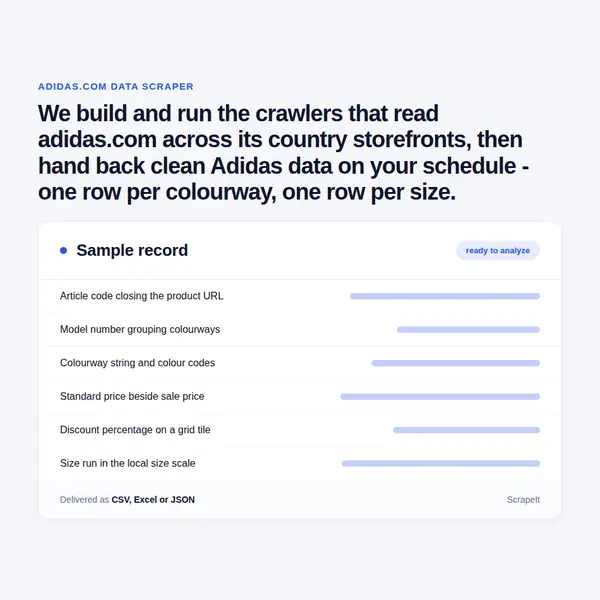
Scope is usually a division, a franchise, a category path or a list of article codes. We resolve those to product addresses, walk the grids with the start offset, then pull each article record and its size run under the storefronts and currencies you care about.
Adidas is guarded against automated clients, and the defences tighten further around releases. Getting past that reliably is our work: anti-bot handling, proxy rotation and CAPTCHA solving are part of the service, run at a rate that does not strain the site and only against publicly reachable pages. We do not sign in, and we do not gather personal details about shoppers or reviewers.
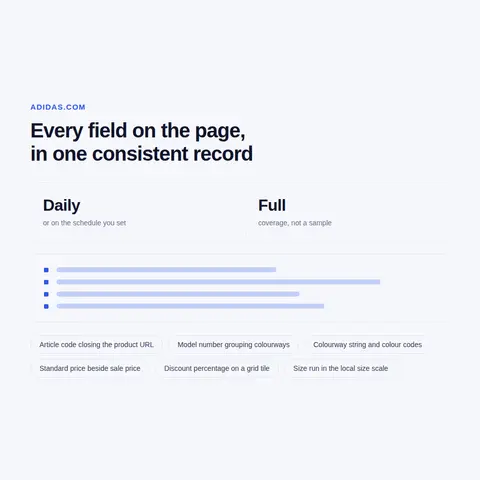
Output leaves as CSV, JSON, XLSX or an API endpoint on the cadence you set - daily for a watchlist, tighter around a drop, weekly for a full division sweep.
One Adidas record is a colourway, not a model: each carries its own article id, and a model number groups the colourways of one shape. We deliver article rows and size rows joined on that pair.
Every row is stamped with its storefront and currency.
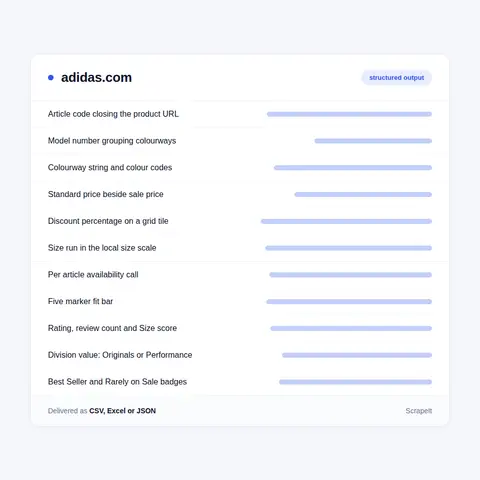
Adidas is merchandised as several labels on one storefront, and the division field says which. Originals, Performance and Sportswear carry the bulk of the catalogue; TERREX covers outdoor, Five Ten climbing and mountain biking, Y-3 the Yohji Yamamoto line, and named collaborations such as Fear of God Athletics sit in the same field as their own values. That one attribute splits a sweep into heritage, sport and premium without guessing from the product name.
Limited releases run on their own rails. A record can be flagged preview, waiting room or special launch, and the calendar page lists what is coming with a reminder signup that fires ahead of the release. Some drops never reach the web shop at all: the page states the release is available through the adidas CONFIRMED app, and the buy action becomes an app download. adiClub layers giveaways and Golden Ticket draws on top, plus members only releases and members only discounts. For a data buyer that is two truths - what the open storefront shows, and what only the app or a signed-in member reaches - and we collect the first.
The sale side is equally structured. A sale flag and an outlet flag sit on the record, sale views are addressed by appending a token to the category path, and tiles carry badges worded Best Seller, New, Selling Fast and Rarely on Sale. In the United States a Buy with Prime option runs alongside adidas fulfilment, exposed as its own filter value and a per tile flag, offered on selected sizes and colours rather than whole products. Size charts map UK, US and EU labels to heel to toe length in inches and centimetres.
Adidas sells direct, and the storefront is not one site but a grid of country builds. The United States sits on a path at adidas.com/us, Germany and the United Kingdom on their own domains at adidas.de and adidas.co.uk, and Gulf markets add a language segment, as in /qa/en and /bh/ar. Every build serves its own sitemap index, stamped with a country code and shaped /glass/sitemaps/adidas/US/en/sitemap-index.xml. Canada publishes an English index and a French one, Germany a German index and an English one, so language is a second axis stacked on country.
A product address ends in the article number: /us/3mc-vulc-shoes/B22705.html. The slug in front of it is translated, the article is not. The same shoe answers at /3mc-vulc-schuh/B22705.html in Germany, /chaussure-3mc-vulc/B22705.html in France and /zapatilla-3mc-vulc/B22705.html in Spain, and the alternate list on each page names every storefront that carries the article. Those six characters are the one key that survives all markets, which is what makes an Adidas scraper worth running across countries rather than in one.
Category pages are assembled from facet tokens glued with hyphens - /us/men-originals-shoes, /us/men-cushioned-shoes, /us/4dfwd-shoes-road - and two values on the same facet are joined with a pipe, /us/men|women-shoes. Grids page on a start offset in steps of forty-eight. Under the current front end sits Salesforce Commerce Cloud, still showing through in size chart links shaped /on/demandware.store/Sites-adidas-US-Site/en_US/. The storefront is guarded against automated clients, so Adidas scraping is a browser-grade job from the first request.
Get a Quote
Developers

Customers worldwide

Pages extracted

Hours saved for our clients
€199 / one-time
setup fee - included
€169 / mo
setup fee €499
€229 / mo
setup fee €499
€349 / mo
setup fee €499
€549 / mo
setup fee €799
Delivery: CSV, JSON or XLSX files, our API or a JSON feed. MCP server on request.
Full plan details →Teams scrape Adidas for three jobs, and they are not the same job.
The first is pricing at colourway level. A model is not a price. Price and discount sit on the article, not on the model, so one colourway can be marked down while its neighbour holds full price on the same grid. Because the article is the record and the model only groups it, Adidas prices have to be collected per article or the markdown story vanishes into an average.
The second is the size run. A colourway reads as in stock while only two sizes are left, and those two are the ones nobody wants. Per size availability is fetched separately from the page body, so a crawl that stops at the first response gets a headline and no depth. Sold out sizes carry their own state with a notify me path attached, the cleanest signal that demand outran the buy.
The third is the country spread. The same article is priced in another currency, sold under another size scale, carries another free shipping threshold and often is not carried at all. European storefronts publish a last lowest price beside the sale figure, so part of the markdown history is printed there and nowhere else. Member pricing adds a layer: some discounts sit behind adiClub, and the open figure is not the figure a member sees.
Under all three sits the release calendar. Preview, waiting room and special launch states appear on a record before it is buyable, so the pre-drop window, the drop and the first days of open trading are three price regimes on one article.
About 1.9 million auto parts listings from eBay.de with brand, OEM, EAN and fitment, plus titles and specs machine-translated for the client's team.
Learn More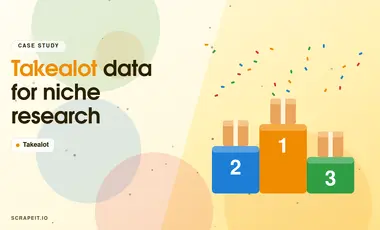
A one-off Takealot product list for an entrepreneur choosing niches: only products rated 4 stars or higher with at least 50 reviews.
Learn More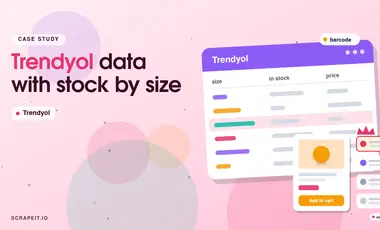
Trendyol product data for an e-commerce startup reselling Turkish fashion: 27 categories in JSON on FTP, with in-stock status for every size.
Learn MoreLearn how to use web scraping to solve data problems for your organization
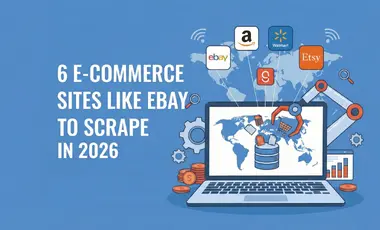
If you sell online, run a marketplace, or advise e-commerce clients, you already know why eBay matters: it’s one of the few places where big retailers compete side by side with thousands of small merchants and private sellers.

E-commerce teams do not just need “some” competitor data anymore. They need a continuous stream of real prices, discounts, stock levels, reviews, and seller behavior from the platforms that actually shape their markets.
Amazon provides valuable information gathered in one place: products, reviews, ratings, exclusive offers, news, etc. So scraping data from Amazon will help solve the problems of the time-consuming process of extracting data from e-commerce.
ScrapeIt is a managed scraping team. We write the crawler, run it on our own infrastructure, watch it when adidas.com changes, and repair it before the gap shows up in your reports. You receive data on a schedule, not a repository to maintain.
Scraping adidas.com is a maintenance job rather than a one off script: facet names, size scales and the payload behind the size grid all move, and the defences move with them. That maintenance is ours. Send us the countries, the divisions and the fields you need, and we will size the work.
Yes. The ScrapeIt Adidas API returns the article id, model number, current and standard price, the size run with per size stock, and ratings as JSON from an endpoint we host, refreshed on the schedule you set. The same data also comes as CSV or XLSX files or straight into your database.
On the article code. It is the last path segment of every product address, it is the record id, and it stays identical across storefronts while the slug around it is translated. Above it sits a model number that groups the colourways of one silhouette, and a base model number underneath that. Watch one detail: the grouping model number is issued per market, so the same article can group under one code in the United States and a neighbouring code in Germany, while the base model stays the same. If you plan to join reviews across countries, join on the base model, not the market model.
Yes, on four axes at once. Currency and tax treatment differ, and European records split the price into a gross figure and a figure without VAT while the United States does not. The price level itself differs, and so does the free shipping threshold. The size scale differs: American shoe rows arrive as a combined men and women label, German rows as EU numbers including thirds such as 36 2/3. And the assortment differs, so an article live in one market may simply be absent in another. We collect per storefront and stamp every row with country and currency, which keeps the comparison honest.
Yes. The size run comes back one row per size with its own key, and availability loads separately for each article, which is exactly the step a shallow crawl skips. Store level stock and delivery estimates are separate again and can be added where you need them. Cadence is yours: daily is normal for a price and stock watchlist, hourly or tighter around a release, weekly for a full catalogue sweep. Deliveries go out as CSV, JSON, XLSX or an API endpoint, with the same columns every run so you can diff one pull against the next.
Yes, and it is a common brief. There is no shared identifier between the two, so the join is built on silhouette, model name, category and colour rather than on a code, and we normalise size labels to one scale before the tables meet. Both sites are crawled separately, on the same cadence, so the snapshots line up in time. Collection stays on publicly reachable pages on both sides, we do not enter member or app only areas, and we do not gather personal data about shoppers or reviewers.
Step 1 - Make a Request
You share your needs, expectations, and desired timeframe. We’ll suggest the best solution based on your request and budget.
Step 2 - Configuring Custom Web Crawlers
Our specialists configure the crawlers and extract a sample dataset for your review before proceeding with the full-scale extraction.
Step 3 - Collect and Deliver
Once you approve the sample, we launch the project and start full data collection. We gather, filter, and structure the data for easy use, delivering it on time in your preferred format.
Step 4 - Maintain and Support
Our team manages ongoing processes, monitors website changes, and supports all data extraction cycles. We can also help integrate data into your systems or create dashboards to simplify analysis.
Adidas data from €169/month. Free project assessment, reply within 1 business day.

Scrapeit Sp. z o.o.
10/208 Legionowa str., 15-099, Bialystok, Poland
KRS: 0000996672
NIP: 5423457175
REGON: 523384582