Beauty Price Monitoring on Notino and Douglas in 15+ Countries, in English
A cosmetics company got monthly prices and promotions from 40+ beauty stores in 15+ countries, translated to English and fed into its existing import.
Learn More
A Discogs release page pins down one pressing by catalogue number, barcode and matrix runout. Our Discogs scraper pairs it with marketplace prices, grades and demand.
Plans from €169/month · Free project assessment · Reply within 1 business day
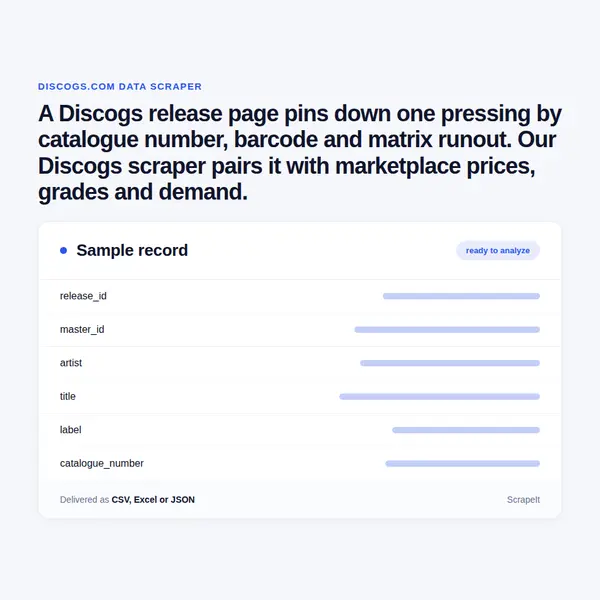
You give us the scope - artists, labels, genres and styles, formats, a list of release ids, or the marketplace offers for a set of releases - and we build, run and maintain the crawlers. Discogs puts a browser check in front of its pages and adapts them to the visitor - interface language and the currency of converted totals - so rendering, pacing, proxy rotation and CAPTCHA handling are part of the job, and so is pinning every run to the same language and currency. Rows are keyed on the r and m ids Discogs prints on every release and master page, so repeat runs update instead of duplicating.
Collection can be a single extract or a standing job that repeats daily, weekly or whenever you ask; fields come documented, and the project assessment before you commit is free.
Discogs is two datasets in one: a catalogue that describes each pressing and a marketplace that prices copies of it. Our Discogs scraper collects both and joins them on the release id:
Sellers, reviewers and the contributors who edit the database appear on these pages by username; that is personal data and is left out by default.
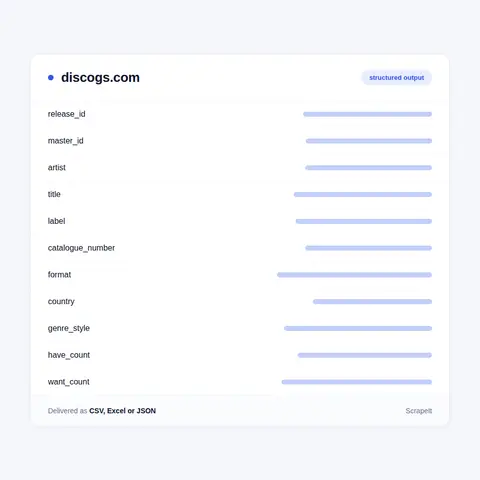
On the public release page Discogs gives sold prices only in summary: the Last Sold date and the Low, Median and High of recent sales. Discogs keeps its most current list of individual sales for signed-in members, and we never log in, so a price history comes from repetition - and it can say more than one sales list:
Release reviews can be added with their text; reviewer names stay out.
Discogs is a crowd-sourced music database with a marketplace attached. It began with the aim of documenting the history of recorded music in a user-built discography and now covers releases in every genre and on formats from vinyl and CD to cassette and VHS. Users submit and correct entries, and each release page shows its contributors and a data quality status.
The catalogue has a clear hierarchy. An artist or label page lists the work; a master release groups every version of one recording under an m id; and each release is one specific pressing with an r id - its country, label, catalogue number, barcode and runout etchings. A single hit can have dozens of versions, as Rick Astley's Never Gonna Give You Up does, which is why collectors and dealers price by release rather than by album.
The marketplace sits on top: sellers list copies against a release id, grade the media and sleeve, set a price in their own currency and ship from their own country. Prices are shown converted for the visitor, and the same pages are served in other interface languages on discogs.com.
Get a Quote
Developers

Customers worldwide

Pages extracted

Hours saved for our clients
€199 / one-time
setup fee - included
€169 / mo
setup fee €499
€229 / mo
setup fee €499
€349 / mo
setup fee €499
€549 / mo
setup fee €799
Delivery: CSV, JSON or XLSX files, our API or a JSON feed. MCP server on request.
Full plan details →Record prices depend on the exact pressing and its condition, and Discogs is where both are written down, which makes its data useful well beyond collectors.

A cosmetics company got monthly prices and promotions from 40+ beauty stores in 15+ countries, translated to English and fed into its existing import.
Learn More
A consultancy working for a fragrance brand owner got sellers, official-store flags and USD prices for 25 fragrances on about 30 marketplaces in 12 countries.
Learn More
Three Amazon US lighting categories collected in full for a lighting manufacturer, with description text and images from brand content blocks.
Learn MoreLearn how to use web scraping to solve data problems for your organization
If you sell online, run a marketplace, or advise e-commerce clients, you already know why eBay matters: it’s one of the few places where big retailers compete side by side with thousands of small merchants and private sellers.

E-commerce teams do not just need “some” competitor data anymore. They need a continuous stream of real prices, discounts, stock levels, reviews, and seller behavior from the platforms that actually shape their markets.
Amazon provides valuable information gathered in one place: products, reviews, ratings, exclusive offers, news, etc. So scraping data from Amazon will help solve the problems of the time-consuming process of extracting data from e-commerce.
Our team at ScrapeIt runs data extraction as a managed service. On a site like Discogs, where one album splits into many pressings and every copy carries its own grade, most of the work is modelling: release, master and offer rows linked by their ids, prices kept with their currency, grades kept exactly as Discogs writes them. We never sign in to collect, GDPR governs any personal data, and usernames stay out unless you need shop-level data from business sellers.
Yes. The ScrapeIt Discogs API returns release id, catalogue number, format, the Low, Median and High sale prices and current asking prices by grade as JSON from an endpoint we host, refreshed when you choose. Files work too - CSV, Excel or JSONLines, delivered to Google Cloud Storage, Dropbox or by e-mail.
Yes. Release pages, master pages, their statistics and the marketplace offers can be read by anyone, signed in or not. We collect only publicly available data - everything a visitor can see on Discogs - and we collect it legally. Discogs keeps its most current list of individual sales for signed-in members, and since we never log in, that list is not part of what we deliver.
As a guide, yes, with care. Low, Median and High come from recent sales of that exact release and are not split by grade, so a Near Mint copy and a worn one feed the same figures. We deliver them next to current asking prices by media and sleeve grade, which shows how far condition moves the price.
Yes, from the public layer. Each run records Last Sold, Low, Median, High and the cheapest copy per grade for every release in scope, so weekly runs build a dated price series. The list of individual sales, kept most current for signed-in members, is not included.
Any of these. We start from artist or label discographies, from genre and style, from master releases with all their versions, or from your own list of release ids, then collect the offers for each release. Offers can be limited by ships from country, currency or media condition, the same filters the For Sale page uses.
Step 1 - Make a Request
You share your needs, expectations, and desired timeframe. We’ll suggest the best solution based on your request and budget.
Step 2 - Configuring Custom Web Crawlers
Our specialists configure the crawlers and extract a sample dataset for your review before proceeding with the full-scale extraction.
Step 3 - Collect and Deliver
Once you approve the sample, we launch the project and start full data collection. We gather, filter, and structure the data for easy use, delivering it on time in your preferred format.
Step 4 - Maintain and Support
Our team manages ongoing processes, monitors website changes, and supports all data extraction cycles. We can also help integrate data into your systems or create dashboards to simplify analysis.
Discogs data from €169/month. Free project assessment, reply within 1 business day.

Scrapeit Sp. z o.o.
10/208 Legionowa str., 15-099, Bialystok, Poland
NIP: 5423457175
REGON: 523384582