eBay Data: 1.9M Auto Parts Listings from eBay.de, Specs Translated
About 1.9 million auto parts listings from eBay.de with brand, OEM, EAN and fitment, plus titles and specs machine-translated for the client's team.
Learn More
Selfridges files every item under its designer: the department on a Selfridges product record is the label itself, and one part number carries a style across all of its country storefronts.
Plans from €169/month · Free project assessment · Reply within 1 business day
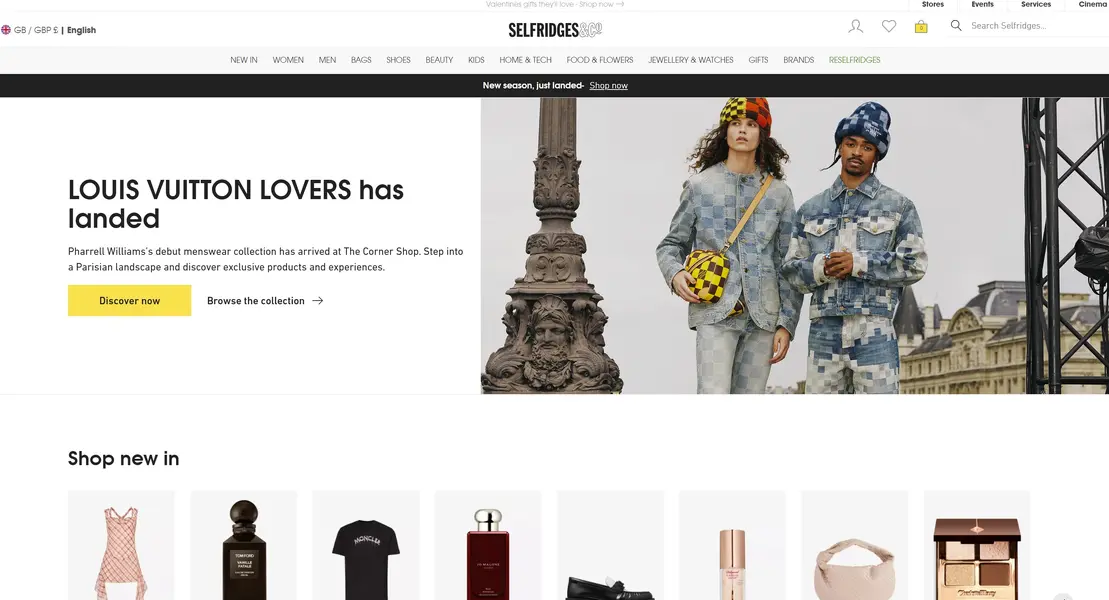
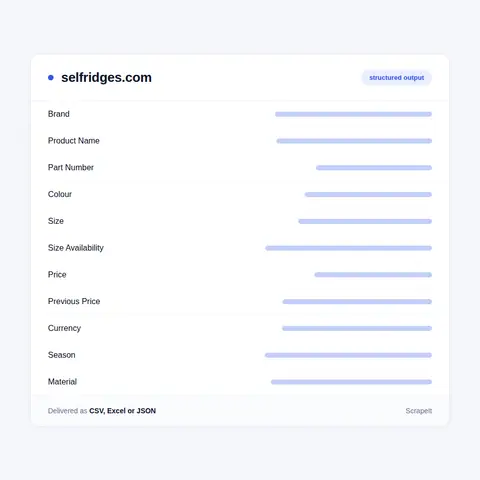
We build the Selfridges scraper, run it on your schedule and hand over the result as CSV, JSON, XLSX, a database drop or an API endpoint, with the schema agreed before the first run.
The storefront is defended and it queues visitors at peaks, so anti-bot handling, proxy rotation and CAPTCHA solving are part of the service rather than something you arrange on the side.
Scope is usually a set of designer shops, a department tree, or a list of part numbers. Parent rows are keyed on the part number, so a rewritten slug or a renamed product still resolves, and child rows are keyed on size so availability lines up week after week. We take public pages only - nothing behind a login, no basket and no checkout - and customer names and other personal data stay out of scope by default.
The record calls the designer the department and the buying area the division, which is a department store speaking its own language: a Dries Van Noten dress carries department Dries Van Noten and division Womens Fashion, plus a group naming the selling floor, Designer Gallery 1 or Denim Studio. Structured markup is a BreadcrumbList and a ProductGroup varying by size, one variant per size with its own offer.
Listing tiles rename the same ideas: price, markdownPrice and prevMarkdownPrice, with previewAttribute for the colour and a rating block that beauty fills and fashion leaves empty. Image tokens are the colour name uppercased and stripped of punctuation, so Gs Black/gs Asphalt Grey becomes GSBLACKGSASPHALTGREY.
Currency is a property of the storefront, not of the item, and that is the trap in any Selfridges product feed. The same part number answers at GBP 1,795 under /GB/en/ and at USD 2,170 under /US/en/, and the gap is not a clean exchange rate: the international pages fold taxes and duties into the item price and say so in the returns block, while the United States pages instead carry a note that taxes and duties are worked out in the shopping bag. A run that does not pin the country segment quietly mixes two tax regimes into one column.
We pin the country segment on every run and store the currency, the current, was and wasWas prices and the taxes-and-duties note beside each part number, so the two tax regimes never share a column.
Ownership sits outside the United Kingdom. Selfridges Group is held sixty per cent by Thailand's Central Group and forty per cent by Saudi Arabia's Public Investment Fund, which bought out Signa's share in 2024. The same group owns De Bijenkorf in the Netherlands and Brown Thomas and Arnotts in Ireland, so comparing those banners is a matter of crawling three further sites rather than one.
Two shelves are peculiar to this retailer and deserve columns of their own: Reselfridges, which carries pre-loved bags, jewellery and clothing beside a refill range, and the Foodhall, whose whisky, tea and champagne houses share the brand index with the fashion labels.
Selfridges trades at selfridges.com from one catalogue re-priced per market. Every address opens with a country segment and a language segment, so the same item sits at /GB/en/product/... and at /US/en/product/..., and the sitemap index fans out into 108 files covering 27 country-language storefronts - 21 countries, with Chinese served beside English for six of them. A Selfridges scraper that ignores that first segment is not reading one site but blending several.
Product addresses take the shape /{country}/{language}/product/{product-key}_{part-number}/. The part number is the identifier that matters: a letter R and eight digits, as in R04667746, closing the address and repeated in the page state. Concession lines break the pattern - Cartier fine jewellery answers on keys such as 852-10134-CRB4085000 - so a parser has to accept both shapes. Colour is carried in the fragment rather than the query string, written #colour=Dessin%20A.
The designer is the primary axis here. Each label has its own shop at /{country}/{language}/cat/{brand-slug}/ and a department cut at /cat/{brand-slug}/{department}/, so /cat/alaia/bags/ and /cat/adidas/shoes/ are ordinary addresses, not search results. The A-Z brand directory listed about 2,300 labels in September 2026, in one index that puts Acne Studios and Zegna next to Aberlour and Veuve Clicquot, because the Foodhall is shelved by house exactly like womenswear.
Departments run womens, mens, bags, shoes, beauty, kids, home-tech, foodhall and jewellery-watches, each with newin, new-season, on_sale and reselfridges-pre-loved leaves. Category paths nest four and five segments deep, from /cat/womens/clothing/dresses/maxi/ to /cat/bags/luggage/travel-accessories/passport-covers/.
Get a Quote
Developers

Customers worldwide

Pages extracted

Hours saved for our clients
€199 / one-time
setup fee - included
€169 / mo
setup fee €499
€229 / mo
setup fee €499
€349 / mo
setup fee €499
€549 / mo
setup fee €799
Delivery: CSV, JSON or XLSX files, our API or a JSON feed. MCP server on request.
Full plan details →Luxury markdowns move in steps, not slopes, and Selfridges price data records the ladder itself: a corduroy jacket sits at GBP 262 with a previous 300 behind it and a previous 375 behind that. Two rungs are legible before you have any history of your own, and a daily Selfridges scrape turns them into a dated series showing when the first cut landed and how deep the second went.
Size availability is the demand signal fashion actually trades on. Because the run is published with an availability flag on every size, you can watch the middle empty while the ends sit untouched - the difference between a style that is selling and one bought in the wrong ratio. The order in which sizes disappear says more about sell-through than any headline discount. Sizes come on the British grid - a womenswear run reads 6 to 14 and the measurement line names a UK size - so European and American conversions belong after collection, not before.
Dispersion is the third question. A house sells through several retailers at once, and a style still at full price in one window is already cut in another. Brand and product name are separate fields here, so matching a style across sites needs no shared identifier.
Assortment analytics uses the facet counts. A sale grid states its own total and splits it by area, and the Brand, Size, Colour and Price refinements each report how many items stand behind them, so the shape of a buy can be counted without opening one. Brand protection teams run the same crawl to confirm where a label is stocked, at what price, and in which markets.

About 1.9 million auto parts listings from eBay.de with brand, OEM, EAN and fitment, plus titles and specs machine-translated for the client's team.
Learn More
A one-off Takealot product list for an entrepreneur choosing niches: only products rated 4 stars or higher with at least 50 reviews.
Learn More
Trendyol product data for an e-commerce startup reselling Turkish fashion: 27 categories in JSON on FTP, with in-stock status for every size.
Learn MoreLearn how to use web scraping to solve data problems for your organization
Eleven UK ecommerce websites worth scraping in 2026, from Tesco and Sainsbury's to ASOS, Boots and Gumtree: what each site shows, the fields a data buyer needs, what only it adds and how to merge them into one dataset.
If you sell online, run a marketplace, or advise e-commerce clients, you already know why eBay matters: it’s one of the few places where big retailers compete side by side with thousands of small merchants and private sellers.

E-commerce teams do not just need “some” competitor data anymore. They need a continuous stream of real prices, discounts, stock levels, reviews, and seller behavior from the platforms that actually shape their markets.
ScrapeIt is a managed scraping agency. We write the crawlers, host them, watch them and repair them when a site changes, so what reaches you is data rather than code.
Selfridges rebuilds its front end in pieces - listings and product pages are already served by separate applications - so maintenance is the service, not an extra line on the invoice. Tell us which fields you need and how often you need them, and we will confirm what is actually published before any work starts.
Yes. The ScrapeIt Selfridges API returns the part number, brand, current, was and wasWas prices, currency and size-level availability as JSON from an endpoint we host, refreshed on the schedule you set. The same data also comes as CSV or XLSX files or straight into your database.
The part number: a letter R followed by eight digits, such as R04667746. It closes the product address after the slug, and the page state repeats it, so a renamed product or a rewritten slug still resolves to the same record. Concession lines are the exception and use supplier-style keys instead, as Cartier does with 852-10134-CRB4085000. Colour is chosen in the address fragment, and each size behaves as a child of the style, so key parent rows on the part number and child rows on size and colour to keep a Selfridges scrape joinable.
Yes, and it has to be an explicit choice. The country and language segments at the front of every address select the storefront, and each one prices in its own currency: the same style reads GBP under the British pages and USD under the American ones. Tax treatment moves with it, since the international storefronts include duties in the shown price while the United States pages leave them to the shopping bag. We pin one country per run and stamp the currency and the market on every row, so a Selfridges price dataset never mixes regimes silently.
Price and size availability move on different clocks. A designer style can hold its price for months and then step down twice inside a few weeks, while sizes drain continuously in between, which is why both previous prices are worth storing rather than just the current one. Markdown activity clusters around the seasonal reductions, which the site runs as its own on_sale grid inside every department. Most clients take price and size availability daily, a designer sweep weekly, and a full catalogue pass monthly to catch new part numbers and withdrawn lines. Output is CSV, JSON, XLSX, a database drop or an API endpoint.
Yes. We collect only publicly available data - product, designer and category pages any visitor can open on Selfridges without an account - and we collect it legally. We do not sign in and we stay out of the basket and checkout. Personal data is out of scope by default. Selfridges does carry short customer reviews on beauty pages, and each line shows a date, a first name with an initial and a verified-buyer badge, so those rows stay out of the feed unless you have a reason to hold them.
Step 1 - Make a Request
You share your needs, expectations, and desired timeframe. We’ll suggest the best solution based on your request and budget.
Step 2 - Configuring Custom Web Crawlers
Our specialists configure the crawlers and extract a sample dataset for your review before proceeding with the full-scale extraction.
Step 3 - Collect and Deliver
Once you approve the sample, we launch the project and start full data collection. We gather, filter, and structure the data for easy use, delivering it on time in your preferred format.
Step 4 - Maintain and Support
Our team manages ongoing processes, monitors website changes, and supports all data extraction cycles. We can also help integrate data into your systems or create dashboards to simplify analysis.
Selfridges data from €169/month. Free project assessment, reply within 1 business day.

Scrapeit Sp. z o.o.
10/208 Legionowa str., 15-099, Bialystok, Poland
KRS: 0000996672
NIP: 5423457175
REGON: 523384582