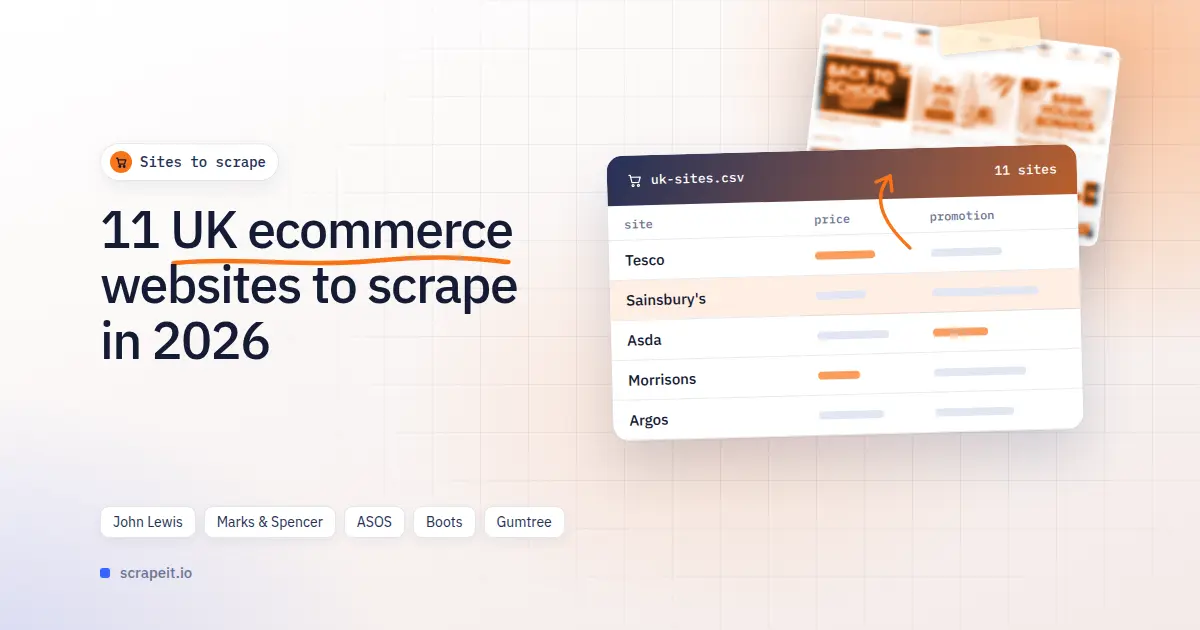
On UK ecommerce websites one product often has two prices. Tesco prints a Clubcard price beside the regular one, Sainsbury's a Nectar Price, and a grocery shelf adds a unit price per kilo and a multibuy line. One price column cannot hold that.
Below are eleven UK sites we scrape, from four grocery chains to a classifieds board, with the fields each shows, what only it adds and how they merge. Other countries are in our worldwide list of e-commerce sites to scrape.
Who this list of UK online retailers is for
It suits teams that order data rather than write crawlers: category and pricing managers comparing chains, suppliers checking agreed prices, brands following markdowns, analysts building a UK panel. Few need all eleven.
What UK retail websites share and where they split
Shop prices are in pounds sterling, VAT included; Gumtree trade adverts carry a VAT marker. Five things shape the schema.
- Loyalty prices. Three of the four UK supermarkets here show loyalty card prices to a visitor: Clubcard at Tesco, Nectar at Sainsbury's, More Card on Morrisons offer pages. Asda pays Rewards cash, Boots shows an Advantage Card price in some sessions, M&S attaches Sparks codes. Each needs its own column.
- Unit price bases. Store value and basis (per kg, litre, 100g, item) apart: a smaller pack at the same shelf price shows only here.
- Reference prices. A was price can be the 30-day low before a cut, the price before a fresh-food discount, or an amount with the dates it applied, as at Currys.
- Location. Asda and Morrisons tie price or availability to a postcode; Argos, Boots, Currys and John Lewis report branch stock.
- Codes and sellers. Each retailer numbers products its own way, EANs appear unevenly, and own label such as No7 is sold by one retailer only. Tesco, Argos and Boots carry flagged listings from outside sellers; Currys and ASOS are the seller on every offer.
11 best UK ecommerce websites to scrape
The order follows usefulness for a UK price panel: grocers first, then general merchandise, electricals and department stores, then fashion and beauty, with Gumtree last because second-hand prices form a separate market. It rates the data, not the shops.
Tesco
Tesco sells groceries online nationwide, and many listings carry two current prices: the regular price and the Clubcard price beside it, printed with the dates the offer is valid between. A row adds the unit price per kilogram, litre, 100g or item, multibuy and meal deal labels, Aldi Price Match and Low Everyday Prices badges, the aisle and shelf path, availability with any purchase limit, and nutrition and allergens. What only Tesco needs is a source flag: a third-party marketplace sits beside the grocery lines, shipped by its sellers, and averaging the two corrupts a price file. Use it for Clubcard price tracking against rival chains. Details: Tesco scraper page.
Sainsbury's
Sainsbury's puts the shelf price and the Nectar Price on one product card, with the date the Nectar offer runs until. A row also carries the price per unit normalised to kg, litre or item, pack size, the promotion mechanic (half price, save a third, stock-up), grid position, sponsored flags, and pack copy with a country of origin split into produced in and packed in. The key is unusual: no numeric code sits in the address, the slug usually carries the pack size, and a new pack size means a new URL. Use it for Nectar price gaps and own-label tiers such as Taste the Difference. Details: Sainsbury's scraper page.
Asda
Asda breaks the two-price pattern: it prints no member price. Asda Rewards tags a line Star or Super Star and pays cash into a Cashpot, so the reward is a money field, not a second price. The comparison price arrives as one string such as 10.25/kg or 15.7p/100ml, which we split into number and unit. Promotions come in named families - Rollback, Dropped and Locked, multibuys - and availability as store flags for today and the four days after, scoped to the store and pricing zone a postcode selects. Labels include the HFSS status UK promotion rules turn on. Use it for unit price comparison. Details: Asda scraper page.
Morrisons
Morrisons prints its unit price with an Ordinarily prefix across unusually wide bases, from per kilo to per wash, per kilo drained and per litre excluding bottle deposit. The More Card price is missing from the tile a logged-out visitor sees and is published on offer pages, so a row joins shelf and member price through the offer id. Reference prices come in three labelled kinds, the lowest price of the 30 days before a discount among them, and one column for all three corrupts a discount figure. Provenance goes furthest here: country of birth, rearing and slaughter on meat. Use it for discount audits and sourcing checks. Details: Morrisons scraper page.
Argos
Argos, the catalogue retailer, keys every sellable item on a seven-digit catalogue number that ends the product address; each size or colour is a separate product with its own number. A row holds that number and the EAN, current and was price, Nectar points earned, clearance badges with start and end dates, and a Trusted Seller flag for items another seller ships. Stock is local: given a postcode, Argos names the nearest shops and whether each holds the item. Argos does not price match, so its price is an independent reading, and only your own price history can test its Lowest Price Ever lines. Use it for general merchandise panels. Details: Argos scraper page.
Currys
Currys and PC World share one catalogue, and Currys sells only its own stock, so a page price is the retailer's own. Identifiers need care: the eight-digit code in the URL is the platform key, the number printed as Product code is a shorter legacy code, and the EAN field can hold more than one barcode. The was price is printed with the dates it applied between, so a daily series becomes a dated promotion calendar per model. Rows also carry delivery and collection stock, care plan prices that move apart from the product price, and grouped specifications. Use it for electronics and appliance pricing. Details: Currys PC World scraper page.
John Lewis
John Lewis is a department store from fashion to electricals, with own labels such as ANYDAY beside outside brands. Its Never Knowingly Undersold promise price-matches branded products against a fixed list of named UK retailers, Argos and Currys among them, so its price is a benchmark for that set. A row holds the numeric id after /p, the separate eight-digit product code customers quote in a shop, the SKU per colour and size, price-now and price-prev, the guarantee length and shop stock, which John Lewis says it refreshes every two hours. Colour variants get their own URLs, so deduplicate on the id. Use it for RRP checks. Details: John Lewis scraper page.
Marks & Spencer
Marks & Spencer sells clothing, home, beauty, furniture and food to order online; the weekly grocery range sells elsewhere. What no other site here publishes is a stock quantity on every SKU: each colour is a variant and each size under it carries quantity on hand, so one run shows which sizes are selling out. A row also holds the eight-digit product id, the strokeId buying code, current and previous price, Sparks promotion codes and true-to-size review scores. Listing rows count colourways rather than products, so shelf totals need deduplication, and a brand filter splits M&S Brands from Other Brands. Use it for size curves and sell-through. Details: Marks & Spencer scraper page.
ASOS
ASOS sells its own labels beside outside brands through eleven storefronts, so price and assortment belong to a market. Its page data carries the markdown clock: current and previous price, a markdown flag, the dates each price took effect or ended and the lowest price of the preceding 30 days, so a first pull already dates a cut. Every size has its own SKU and EAN; for an outside brand that is the manufacturer's barcode, which locates the same garment at other retailers. An outlet flag separates clearance from in-season markdown, and sets and multipacks sit in a separate URL family. Use it for fashion markdown tracking. Details: ASOS scraper page.
Boots
Boots is both a health and beauty chain and a registered pharmacy, and its site holds general retail, pharmacy lines and own brands sold nowhere else. The Advantage Card reaches the shelf price: a Price Advantage member price renders or not depending on session state, so a single price column mixes card holder and standard prices. We keep standard price, member price and points offer apart. Own brands such as No7 and Soltan have no equivalent elsewhere and are compared on brand, product type and pack size. Branch stock comes from a separate lookup, and we stay off prescription and patient pages. Use it for beauty price checks. Details: Boots scraper page.
Gumtree
Gumtree, the UK classifieds board, is the only second-hand source here: a used phone or sofa sells at a different price than in a shop, and that gap drives resale margins and residual values. Each section has its own attributes: cars carry make, model, year, mileage and insurance group, and property rents come per month or per week. Every advert has a ten-digit advert id, a seller type of Private, Trade or Agency and paid flags such as Featured. Results stop at fifty pages per query, so coverage splits a search by town and price band. Seller names and phone numbers stay out. Use it for used car prices. Details: Gumtree scraper page.
Other UK sites on our list
Selfridges and Lookfantastic, also on our list of UK sites we scrape, are left out: ASOS, John Lewis and Boots cover their categories, and their data is strongest across borders, with one product key across country storefronts. Amazon.co.uk and eBay.co.uk belong to our global Amazon and eBay pages among the ecommerce sites we scrape.
Get your Business Back on Track
Boost the growth and productivity of your retail or manufacturing business with e-commerce data
- Free Sample Data Sets
- Regular Data Delivery
- Legal and GDPR compliance
Get a Quote
Scraping UK ecommerce websites into one product table
To match products across UK retailers, start from codes, as three of our projects show.
Codes first. A pricing client on the Polish marketplace Allegro.pl sends about 150,000 EANs a day, and we return the lowest price for each, which their pipeline sets against supplier prices. Completing that volume daily was the hard part of our Allegro case with 150,000 EANs a day. Argos, Currys and ASOS pages carry EANs for the same lookup.
One series per storefront. Our Ralph Lauren case across eight Amazon markets included amazon.co.uk and delivered 41,000 rows: an ASIN for each colour and size, the seller list per item, other brands removed. Building and testing the scraper took 4 days, the crawl 1 day.
One row per pack. Our iHerb supplements catalogue case kept every packaging size in its own row across 250,000 rows; UK unit prices need the same.
The merged table carries retailer code, EAN, store or postcode, shelf, loyalty and reference price, unit price with basis, promotion, availability and timestamp. Rows sharing an EAN collapse into one product; own label is matched on brand, product type and pack size.
How ScrapeIt runs UK retail data projects
We run it as a managed service, building, running and repairing the crawlers; anti-bot handling (pacing, proxy rotation, CAPTCHA handling, rendering) is included. Projects open with a free assessment, a sample can be ordered, field documentation ships with the dataset, and runs are one-off or on your schedule.
Formats: CSV, Excel (XLSX), JSON, JSONLines or XML. Channels: our API (an endpoint we host), a JSON feed, FTP, SFTP, Amazon S3, Google Cloud Storage, Dropbox, Google Drive, e-mail or a load into your database; an MCP server on request. Plans start from EUR 169 a month, or EUR 199 for a one-time extract. Wider retail scope is on our ecommerce data scraping page.
FAQ
Is it legal to scrape UK ecommerce websites?
Yes. We collect only publicly available data - everything a visitor can see on the site - and we collect it legally. Reviewer names and private sellers' contacts are personal data: we handle personal data under GDPR, leave such fields out by default, never log in and never go behind paywalls.
Can you scrape UK supermarket prices with Clubcard and Nectar offers?
Yes. Clubcard and Nectar prices land in their own columns beside the shelf price, with the offer end date, and stay empty where no offer exists. Offers personalised to a signed-in shopper are not collected.
Do UK retailers show different prices by postcode?
Some do. At Asda a postcode resolves to a store and a pricing zone, and Morrisons prices and promotions change with location; public Tesco availability is the national listing state. Keep the postcode set fixed.
How often do UK retail prices need to be scraped?
Grocery prices usually run daily: loyalty offers carry start and end dates, and multibuys rotate weekly or faster. John Lewis refreshes shop stock every two hours, so polling faster adds nothing. Ranges, pack copy and specifications are fine weekly or monthly.