The Entire Iherb Supplements Catalog, Captured End-to-End in 3 Days
Scraping supplement products from iHerb.com with full details, including descriptions and packaging variations.
Learn More
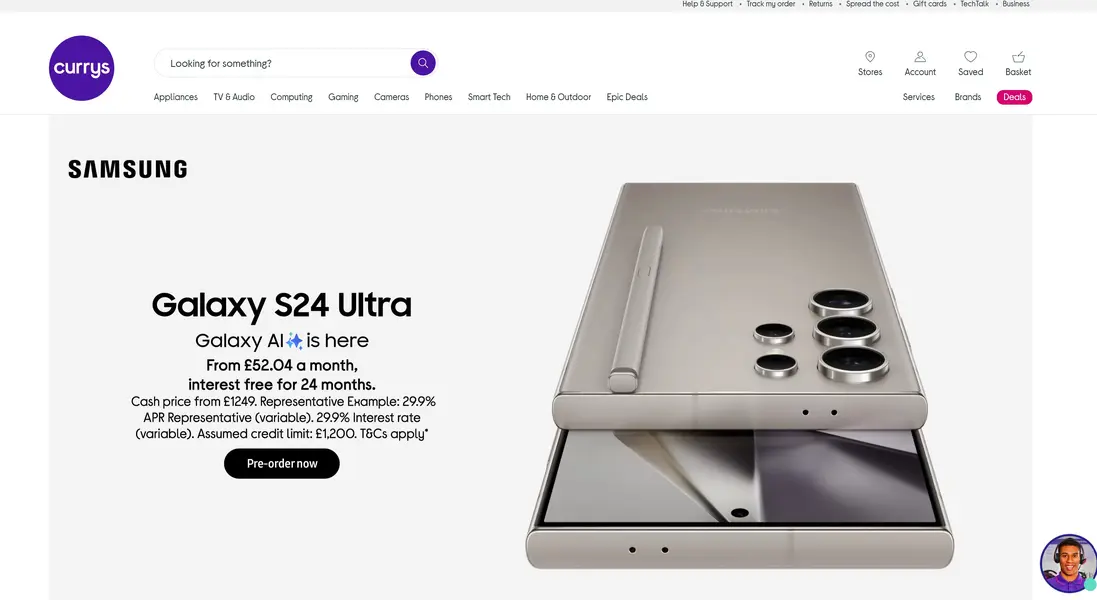
Currys runs one catalogue behind the Currys and PC World names, and every listing hangs off an eight digit product code we key the whole dataset on.
Plans from €169/month · Free project assessment · Reply within 1 business day
This runs as a managed service. You define the scope - a category tree, a brand list, a set of product codes, or the full catalogue - and we build the crawler, run it on your schedule and hand over the output.
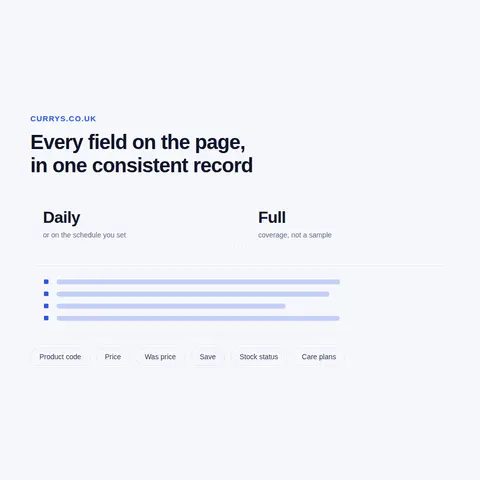
Delivery is CSV, JSON, XLSX or a REST API, on a stable schema so your load job does not change when the site does. Daily suits price and stock; weekly or monthly is usually enough for specifications and assortment. Category listings paginate at twenty products per page, which sets the crawl budget for a full sweep, and we size the schedule around that rather than hammering the site.
Currys publishes most of a product record twice: once as visible HTML and once as a JSON object in the data-datalayer attribute on the product detail wrapper. We read both and reconcile them, because the two disagree about what a SKU is.
Several things on a Currys page are absent from the first HTML response and have to be fetched separately.
The add to cart button and the out of stock notify block load after the page itself, so a parser that reads only the initial markup can pick up a price and still miss whether the item can be bought. Store level collection sits behind a town or postcode typed into a form, and delivery slots and trade-in valuations load on their own. We run each of those as its own job with its own cadence rather than pretending they are page fields.
The catalogue also has edges worth naming. /clearance is a parallel tree with brand and category children and the same pagination. Currys Business sits on a separate domain, business.currys.co.uk, on a different platform whose pages end in .jtp, and quotes prices excluding VAT. Currys Ireland shares both identifiers with the UK site but prices in euro at the Irish VAT rate, so the two catalogues join cleanly on code and compare on price only once tax is handled.
Currys and PC World were separate Dixons chains until the combined store format was trialled in 2008 and rolled out across the estate. In October 2021 every Currys PC World store was rebranded to Currys and the parent company became Currys plc. The pcworld.co.uk domain now redirects to currys.co.uk, and there is a single catalogue behind both names rather than two ranges to reconcile.
The storefront runs on Salesforce Commerce Cloud. The site identifier Sites-curryspcworlduk-Site still appears in asset paths and controller URLs, so the pre-2021 brand name survives inside the platform long after it left the shop fronts. Product pages sit at /products/{slug}-{code}.html, where the code is an eight digit number that is repeated as the schema.org sku in the embedded JSON-LD and as id in the page datalayer.
Category pages use readable hierarchical paths such as /appliances/cooking/cookers, and brand or colour refinements become extra path segments rather than query strings. Those pretty paths are rewrites of a Search-Show controller that takes a cgid category id plus refinement pairs. Ireland is served from currys.ie on the same platform under the identifier Sites-curryspcworldie-Site, and UK pages carry an hreflang alternate pointing at the identical slug on the Irish domain.
Get a Quote
Developers

Customers worldwide

Pages extracted

Hours saved for our clients
€199 / one-time
setup fee - included
€169 / mo
setup fee €499
€229 / mo
setup fee €499
€349 / mo
setup fee €499
€549 / mo
setup fee €799
Delivery: CSV, JSON or XLSX files, our API or a JSON feed. MCP server on request.
Full plan details →Currys sells its own stock. There is no seller layer, so a price on the page is the retailer's price and not one offer among many for the same listing. That makes the catalogue a clean reference point for UK consumer electronics and major domestic appliances.
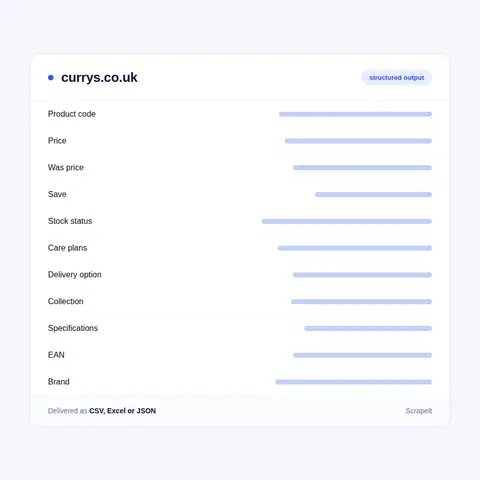
The was price is what most buyers come for. UK pricing practice means the higher price is published together with the exact window it applied in, so a discounted Currys page states not only that something is reduced but how long the reference price stood. Collected daily and keyed on the product code, that becomes a promotion calendar per model instead of a guess about when a deal started.
Assortment work is the other common brief: which planning group a rival brand is taking space in, when a model drops out of a category, and when it turns up again under /clearance. Care plan pricing is worth its own column, because the plan price for a given product moves independently of the product price and is set per line rather than per category.
Brands selling into Currys use the same feed in the other direction, to check that their listings carry the right specification values, imagery and barcode. Because the datalayer exposes the EAN next to the Currys codes, a brand file joins to the site without a fuzzy title match.

Scraping supplement products from iHerb.com with full details, including descriptions and packaging variations.
Learn More
Daily scraping of lowest prices for 150K products on Allegro.pl to support marketplace pricing and margin optimization.
Learn More
Regular monitoring of Ralph Lauren clothing, footwear, and accessories sold across Amazon subdomains: AE, DE, ES, FR, IT, NL, PL, UK.
Learn MoreLearn how to use web scraping to solve data problems for your organization
If you sell online, run a marketplace, or advise e-commerce clients, you already know why eBay matters: it’s one of the few places where big retailers compete side by side with thousands of small merchants and private sellers.

E-commerce teams do not just need “some” competitor data anymore. They need a continuous stream of real prices, discounts, stock levels, reviews, and seller behavior from the platforms that actually shape their markets.
Amazon provides valuable information gathered in one place: products, reviews, ratings, exclusive offers, news, etc. So scraping data from Amazon will help solve the problems of the time-consuming process of extracting data from e-commerce.
ScrapeIt is a managed web scraping agency. We design the crawler, operate it, monitor the output and hand over a finished dataset. There is nothing for you to install and no proxy pool for you to run.
Scope, fields and frequency are agreed before we start. Crawling is paced to stay well inside what the site can absorb. When Currys changes its markup or renames a field, fixing it is our job and the schema you load stays the same.
A product page is /products/{slug}-{code}.html, where the code is an eight digit number. That number is the identifier the platform uses everywhere: it appears as id in the page datalayer, as sku in the JSON-LD and in the image URLs on media.currys.biz. It is not the number printed on the page under the label Product code, which is a shorter six digit legacy code. If you are matching against store receipts or supplier files, check which of the two you actually hold.
Yes. PC World stopped being a separate brand in the October 2021 rebrand, when every Currys PC World store became Currys and Dixons Carphone became Currys plc. The pcworld.co.uk domain redirects to currys.co.uk and there is one product range, not two. The old name survives only inside the platform, in the Salesforce Commerce Cloud site identifier Sites-curryspcworlduk-Site, which still shows up in asset and controller URLs on live pages.
Yes. Currys prints the reference price directly under the current price as a Was line that names the amount and the date range it was charged between, and shows the difference as a Save figure. We store the amount, the start date and the end date as separate columns. The same reduction appears again in the page datalayer as an offer entry named price drop with the value in offerReduction, so we cross-check the two and flag any page where they disagree.
Yes. The ScrapeIt Currys PC World API returns the eight digit product code, the EAN, the current price, the was price with its dates, availabilityStatus and care plan prices as JSON from an endpoint we host, refreshed on the schedule you set. The same data also comes as CSV or XLSX files or straight into your database. There is no third-party marketplace: Currys sells its own stock, so there is no sold-by field to collect and no seller identity to disambiguate. Some lines ship direct from the manufacturer or an approved supplier instead of from a Currys warehouse, and the page reports that as Approved third-party delivery with an estimated working-day range in the availabilityType field. We keep that value so you can separate supplier-shipped lines from warehouse stock, because the two behave differently on lead time and on how often they fall out of stock.
Store level availability is postcode-scoped: the page asks for a town or full postcode before it shows stock, so it is a second request per product and per location rather than a field on the page. We can run it for a defined list of stores or postcodes. Currys Ireland is a separate storefront at currys.ie on the same platform, and it reuses both the eight digit code and the six digit product code from the UK site, so UK and Irish records join on identifier. Prices there are in euro at the Irish VAT rate, so compare them net of tax.
Step 1 - Make a Request
You share your needs, expectations, and desired timeframe. We’ll suggest the best solution based on your request and budget.
Step 2 - Configuring Custom Web Crawlers
Our specialists configure the crawlers and extract a sample dataset for your review before proceeding with the full-scale extraction.
Step 3 - Collect and Deliver
Once you approve the sample, we launch the project and start full data collection. We gather, filter, and structure the data for easy use, delivering it on time in your preferred format.
Step 4 - Maintain and Support
Our team manages ongoing processes, monitors website changes, and supports all data extraction cycles. We can also help integrate data into your systems or create dashboards to simplify analysis.
Currys PC World data from €169/month. Free project assessment, reply within 1 business day.

Scrapeit Sp. z o.o.
10/208 Legionowa str., 15-099, Bialystok, Poland
NIP: 5423457175
REGON: 523384582