eBay Data: 1.9M Auto Parts Listings from eBay.de, Specs Translated
About 1.9 million auto parts listings from eBay.de with brand, OEM, EAN and fitment, plus titles and specs machine-translated for the client's team.
Learn More
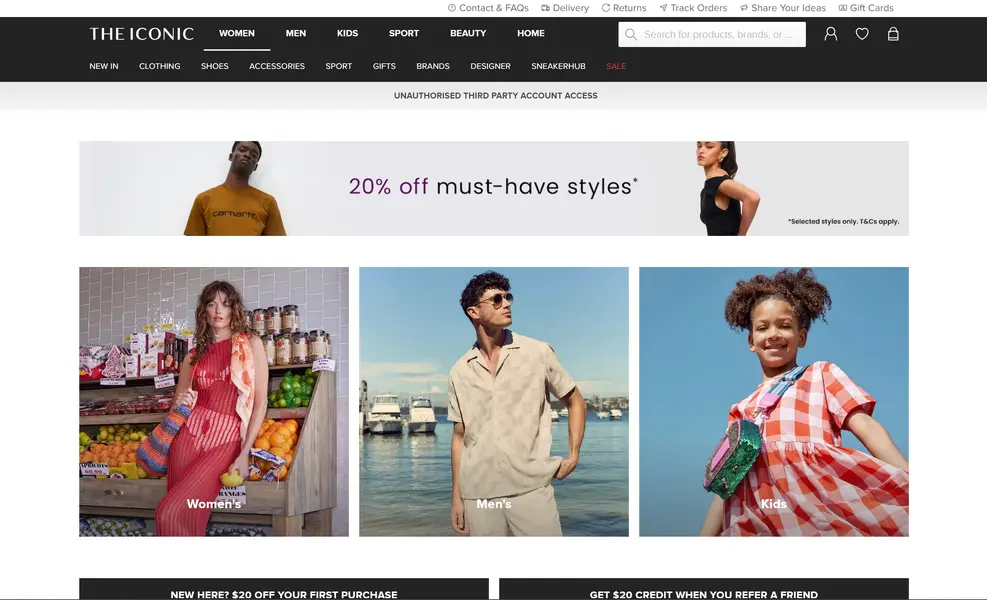
The Iconic runs one catalogue across two countries and prices a garment size by size. We scrape The Iconic so the size system, the seller and the New Zealand price all survive the export.
Plans from €169/month · Free project assessment · Reply within 1 business day
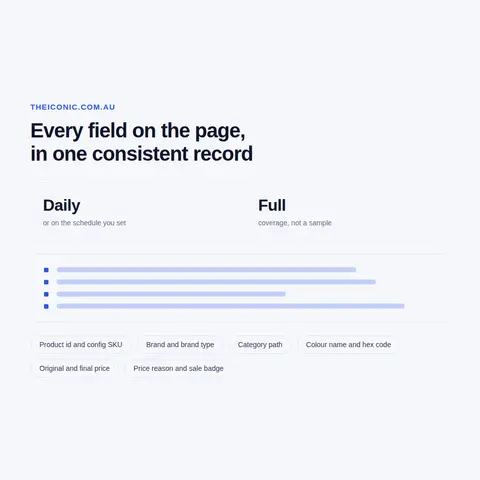
We build The Iconic scraper, run it on your schedule and hand back a file. Daily suits price and stock work; weekly suits assortment tracking. Delivery is CSV, XLSX or JSON, pushed to your storage, or an API endpoint your systems poll. These are scheduled runs rather than a live feed, and we state the run window instead of implying the numbers are instantaneous.
The site sits behind a managed bot challenge and plain scripted clients do not get through it. Anti-bot handling, proxy rotation and CAPTCHA solving are part of the service, not a separate line on the invoice. Scope is yours to set: a brand list, a set of category slugs, one storefront or both. We agree the field list against a sample first, and discontinued products keep their row with a status flag so a price series stays joinable over time.
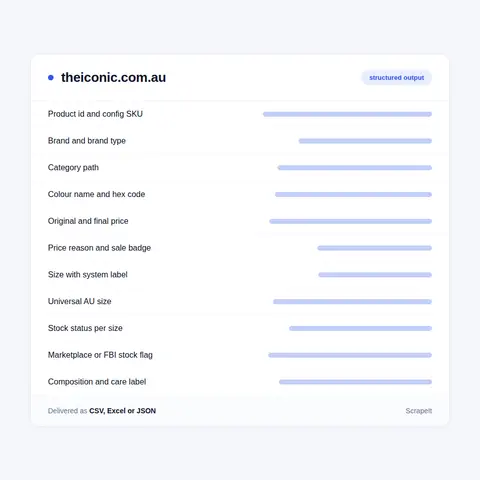
Behind the rendered page each The Iconic product carries a structured record, and inside it a row for every purchasable size. That is what we extract, mapped to named columns rather than left in one description blob:
Prices come through as numbers with the currency in its own column, so an Australian row and a New Zealand row stay comparable rather than collapsing into formatted strings. The measurements note earns a field of its own: garment length quoted against a named Australian size, plus the model's height, bust, waist and hips. Size data can be nested one row per product or flattened to one row per size, the shape you want when the question is which sizes sold out first.
Two storefronts, one product record, and the difference lands where a naive parse misses it. The Australian page and the New Zealand page carry the same product id, the same config SKU and the same per-size SKUs, but the shelf figure differs: a Dr Denim hoodie listed at 130.00 in Australia rings up as A$135.91 across the Tasman. The product markup on the New Zealand page still reports the Australian figure and AUD as its currency, so anything reading only that markup will file New Zealand rows at Australian prices. Assortment differs too - the same dresses category currently shows about a thousand fewer items on the New Zealand shelf.
Who sets the price is itself a published field. The Iconic buys and prices wholesale ranges, runs private labels of its own such as AERE, Atmos&Here and Dazie, takes agency consignment stock, and hosts marketplace sellers on dropship or fulfilled-by-Iconic terms. A single product can mix them: a marketplace size row can be grafted onto a listing under a different config SKU and carry its own price. On own-label lines there is no competitor listing to compare against, which is exactly why assortment depth and markdown history are the only read available on them.
Some things stay out by design. Reviews render through a third-party widget and carry shopper names, so we leave them out by default; no customer accounts, no order data, no personal data of any kind. The shelf figure is also not the figure paid - basket thresholds and a points programme sit on top of it - and we deliver the shelf price, labelled as such.
The Iconic is Australia's largest online fashion, sport and beauty retailer and part of Global Fashion Group. It trades as two storefronts over a single catalogue: theiconic.com.au for Australia and theiconic.co.nz for New Zealand, tied together by hreflang tags on every product page.
Product addresses are flat and readable - theiconic.com.au/{slug}-{id}.html, with the product id as the last number before the extension. That same id opens the same garment on the New Zealand domain, so country is a change of host rather than a second identifier. Brand pages and category pages share the flat namespace: /dr-denim/ sits at the same depth as /accessories-bags-backpacks/, and only the sitemaps tell the two apart.
The Australian storefront publishes three sitemap indexes, for products, brands and categories. The New Zealand storefront publishes none, so the New Zealand shelf has to be covered from the Australian product list and the category tree instead. Category slugs pack the whole path into a single segment, joining gender, department and range with dashes, as in womens-curvy-clothing or womens-iconicexclusives-clothing.
Listing pages take ?page= and ?sort=, repeated brand[] parameters, a price=*-50 band syntax, campaign= edits for curations such as adaptive, modest and wide fit, and sustainability_group[] values including Eco-Production and Fair Production. About sixty products render per page and deep pages keep returning stock, so a big department is reachable - but the workable plan is to slice The Iconic by category, brand and facet rather than page one tree to its end.
Get a Quote
Developers

Customers worldwide

Pages extracted

Hours saved for our clients
€199 / one-time
setup fee - included
€169 / mo
setup fee €499
€229 / mo
setup fee €499
€349 / mo
setup fee €499
€549 / mo
setup fee €799
Delivery: CSV, JSON or XLSX files, our API or a JSON feed. MCP server on request.
Full plan details →Australian womenswear numbers look European and behave like nothing else, and The Iconic prints several systems on the same site.
In the tops chart AU 8 equals UK 8, US 4, EU 36 and international S. In footwear the pairing flips: Australian sizes track US sizes, so AU 8 is US 8, EU 39 and UK 6. The swimwear chart then calls AU 8 an XS while the tops chart calls it an S - one retailer, one shopper, two answers. Lingerie puts five systems in a single row, AU/NZ against EU, French, Italian and UK/US, over a cup ladder that runs A to J through DD, GG and HH. Denim keeps its own column, where AU 8 is a 26 and the odd Australian sizes 5, 7 and 9 map to 23, 25 and 27 with no US or EU equivalent at all. Curve is defined as AU 14 to 26. Rings are AU/UK letters against US numbers.
This is why a size column holding only S is worthless. Every size row here names its own system: a Lorna Jane legging is an international XXS whose universal size is AU 6, a Salomon sneaker is US 4 whose universal size reads US Mens 4 / Womens 5, and a dress cut for the local market is simply AU 8 in both slots. The brand mapping and the site chart openly disagree - the chart puts S at AU 8, the legging puts S at AU 10 - and that disagreement is something a buyer needs to see rather than have averaged away.
Extract The Iconic size data with the system label attached and stock by size turns into a demand signal you can trust: the sizes that fall to one-left first are the sizes actually selling.
About 1.9 million auto parts listings from eBay.de with brand, OEM, EAN and fitment, plus titles and specs machine-translated for the client's team.
Learn More
A one-off Takealot product list for an entrepreneur choosing niches: only products rated 4 stars or higher with at least 50 reviews.
Learn More
Trendyol product data for an e-commerce startup reselling Turkish fashion: 27 categories in JSON on FTP, with in-stock status for every size.
Learn MoreLearn how to use web scraping to solve data problems for your organization
If you sell online, run a marketplace, or advise e-commerce clients, you already know why eBay matters: it’s one of the few places where big retailers compete side by side with thousands of small merchants and private sellers.

E-commerce teams do not just need “some” competitor data anymore. They need a continuous stream of real prices, discounts, stock levels, reviews, and seller behavior from the platforms that actually shape their markets.
Amazon provides valuable information gathered in one place: products, reviews, ratings, exclusive offers, news, etc. So scraping data from Amazon will help solve the problems of the time-consuming process of extracting data from e-commerce.
ScrapeIt is a managed service, not a tool you install and then keep alive yourself. We have run comparable fashion work, including regular price and assortment monitoring for apparel brands across several country storefronts consolidated into one clean dataset. Beyond The Iconic we cover other retailers and marketplaces, real estate portals, job boards and classifieds. When The Iconic revises its front end we repair the parser and re-run, and that maintenance is part of the engagement rather than a separate invoice.
Yes. The ScrapeIt Iconic API returns the product id, config SKU, price, markdown_price, final_price and stock_status per size as JSON from an endpoint we host, refreshed on the schedule you set. The same data also comes as CSV or XLSX files or straight into your database. We work from public pages and the published sitemaps.
Yes, and it pays to run them separately. The two storefronts share product ids and SKUs, and hreflang pairs each page with its twin, so rows join cleanly on identity. What differs is the number on the shelf and what reaches the shelf at all: the same category currently carries about a thousand fewer items in New Zealand, and the structured markup on the New Zealand page repeats the Australian price. We render each storefront in turn and return one row per product per country, with the currency in its own column.
One row per purchasable size, each with its own SKU, price, special price, dispatch time and stock status, which reads in-stock, low-in-stock or one-left. Every row names its size system, so an international S arrives with the Australian equivalent beside it rather than instead of it. Rows also flag whether that size is marketplace stock, fulfilled-by-Iconic stock or sold by a partner, which is what lets you tell a retailer markdown apart from a seller undercutting one.
Daily is the usual cadence for price and stock monitoring; some clients take intraday runs on a short watchlist and weekly runs over the full catalogue. Output is CSV, XLSX or JSON, delivered to your storage or exposed as an API endpoint you poll. Price fields arrive as numbers with the currency in a separate column, and both the original and the final figure are kept, so markdown depth is arithmetic rather than string parsing.
Yes. We collect only publicly available data - the product, price and size data any visitor can see on The Iconic - and we collect it legally, at a polite rate. Product reviews render through a third-party widget and carry shopper names, so they stay out of the standard deliverable; if you need sentiment we scope it separately and strip identifiers. No customer accounts, no order data, no personal data of any kind.
Step 1 - Make a Request
You share your needs, expectations, and desired timeframe. We’ll suggest the best solution based on your request and budget.
Step 2 - Configuring Custom Web Crawlers
Our specialists configure the crawlers and extract a sample dataset for your review before proceeding with the full-scale extraction.
Step 3 - Collect and Deliver
Once you approve the sample, we launch the project and start full data collection. We gather, filter, and structure the data for easy use, delivering it on time in your preferred format.
Step 4 - Maintain and Support
Our team manages ongoing processes, monitors website changes, and supports all data extraction cycles. We can also help integrate data into your systems or create dashboards to simplify analysis.
The Iconic data from €169/month. Free project assessment, reply within 1 business day.

Scrapeit Sp. z o.o.
10/208 Legionowa str., 15-099, Bialystok, Poland
KRS: 0000996672
NIP: 5423457175
REGON: 523384582