eBay Data: 1.9M Auto Parts Listings from eBay.de, Specs Translated
About 1.9 million auto parts listings from eBay.de with brand, OEM, EAN and fitment, plus titles and specs machine-translated for the client's team.
Learn More
Wine Spectator is not a shop and not a crowd. Staff editors taste blind on a published 100-point scale, and every note is signed, priced and dated to a magazine issue.
Plans from €169/month · Free project assessment · Reply within 1 business day
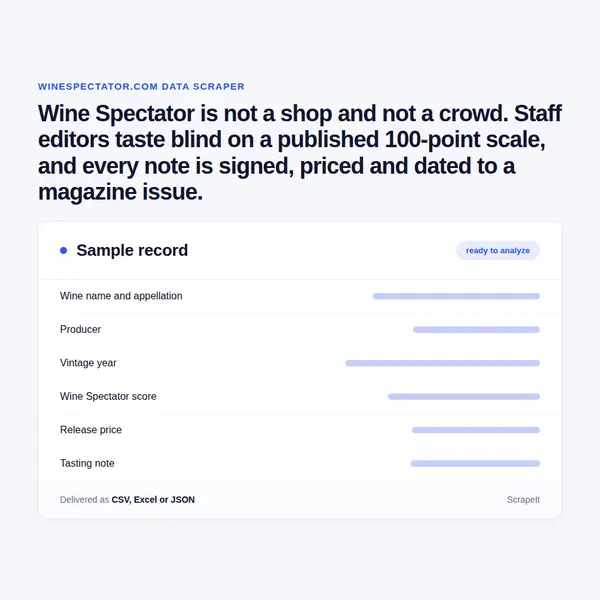
You set the scope: which lists and reports, which regions, grapes and years, and whether you want one row per review or your catalog enriched with matched scores. We build the crawler, run it on your schedule and deliver CSV, JSON, XLSX, a database drop or an API endpoint. Matching is agreed first: the key is producer, wine string and vintage, with rules for accented names, abbreviations, bottle size and non-vintage bottlings, and every row ships with a match confidence and an unmatched list.
The engineering is ours. Anti-bot handling, proxy rotation and CAPTCHA solving are part of the managed service, along with adaptive pacing. Coverage is built from the open lists, the issue and section fronts and public review pages, since the site offers no crawl map. We work only on pages a signed-out visitor can reach, and we do not log in.
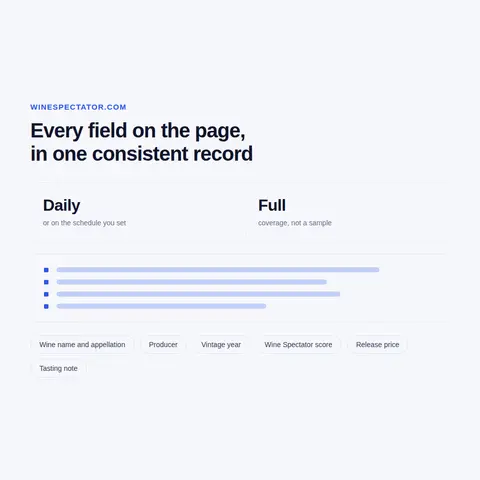
One review is one bottle, one vintage, one score, one taster. These are the fields we extract from Wine Spectator pages, in the publication's own naming:
Not all of that is open to a visitor. On a review page a signed-out reader gets the producer, the wine name, the vintage, color and type, primary and other grapes, the region ladder, the accolades and the issue date, while the score and the price show as placeholders and the note breaks off after its first clause. The ratings search returns nothing without a member session. We do not log in, so a Wine Spectator data feed from us is the public layer plus the open lists below, and we name the missing fields up front. Reviews are signed work: we carry the taster initials the publication prints and build no profiles of the editors behind them.
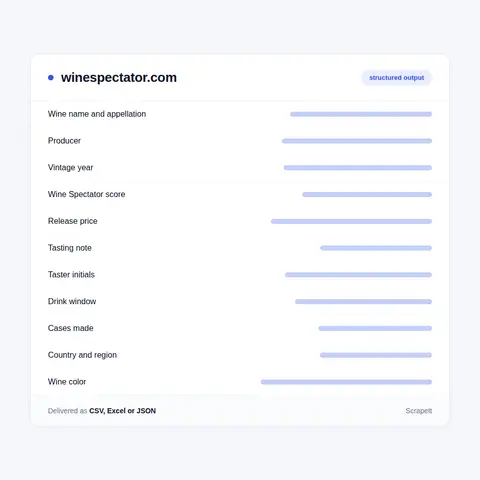
Around the paid archive sit open datasets, the strongest part of a Wine Spectator scraping brief. The Top 100 is currently published as thirty-eight annual lists, 1988 through 2025, one hundred wines each, and every entry carries rank, score, release price, vintage, color, country, region, taster initials, issue date, the full tasting note and a bottle image on recent lists. Every wine on every list scored 90 or better, so the run reads as a time series of what the critics stood behind, by year, grape, region and producer. It needs cleaning: older lists put California and Washington in the country field beside United States.
Vintage charts are open too, and they score years rather than bottles. Editors rate new vintages for more than 50 regions and varieties each season, and each row gives a vintage, a score, a drink window of drink, drink or hold, or past peak, a growing-season paragraph and the top-scoring wines of that year. The ladders go deep: Bordeaux splits into Left Bank reds, Right Bank reds and Sauternes, Burgundy into Cotes de Beaune, Cotes de Nuits and whites, the Rhone into north and south.
Three more open sets round it out. The Daily Wine Pick publishes one complete review a day, with score, price, note, taster and drink window, from an archive of about 13,720 picks. Tasting report articles carry alphabetical listings that print wine, score and price several hundred rows at a time. And the Restaurant Awards search lists about 4,010 winning venues at three award levels, each with address, cuisine, wine and food price bands, wine strengths and the year it first won.
Wine Spectator is a magazine with a scoring archive attached, published by M. Shanken Communications. Editors blind-taste roughly 10,000 to 12,000 wines a year, in dedicated tasting rooms in Napa and New York and at sittings organized in the European wine regions, and every issue prints 400 to 1,000 reviews in its Buying Guide. The archive currently holds more than 450,000 reviews, and that archive is what a Wine Spectator scraper is pointed at.
Scores sit on a 100-point scale with published bands: 95 to 100 Classic, 90 to 94 Outstanding, 85 to 89 Very Good, 80 to 84 Good, 75 to 79 Mediocre, and 50 to 74 not recommended. Editors hold regional beats year after year, so the same taster follows Bordeaux or Piedmont across vintages, and the initials at the end of a note say who scored the bottle. Wines judged from barrel are given four-point ranges such as 85-88 to mark the rating as preliminary, and any review made outside a blind sitting is labeled unofficial.
Addressing is by review id. A single review sits at a wine-detail path carrying a numeric id plus a name slug built from producer, wine and vintage, so one number stands for one bottle in one year as one taster scored it. Editorial pieces sit under an articles path with a spoken-word slug, magazine issues under an issues path with the cover date appended, back to the mid-1990s. The site publishes no crawl map of its own, which decides how coverage of Wine Spectator data has to be assembled.
Get a Quote
Developers

Customers worldwide

Pages extracted

Hours saved for our clients
€199 / one-time
setup fee - included
€169 / mo
setup fee €499
€229 / mo
setup fee €499
€349 / mo
setup fee €499
€549 / mo
setup fee €799
Delivery: CSV, JSON or XLSX files, our API or a JSON feed. MCP server on request.
Full plan details →A rating here is an instrument, not a mood. One trained taster, working blind on a beat they have covered for years, puts a whole number on a bottle on a fixed date and signs it with initials. That number then stops moving. A 95 awarded in a spring issue is the same 95 five years later, which makes the score a stable attribute you attach to a product record once and keep, unlike a running average that drifts every week.
The money question is what the score does to a shelf. The dollar figure printed in a review is a release price at review time, a reference rather than a live quote, and the publication never sells the bottle itself. So the job is a join: take the score, the vintage and the producer, and bind them to the live wine price rows in a retailer or distributor catalog. Once that join holds you can measure what a point is worth inside a category, watch how 90-plus bottlings clear against 88s, and see which suppliers quietly price above their rated tier.
That join is the real work, and it is why briefs land here rather than on a shop feed. Label strings are written the publication's way, with abbreviations such as Ch. and St.-Emilion, accented producer names, vineyard designations, and reserve or riserva bottlings that differ by one word and by twenty dollars. Retailers, importers, brand owners watching how their own scores move across vintages, auction desks and cellar software all buy the same thing: a critic verdict bound correctly to a bottle somebody can actually sell.
About 1.9 million auto parts listings from eBay.de with brand, OEM, EAN and fitment, plus titles and specs machine-translated for the client's team.
Learn More
A one-off Takealot product list for an entrepreneur choosing niches: only products rated 4 stars or higher with at least 50 reviews.
Learn More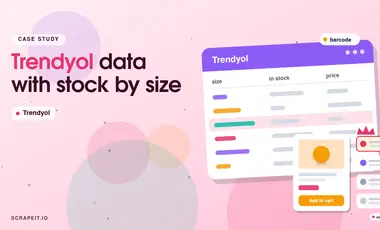
Trendyol product data for an e-commerce startup reselling Turkish fashion: 27 categories in JSON on FTP, with in-stock status for every size.
Learn MoreLearn how to use web scraping to solve data problems for your organization

If you sell online, run a marketplace, or advise e-commerce clients, you already know why eBay matters: it’s one of the few places where big retailers compete side by side with thousands of small merchants and private sellers.

E-commerce teams do not just need “some” competitor data anymore. They need a continuous stream of real prices, discounts, stock levels, reviews, and seller behavior from the platforms that actually shape their markets.
Amazon provides valuable information gathered in one place: products, reviews, ratings, exclusive offers, news, etc. So scraping data from Amazon will help solve the problems of the time-consuming process of extracting data from e-commerce.
ScrapeIt is a managed web scraping team. We have no affiliation with Wine Spectator or with M. Shanken Communications, and we do not resell a stored ratings dataset. You get a crawler built to your brief, watched when the site changes, and clean files or an API on the schedule you set. Layout changes on winespectator.com are handled as maintenance, not as a new project. Start with a sample - one Top 100 decade, one tasting report, or your own catalog matched against the open lists - check the fields and the match rate against your model, then scale.
Yes. The ScrapeIt Wine Spectator API returns Top 100 rank, score, release price, vintage, region and taster initials as JSON from an endpoint we host, refreshed on the schedule you set. The same data also comes as CSV or XLSX files or straight into your database, matched to your product keys.
Open and collectable: the Top 100 lists from 1988 to the current year with scores, prices and full notes; the vintage charts with per-year scores, drink windows and growing-season text; the Daily Wine Pick; the alphabetical listings attached to tasting reports, which print wine, score and price by the hundred; the Restaurant Award winners; news and feature articles with byline and date; and the identity half of a review page, meaning producer, wine, vintage, grapes, region ladder, accolades and issue date. Behind the member login: the ratings search itself, the archive of 450,000-plus reviews, complete notes on individual reviews and the daily pick back catalog. We do not log in, so those stay out of scope.
Yes, and on this source it is the bulk of the work rather than an extra. The key is producer plus the label string plus the vintage: the publication writes a wine as grape, appellation, vineyard designation and bottling name in a single field, so Pinot Noir Russian River Valley Bacigalupi Vineyards Frost Ranch 2024 has to meet whatever your catalog calls the same bottle. We normalize accents and house abbreviations, keep bottle size separate so a 375ml is never matched onto a 750, treat non-vintage bottlings on their own path, and return a confidence value per row plus the unmatched tail for your team to rule on. Score, release price and issue date come across as columns on your product key.
The publication moves on its own calendar and we schedule to it. The Daily Wine Pick lands every day. Tasting reports and their alphabetical listings arrive with each magazine issue, dated to the middle or the end of a month, so a monthly or twice-monthly run catches them whole. The Top 100 is revealed each November, one list a year. Vintage charts are revised as regions are retasted, several updates a month across the chart set. Restaurant Awards refresh annually. Output is CSV, JSON, XLSX, a database drop or an API endpoint from us, with your field names and your product keys.
Yes. The Top 100 lists, the vintage charts, the Daily Wine Pick, the Restaurant Award winners and the identity half of each review page are shown to every visitor, and that is what we collect. We collect only publicly available data - everything a visitor can see on Wine Spectator - and we collect it legally. We work only on public pages, we do not log in, and we collect no personal data.
Step 1 - Make a Request
You share your needs, expectations, and desired timeframe. We’ll suggest the best solution based on your request and budget.
Step 2 - Configuring Custom Web Crawlers
Our specialists configure the crawlers and extract a sample dataset for your review before proceeding with the full-scale extraction.
Step 3 - Collect and Deliver
Once you approve the sample, we launch the project and start full data collection. We gather, filter, and structure the data for easy use, delivering it on time in your preferred format.
Step 4 - Maintain and Support
Our team manages ongoing processes, monitors website changes, and supports all data extraction cycles. We can also help integrate data into your systems or create dashboards to simplify analysis.
Wine Spectator data from €169/month. Free project assessment, reply within 1 business day.

Scrapeit Sp. z o.o.
10/208 Legionowa str., 15-099, Bialystok, Poland
KRS: 0000996672
NIP: 5423457175
REGON: 523384582