eBay Data: 1.9M Auto Parts Listings from eBay.de, Specs Translated
About 1.9 million auto parts listings from eBay.de with brand, OEM, EAN and fitment, plus titles and specs machine-translated for the client's team.
Learn More
A WebstaurantStore row is not a retail row: it carries a selling unit, a case count, a per-each price and a volume break, and the parts pages say which model each part fits.
Plans from €169/month · Free project assessment · Reply within 1 business day
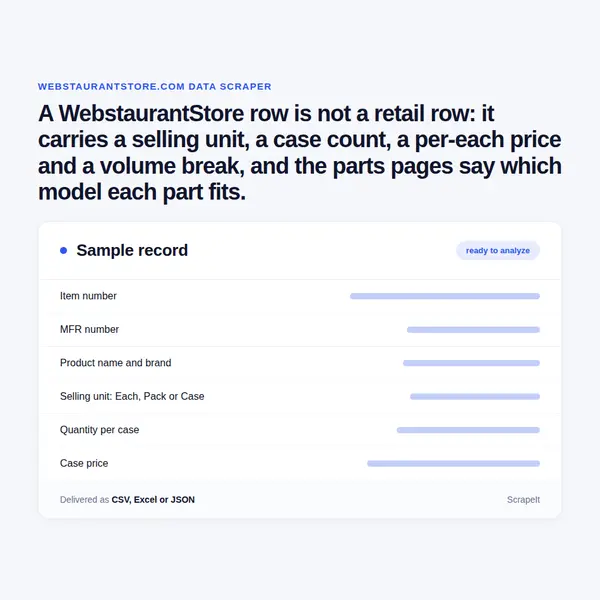
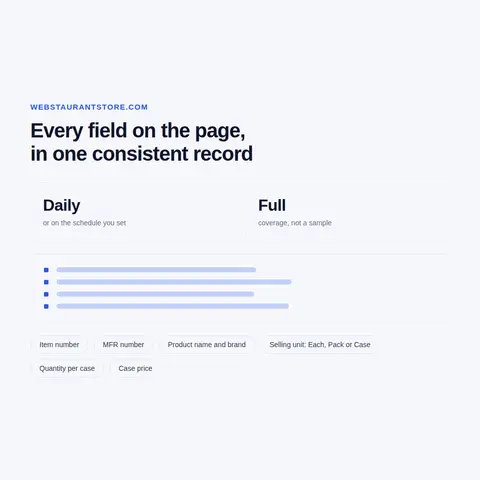
You set the scope - whole departments, named leaf categories, a vendor list, a set of item numbers, or the parts graph around specific equipment models - and we deliver CSV, JSON, XLSX or an API endpoint of ours on your schedule. Price, member price and stock usually run daily or weekly; spec fields, documents and the fitment graph move slowly, so a monthly pass covers them.
The engineering is ours. Listings serve a hundred items to a page, and asking for a page past the last one quietly returns the first page again, so coverage is assembled from the department sitemaps and the category tree instead of looping until a page comes back empty. Anti-bot handling, proxy rotation and CAPTCHA solving are part of the managed service, run at a polite rate rather than a brute-force one. We take only what a signed-out visitor sees, we do not log in, and we do not collect personal data.
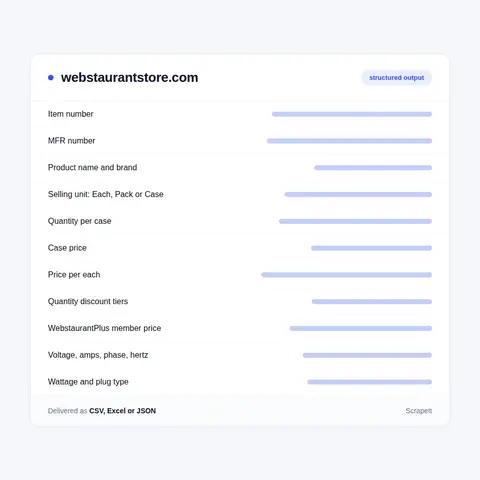
What separates WebstaurantStore data from retail data is the selling unit. Every item carries a Quantity field written as 1/Each, 100/Pack or 200/Case, and the price is quoted against that unit. A clamshell container listed at 200/Case prints the case price and, beside it, the derived per-each figure. Two numbers, one row, different meanings.
Volume breaks are published, not hidden behind a quote form. Above the price sits a Quantity Discounts block: Buy 1 at the case price, then a 2+ tier at a lower case price, each tier restating the per-unit cost. Pack size is a second axis - the same kids crayon pack is sold both as a hundred-count case and a thousand-count case, each with its own item number and its own per-each economics. Store one price per URL and you lose the ladder, and the ladder is the point of a wholesale price monitoring feed.
Two prices and two identifiers. An item publishes the list price and a second price valid for the WebstaurantPlus member tier, so a WebstaurantStore price series has to keep both. Identity is doubled as well: an Item number that belongs to the site, and on parts and components an MFR number that belongs to the manufacturer, the first built from a three-digit vendor prefix wrapped around the second. Beverage-Air bracket 401-832A is item 065401832A here. UPC codes are on the page too, and equivalent parts carry a caret suffix in the item number.
Then the specification block, which for equipment is the reason buyers arrive: shipping weight, exterior and interior width, depth and height, Voltage, Amps, Phase, Hertz, Wattage in kilowatts, Plug Type given as NEMA 5-15P or Hardwire, Gas Connection Size, total BTU, temperature range, number of decks, doors, racks and chambers, control type, door type, installation type, material, color, and feature flags including NSF Certified, Energy Star Qualified and Made in America. Equipment rows also print a Quality Rating of Good, Better or Best and a warranty note voiding cover on residential installs.
The fitment graph is the rarest thing here. Each stocked model has its own page at compatible-with.html keyed by item number, titled Parts and Manuals for that model, listing replacements and accessories with their own item numbers and prices. Read from the other end, a part page prints a Compatible Models list - one infinite heat switch names 165 APW Wyott units by model code and voltage - and an Equivalent Items block cross-referencing the OEM part numbers it stands in for. Roughly 28,000 fitment pages and about 5,000 equivalent-part records are published, which is a usable spine for any foodservice equipment data or aftermarket parts project.
Documents. Items link out to spec sheets, user manuals, parts manuals, warranty statements, brochures, elevation charts and safety data sheets; the document sitemaps together list roughly 113,000 PDFs.
Availability and freight. A row says whether stock leaves the warehouse in a business day or comes from the manufacturer in one to five days with lead times that vary, and many items carry state-level shipping restrictions - one oven cannot ship to Colorado or Washington, another is barred from six states. Nine warehouse states drive the transit map and installation availability is checked by ZIP code, so delivery promise is a function of the address.
Also published: roughly 10,000 product videos, 358 buying guides, outlet and Scratch and Dent stock, and 126 city supply pages. Reviews carry buyer names, so personal data is left out by default.
WebstaurantStore is a United States wholesale supplier to restaurants, bars, hotels, schools, caterers and other foodservice operators, and its catalog behaves like a distributor price list rather than a shop window. In September 2026 the department sitemaps carry about 519,000 product addresses across thirty-two files, split the way a supply house splits its floor: cooking equipment, refrigeration equipment, equipment parts, smallwares, tabletop, disposables, janitorial supplies, industrial supplies, commercial furniture, storage and transport, food and beverage, with narrower sets for concession equipment, candy making machines and smart kitchen appliances.
Ten departments sit across the top - Restaurant Equipment, Refrigeration, Smallwares, Food and Beverage, Tabletop, Disposables, Furniture, Storage and Transport, Janitorial, Industrial - beside a Business Type entry that regroups the same stock by who is buying. Below them the tree is deep and numeric. A leaf category is addressed as an id plus a slug, as in /14181/commercial-convection-ovens.html, while department roots keep a bare slug. Breadcrumbs run four and five levels: a burner valve knob lives under Restaurant Equipment, then Cooking Equipment, then Cooking Equipment Parts and Accessories, then Griddle Parts and Accessories.
Roughly 30,000 category addresses are published, and on top of them roughly 25,000 category-plus-vendor combinations and a separate set of specification facets, each a real URL of the form filter equals material colon stainless-steel. A WebstaurantStore scraper that walks this tree inherits the merchandising hierarchy, which is exactly what a flat product dump throws away.
Get a Quote
Developers

Customers worldwide

Pages extracted

Hours saved for our clients
€199 / one-time
setup fee - included
€169 / mo
setup fee €499
€229 / mo
setup fee €499
€349 / mo
setup fee €499
€549 / mo
setup fee €799
Delivery: CSV, JSON or XLSX files, our API or a JSON feed. MCP server on request.
Full plan details →Wholesale comparison runs on different arithmetic. A rival selling the same clamshell at a lower case price can still be dearer per unit once the pack count changes, so any comparison built on the headline figure is wrong more often than it is right. Scrape WebstaurantStore with the selling unit attached and the per-unit series becomes comparable across suppliers, pack sizes and quantity tiers - that is the whole job of a B2B product feed.
Manufacturers and distributors read the same feed differently. The catalog is a public price list covering roughly 3,300 vendor pages, so a brand can see where its models sit against substitutes, which of its items are stocked and which are drop-shipped, and where a house label has been placed on the same shelf. Equipment dealers use WebstaurantStore price data to sanity-check their own quotes on models both sides carry.
Operators and procurement software want the spec fields more than the money. Voltage, phase, plug type, gas connection size and BTU decide whether a unit can be installed at all, and a kitchen design or menu costing tool that carries those fields rules out the wrong machine before anyone measures a wall. Restaurant supply data with real electrical and dimensional attributes is far harder to buy than another list of names and photographs.
About 1.9 million auto parts listings from eBay.de with brand, OEM, EAN and fitment, plus titles and specs machine-translated for the client's team.
Learn More
A one-off Takealot product list for an entrepreneur choosing niches: only products rated 4 stars or higher with at least 50 reviews.
Learn More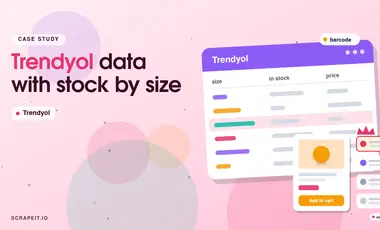
Trendyol product data for an e-commerce startup reselling Turkish fashion: 27 categories in JSON on FTP, with in-stock status for every size.
Learn MoreLearn how to use web scraping to solve data problems for your organization
If you sell online, run a marketplace, or advise e-commerce clients, you already know why eBay matters: it’s one of the few places where big retailers compete side by side with thousands of small merchants and private sellers.

E-commerce teams do not just need “some” competitor data anymore. They need a continuous stream of real prices, discounts, stock levels, reviews, and seller behavior from the platforms that actually shape their markets.
Amazon provides valuable information gathered in one place: products, reviews, ratings, exclusive offers, news, etc. So scraping data from Amazon will help solve the problems of the time-consuming process of extracting data from e-commerce.
ScrapeIt is a managed web scraping agency with no affiliation with The WEBstaurant Store, LLC. We scope the job, build the crawler, run it on your schedule, watch it when the site changes and repair it before you have to file a ticket. We collect only publicly available data - everything a visitor can see on WebstaurantStore - and we collect it legally. Begin with a sample of one department, check the case and each fields against your model, then scale to the catalog you need.
Yes. The ScrapeIt WebstaurantStore API returns item number, selling unit, list price, WebstaurantPlus member price, quantity discount tiers and stock status as JSON from an endpoint we host, refreshed on the schedule you set. The same data also comes as CSV or XLSX files or straight into your database.
Every row keeps the selling unit as its own column - Each, Pack or Case - with the pack count, the price for that unit, and the per-unit price the site prints beside it. Quantity Discount tiers become their own rows or a nested list, so Buy 1 and the 2+ tier are both preserved with their per-unit figures. Where the same product is sold in several pack sizes, each size keeps its own item number and price, and we add a normalised per-unit field so pack sizes can be compared directly. The WebstaurantPlus member price is a separate column from the list price.
Yes, and for the parts trade it is the most valuable set here. We collect it in both directions: from an equipment item to its replacements and accessories through the compatible-with page keyed by item number, and from a part to the Compatible Models list and the Equivalent Items cross-reference of OEM numbers it replaces. The result is an edge table of part item number, model reference, brand and relation type, plus the equivalence pairs. Long fitment lists load in batches on the page, so the crawler is built to page through them rather than take the first screen.
As often as the question needs. Price, member price, quantity tiers and stock status are the volatile fields and normally run daily or weekly against a fixed set of item numbers so the series stays comparable. Category membership, specification tables, documents and the fitment graph change slowly and a monthly or quarterly pass is enough. Full-catalog sweeps across all departments are scheduled less often and paced politely; a watchlist of a few thousand items can run every day without strain.
Yes. Case, pack and each prices, member prices, specification tables and the parts fitment lists are shown to every signed-out visitor, and those are the fields we collect. We collect only publicly available data - everything a visitor can see on WebstaurantStore - and we collect it legally. We work only on pages a signed-out visitor can reach, we do not log in and we do not gather personal data.
Step 1 - Make a Request
You share your needs, expectations, and desired timeframe. We’ll suggest the best solution based on your request and budget.
Step 2 - Configuring Custom Web Crawlers
Our specialists configure the crawlers and extract a sample dataset for your review before proceeding with the full-scale extraction.
Step 3 - Collect and Deliver
Once you approve the sample, we launch the project and start full data collection. We gather, filter, and structure the data for easy use, delivering it on time in your preferred format.
Step 4 - Maintain and Support
Our team manages ongoing processes, monitors website changes, and supports all data extraction cycles. We can also help integrate data into your systems or create dashboards to simplify analysis.
WebstaurantStore data from €169/month. Free project assessment, reply within 1 business day.

Scrapeit Sp. z o.o.
10/208 Legionowa str., 15-099, Bialystok, Poland
KRS: 0000996672
NIP: 5423457175
REGON: 523384582