ESPN Scraper for Scores, Rosters and Broadcast Listings

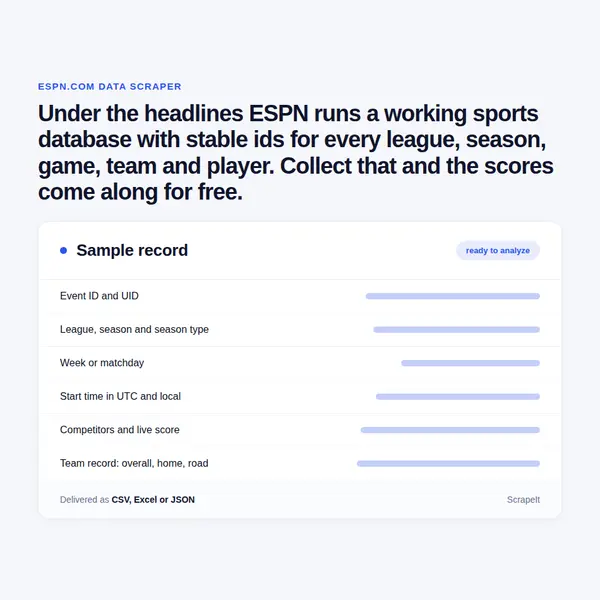
Under the headlines ESPN runs a working sports database with stable ids for every league, season, game, team and player. Collect that and the scores come along for free.

ESPN Scraper
Solutions

ESPN scraping built, run and watched by our engineers

ScrapeIt runs the ESPN scraper as a managed service. You name the sports, competitions and seasons; we build the pipeline, pace it inside the crawl rules the site publishes, and deliver CSV, JSON, Excel or a load straight into your warehouse.

The plumbing is part of the job, because ESPN answers automated clients unevenly and its edge decides what you see: anti-bot handling, proxy rotation and CAPTCHA solving are included, and we hold the exit region steady so broadcast and odds rows keep their meaning between runs. Nothing behind a sign-in is touched. Player data is professional sporting information about public figures; contact details, injury and medical notes, private life and fantasy users' own profiles stay out. ESPN content is rights-protected, so the output is built for analysis rather than republication - take the use case to your own counsel first, especially where it feeds a betting product.

What lands in an ESPN data export, field by field

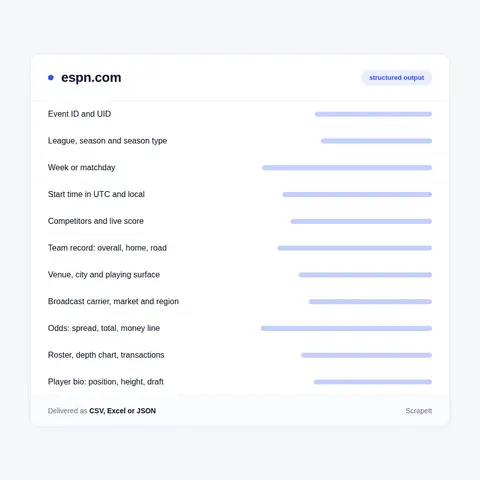
The event record is the spine of any ESPN data export: event id and uid, sport, league, season year, season type, week or matchday, start time in UTC with the local kickoff kept beside it, the short ATL @ GB form of the name, the long form, and a status block with period, clock, display clock and a state of pre, in or post.

Around that sit the blocks buyers actually ask for:

  • Competitors - team id and uid, location, nickname, abbreviation, primary and alternate color, live score, home or away, and records split into overall, home and road.
  • Venue and conditions - venue id, name, city, state, country, indoor flag and playing surface, plus the weather line on outdoor fixtures.
  • Broadcast - named carriers per fixture with a market of national, home or away, a type of TV or streaming, and the language and region the entry belongs to.
  • Odds - sportsbook provider, spread, over/under total, money line for both sides and an opening-favourite flag.
  • Tickets - ESPN ticket prices arrive as a resale floor with a seat count, supplied by a partner rather than a box office, and labelled that way.
  • Event stream - typed incidents on a clock: goals, yellow and red cards, penalty kicks, own goals and shootout flags on the football side; drives and scoring plays on the American side; each tied to the athletes involved.
  • Leaders - match and season statistical leaders with metric name, value, display value and the athlete behind it.

Team records carry franchise, venue, coaches, groups, depth charts, transactions, awards, season statistics, leaders, ranks, against-the-spread records and odds records. Athlete records carry athlete id, full and display name, jersey, position, height, weight, age, date of birth, birthplace, college, draft round, pick and year, years of experience, active status and current team, with per-season statistics and a game-by-game log behind their own references. Standings arrive as conference groups with divisions nested under them, each row holding wins, losses, ties, percentage, points for and against, and streak. Every row we hand back carries its league, season, season type and collection time, because a score without a season type is a guess, not a fact.

What lands in an ESPN data export, field by field
Editions, region-scoped broadcast rows and the fantasy side

Editions, region-scoped broadcast rows and the fantasy side

ESPN is not one storefront. The same host serves a different edition depending on where the request lands, switched by country and language parameters and labelled espn-en-us, espn-es-mx, espn-pt-br, espn-en-au and so on, while several editions also answer on their own domains: espn.co.uk, espn.com.au, espn.com.br and africa.espn.com. The switcher carried fourteen storefronts in September 2026, among them a Spanish-language Deportes edition, the UK, Australia, India, the Philippines and five Latin American ones.

The differences are not cosmetic. The UK edition leads with the Premier League, darts and cricket; the Australian edition carries AFL, NRL, NBL, netball and the A-Leagues beside the American sports, and swaps season-long fantasy for tipping games; the Spanish and Portuguese editions translate labels and reorder competitions. Broadcast rows follow the same logic: a Premier League fixture returns US carriers for a US region and nothing at all for a UK one, because those rights are not ESPN's to list there. Listings for a market have to be collected as that market, and we pin that per feed.

Fantasy is a separate system with its own host, path shape and season labels. Games are coded ffl, fba, flb and fhl for football, basketball, baseball and hockey, addressed by season and scoring period, with a public player universe holding roster slots, default position, pro team and ownership percentage. Pick'em, Survivor, Win Totals and Playoff Predictor are versioned by year in their own paths. Individual leagues need a sign-in, so that is where we stop: aggregate ownership is public, managers are not.

How ESPN is put together: sports, leagues, seasons, events

ESPN publishes sport, but underneath the articles it runs a working sports database, and that database is the part worth collecting. The public index carries seventeen sports - football, basketball, baseball, hockey, soccer, golf, tennis, racing, rugby, rugby league, cricket, MMA, lacrosse, volleyball, water polo, field hockey and Australian football - and each one holds its own league list, from a single league under Australian football to 219 soccer competitions in September 2026, coded with dots: eng.1, esp.1, ger.1, usa.1, uefa.champions, fifa.world.

Addressing is regular once the shape is clear. Everything hangs off sport, then league, then season, then season type, then a week or a calendar date, then an event. Season types separate preseason, regular season, postseason and off season, and tables exist only for the first two. Playoff rounds are modelled as weeks named Wild Card, Divisional Round, Conference Championship and Super Bowl, so a bracket is rebuilt from round-labelled events rather than read out of a bracket object. Ids are numeric and travel with a compact uid: s:20~l:28~t:9 is a team, where 20 is the football sport and 28 the NFL, while soccer sits under sport 600 with the Premier League as league 700.

Web pages reuse the same ids. A gamecast is /nfl/game/_/gameId/ plus the event id. A club page is /nfl/team/_/name/gb/green-bay-packers, with roster, depth chart, schedule, stats, injuries and transactions tabs beneath it. A player is /nfl/player/_/id/ plus the athlete id, carrying stats, splits, gamelog and bio. Football uses /soccer/match/_/gameId/. The trailing name in the path is decoration; the id is the stable handle.

Get a Quote

dev_w
25

Developers

customers
500+

Customers worldwide

pages
1 500 000 000+

Pages extracted

stime
15000+

Hours saved for our clients

Plans

Airplane

€199 / one-time

setup fee - included

Data limits100,000
Frequencyone-time
Run timeup to 5 days
Data storing7 days

Helicopter

€169 / mo

setup fee €499

Data limits250,000
Frequencymonthly
Run timeup to 5 days
Data storing14 days

Glasses

€229 / mo

setup fee €499

Data limits1,000,000
Frequencyweekly
Run timeup to 5 days
Data storing30 days

DNA

€549 / mo

setup fee €799

Data limits3,000,000
Frequency3 times daily
Run timesame day
Data storing90 days

Why an ESPN feed is a join key before it is a dataset

The first reason to scrape ESPN is not the scores, which exist in plenty of places. It is the identity layer underneath them. A single numeric athlete id runs from the fantasy player universe through the match leaders block to the player page; a single team id runs from the scoreboard through standings, depth charts and transactions. Anyone stitching several sports sources together spends most of the budget matching names; starting from ESPN ids turns that into a lookup.

The second reason is breadth from one grammar. The same sport, league, season and event path serves an NFL Sunday, a LaLiga round, an NHL night, a college volleyball fixture and a UFC card, so adding a competition is a configuration change rather than a new collector. That is what makes wide coverage affordable.

The third is material that sports data vendors normally sell separately, sitting in the same payload as the score: broadcast listings, sportsbook lines and a matchup projection with a win percentage for each side. A rights analyst or a media planner needs to know which carrier has a given week's game - Prime Video, FOX, CBS, NBC, Netflix, ABC or ESPN itself - and almost no scores feed carries that.

Historical depth is real but lopsided, and scoping it honestly saves money. The American leagues reach a long way back: the NFL season list starts in the 1920s, baseball earlier still, college football earlier again. Soccer competitions here begin around the turn of the century. Backfill on the deep leagues is a one-off, so the recurring cost is only the live half.

Our Blog

Reads Our Latest News & Blog

Learn how to use web scraping to solve data problems for your organization

How Artificial Intelligence Is Used In Web Scraping

How Artificial Intelligence Is Used In Web Scraping

Leveraging advances in technology, the AI-powered web scraper has skyrocketed in demand and is helping to expand capabilities by automating tedious daily tasks and speeding up data collection from thousands of websites several times over.

What is Web Scraping and What is it Used For?

What is Web Scraping and What is it Used For?

Web scraping is a method of obtaining web data by extracting it from pages of web resources with the help of a program, that is, in automatic mode. It is used to syntactically convert web pages into more usable forms.

Web Scraping for Machine Learning

Web Scraping for Machine Learning

If you specialize in machine learning, you need to feed large amounts of data to the algorithms. Web scraping is the easiest and the most efficient method of collecting the data from all over the Internet.

scrapeit logo

Who builds and keeps your ESPN feed running

ScrapeIt is a managed web scraping agency, not a self-serve tool. A named engineer owns the job end to end: scoping the sports and competitions with you, building the extraction, watching it when the site changes shape mid-season, and repairing it before your dashboard notices. Delivery lands on the schedule you asked for, in the format your systems already read, and the support channel is staffed by the people who wrote the collector. Start with a paid sample, test it against what you expect to see, then scale the competition list.

FAQ

Does ESPN have a public API we can license instead?

Not in any usable public form. The old documented v1 service refuses requests without a key, and the developer portal that once issued those keys no longer serves anything. The endpoints the site itself calls - the site and core sports hosts, and the fantasy read host - answer without a key, but they are undocumented, unversioned and unsupported; internal host names even leak into their own cross-references. They change without notice and break quietly, so we treat them as one input among several, monitor for shape changes and fall back to page collection. A licensed feed from ESPN or a rights holder is a different product with guarantees attached, and this is not it.

Which sports and competitions can you actually cover?

Seventeen sports are addressable, each with its own league list: soccer is by far the deepest at 219 competitions, followed by MMA, rugby, basketball, baseball, golf, hockey, racing and the rest. In practice nobody needs all of it. We agree the competition set at the start - say the four North American majors, college football and basketball, and thirty soccer leagues - and price the live half against that list. Adding a competition later is a configuration change, not a rebuild, because every league sits behind the same path grammar.

How often can ESPN data be refreshed?

Per phase, not uniformly, because that is what keeps the bill sensible. Fixture lists and rosters move on a daily or weekly pass. Odds and lineups tighten in the hours before a start. Live score and event state runs at minute level, and only for the fixtures on your list, then stops the moment a game is final. Completed seasons are collected once and never revisited, since a finished box score never changes. We set the cadence per competition and per phase and show you the request volume each choice implies before anything is built.

What formats do you deliver ESPN data in?

CSV, JSON, Excel, Parquet, or a direct push into your warehouse or object storage - Snowflake, BigQuery, Postgres, S3 and GCS are all routine. Events, teams, athletes, standings and incident streams come as separate related tables joined on ESPN ids, so you can load the lot or only the slice you use. Runs are incremental with change records, timestamps are UTC with the local start kept alongside, and the schema is agreed up front and versioned, so a downstream model does not break when we add a column.

Is it legal to scrape ESPN, and what do you leave out?

We collect what the site renders publicly, at a polite rate, inside the crawl rules it publishes - which on this source means leaving the disallowed soccer lineup, commentary, match-stats and video paths alone and taking those from the competition's own site instead. We do not sign in, so subscriber video and private fantasy leagues are out of scope, and we do not work around geographic restrictions. Athlete records are professional sporting information about public figures; injury and medical notes, contact details and private life are excluded, as are fantasy users' profiles. ESPN content is rights-protected, so the dataset is for analysis, not republication. Bring your use case to your own counsel before the build.

How does it Work?

Step 1 - Make a Request

You share your needs, expectations, and desired timeframe. We’ll suggest the best solution based on your request and budget.

Step 2 - Configuring Custom Web Crawlers

Our specialists configure the crawlers and extract a sample dataset for your review before proceeding with the full-scale extraction.

Step 3 - Collect and Deliver

Once you approve the sample, we launch the project and start full data collection. We gather, filter, and structure the data for easy use, delivering it on time in your preferred format.

Step 4 - Maintain and Support

Our team manages ongoing processes, monitors website changes, and supports all data extraction cycles. We can also help integrate data into your systems or create dashboards to simplify analysis.

Request a Quote

Tell us more about you and your project information.
Which sites, which fields, how often. A couple of lines is enough.

We reply within 1 business day. No obligation.

scrapiet

Scrapeit Sp. z o.o.
10/208 Legionowa str., 15-099, Bialystok, Poland
NIP: 5423457175
REGON: 523384582