NFL Scraper for Game Books, Next Gen Stats and Injury Reports

Every NFL game leaves a league-issued game book: officials, weather, each play in order and a snap-share page per player. Add stats back to 1970 and a season turns into a dataset.

Plans from €169/month · Free project assessment · Reply within 1 business day

NFL Scraper
Solutions

NFL data scraping run for you from Thursday night to Monday night

ScrapeIt runs the NFL scraper as a managed service. You choose the seasons, weeks and tables; we build the collectors that extract NFL data from the pages, turn each game book PDF into drive, play and snap tables, and deliver CSV, JSON, Excel, Parquet or a load into your warehouse. Collection follows the game week: schedule and transactions daily, the injury report each time it moves, scores and drives through every Thursday, Sunday and Monday window, the game book once it posts.

The heavy lifting is ours: anti-bot handling, proxy rotation and CAPTCHA solving come with the service, and parsers are re-tested whenever a page changes shape mid-season. No logins, no paywalls: NFL+, NFL Game Pass and NFL Pro stay out of the job.

Fields an NFL data scraper lifts from every game, drive and snap

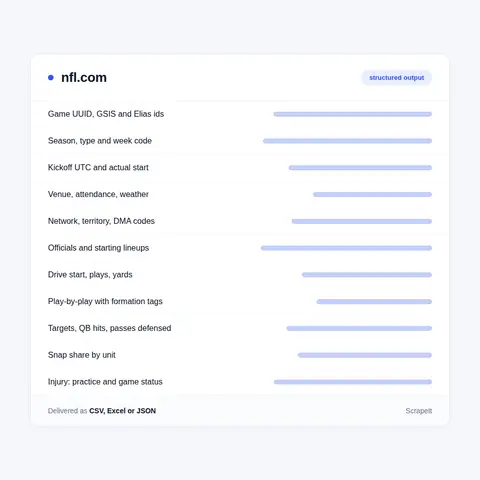
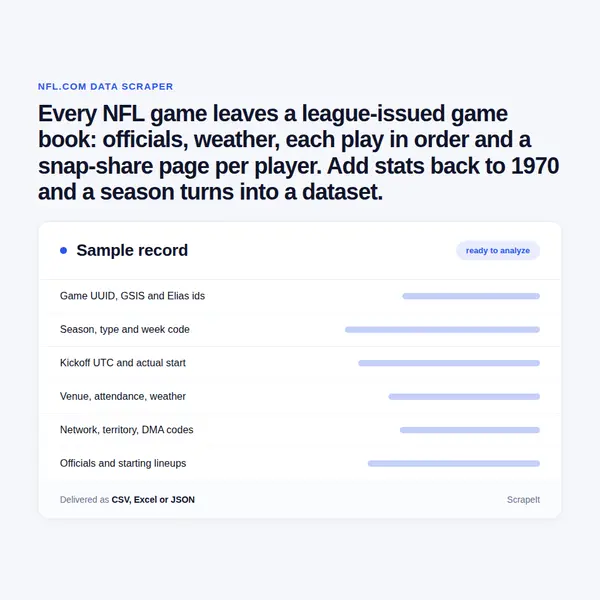
The game record is the spine: UUID, GSIS and Elias ids, slug, season, season type and week, a TNF, SNF or MNF prime-time flag, scheduled kickoff and actual start in UTC, venue id, city and country, international and neutral-site flags, phase, attendance, a weather line, score by quarter and overtime, timeouts left. The broadcast block doubles as NFL TV listings: network per side, national or regional territory, Spanish-language and alternate streams, audio from Westwood One, Entravision and both clubs' radio calls, and for regional windows the TV markets as Nielsen DMA codes.

The game book adds what no score strip carries:

  • Lineups - officials with numbers, starters by position, substitutions, did-not-play and not-active lists.
  • Drive chart - how each possession began and ended, start spot, plays, yards, penalty yards and first downs.
  • Play-by-play - down, distance, yard line, clock, Shotgun and No Huddle tags, play text with tacklers, penalties, replay reversals and in-game injury notes.
  • Player lines - passing, rushing, receiving with targets, returns and kicking, plus a defensive sheet with tackles, assists, sacks, tackles for loss, QB hits and passes defensed.
  • Team sheet - third-down, fourth-down, red-zone and goal-to-go rates, possession by quarter, largest lead and lead changes.
  • Playtime percentage - snaps and share per player on offense, defense and special teams, the league's own snap counts, flagged unofficial.

Season tables sit beside the games. Player stats come in eleven categories from passing to punt returns, 1970 onward, twenty-five rows a page and sortable on any column, so NFL stats leaders for any measure are one sort away. Team tables split offense, defense and special teams. Standings rows hold W, L, T, PCT, points for and against, net points, home, road, division, conference and non-conference marks, streak and last five, with clinch flags for playoff berth, division, bye, home field and elimination: NFL team records in one row. Rosters add jersey, position, a roster status such as ACT, DEV, RES or PUP, height in inches, weight, experience and college, which is how NFL stats by position get built. Every row carries season, week and collection time.

Fields an NFL data scraper lifts from every game, drive and snap
Injury reports, transactions, draft and combine: the rest of an NFL dataset

Injury reports, transactions, draft and combine: the rest of an NFL dataset

The official injury report runs per week and per game from 2009, postseason included. Each row gives player, position, the injury as listed, practice participation - did not participate, limited or full - and a game status of Out, Doubtful or Questionable; reports up to 2015 also carry Probable, a status later seasons dropped. We take it exactly as published, with no guesses about severity or return dates, which makes an NFL injury dataset you can stand behind.

Transactions arrive in six streams - trades, signings, reserve list, waivers, terminations and other - by year and month, each row naming both clubs, date, player, position and the league's wording, from Reserve/Injured to Waived, Injury Settlement.

The draft tracker covers 2014 to date: round, pick, club, school, class, measured height, weight, arm, hand and wingspan, production, athleticism and overall scores, and the analyst's write-up, an NFL draft dataset that joins to the pro career by id. Combine results add the 40-yard dash, 10-yard split, vertical, broad jump, 3-cone, shuttle and bench press, filterable by position and college, the core of an NFL combine dataset.

Two pieces live elsewhere. Depth charts are not on NFL.com: each club publishes its own depth chart on its own site, several marked unofficial, and we collect them on the same schedule. Game-day inactives sit in each game book's not-active list.

NFL.com runs on weeks, and every game leaves a game book

NFL.com is the league's own publishing arm, run by NFL Enterprises, and it keeps the record other outlets re-type: NFL results for every week since 1920, NFL standings to match, season stats from 1970, the official injury report, transactions, the draft and, for most games back to 2000, an official game book in PDF. An NFL scraper that learns how the site counts time reaches all of it.

Time is counted in weeks. A season runs pre0, the Hall of Fame game, through pre3, then reg1 through reg18, then post1 through post4 for the Wild Card round, the Divisional round, the conference championships and the Super Bowl, with the Pro Bowl filed apart as pro. Weekly pages follow that code, and a game is addressed away-at-home with season, type and week: falcons-at-packers-2026-reg-3. Slugs keep the name a club carried at the time, so a 2005 opener reads bears-at-redskins-2005-reg-1.

Behind each slug sit three ids: a UUID, a five-digit GSIS number such as 60210, and an Elias key made of the date and a two-digit counter, 2026092400 for the first game of 24 September 2026. Older games keep the date inside the UUID as well: 10012005-0911 is 11 September 2005. Clubs carry UUIDs that open with 1040 and a four-digit legacy code, so 10401800 is Green Bay and 10405110 is Washington under every nickname it has used. Tricodes drift - Jacksonville was JAC in 1999 and is JAX now, the Rams are LAR in the data but LA in logo paths - which is why the UUID is the join key.

Get a Quote
dev_w
25

Developers

customers
500+

Customers worldwide

pages
1 500 000 000+

Pages extracted

stime
15000+

Hours saved for our clients

Plans

NFL Scraping Plans and Pricing

Airplane

€199 / one-time

setup fee - included

Data limits100,000
Frequencyone-time
Run timeup to 5 days
Data storing7 days

Helicopter

€169 / mo

setup fee €499

Data limits250,000
Frequencymonthly
Run timeup to 5 days
Data storing14 days

Glasses

€229 / mo

setup fee €499

Data limits1,000,000
Frequencyweekly
Run timeup to 5 days
Data storing30 days

DNA

€549 / mo

setup fee €799

Data limits3,000,000
Frequency3 times daily
Run timesame day
Data storing90 days

Why scrape NFL data at the league itself

Scraping NFL data at the league is about provenance first. The game book is the league's own account of a game, the stats pages feed its leaderboards and the injury report is the official one; everything downstream is a copy with a delay. When two sources disagree on a target, a snap or a tackle, this is where the argument ends.

It is also the most complete public record. Scores, drives, snaps, the injury report and the Next Gen Stats boards all sit on pages any visitor can open, so web scraping NFL data from those pages gives one consistent set of numbers from Thursday night to Monday night.

Then there is tracking. Two or three RFID tags in each player's shoulder pads report position, speed and acceleration ten times a second, and the Next Gen Stats boards publish what comes out: time to throw, completed and intended air yards, aggressiveness, completion percentage above expectation, rush yards over expected, cushion, separation and ball-carrier top speed in miles per hour, week by week from 2018.

Depth comes with seams worth mapping. A 2005 game book has no targets, QB hits or playtime page, and 1970 stat rows print zeros for 20-plus and 40-plus yard completions nobody counted then. An NFL dataset for machine learning should mark those as missing, not as none.

Our Blog

Reads Our Latest News & Blog

Learn how to use web scraping to solve data problems for your organization

How Artificial Intelligence Is Used In Web Scraping

How Artificial Intelligence Is Used In Web Scraping

Leveraging advances in technology, the AI-powered web scraper has skyrocketed in demand and is helping to expand capabilities by automating tedious daily tasks and speeding up data collection from thousands of websites several times over.

What is Web Scraping and What is it Used For?

What is Web Scraping and What is it Used For?

Web scraping is a method of obtaining web data by extracting it from pages of web resources with the help of a program, that is, in automatic mode. It is used to syntactically convert web pages into more usable forms.

Web Scraping for Machine Learning

Web Scraping for Machine Learning

If you specialize in machine learning, you need to feed large amounts of data to the algorithms. Web scraping is the easiest and the most efficient method of collecting the data from all over the Internet.

scrapeit logo

The team that keeps an NFL feed in step with the season

ScrapeIt is a managed web scraping agency, so you get people rather than a tool to configure. One engineer owns your NFL feed from the first call: maps it to your schema, watches it through preseason, flex weeks and the playoffs, and fixes it the day a page changes shape, usually before a downstream job notices. Pricing for an NFL feed follows the seasons, tables and refresh windows in scope, not the pages loaded. A sample comes first, so you can hold it against a game you remember play by play before anything is scheduled.

FAQ

Do you offer an NFL stats API?

Yes. The ScrapeIt NFL API returns scores, schedules and standings, player and team stats, game book drives, plays and snap counts, injury reports, transactions and draft picks, all keyed on game and player ids. You get JSON on the schedule you set - live on game days, daily through the week - plus CSV and XLSX exports, with every field described in one data dictionary.

How far back do NFL stats go, and which seasons can you cover?

Further than most buyers expect, with seams. Standings and weekly score pages reach 1920, player and team season tables 1970, injury reports 2009, the draft tracker 2014 and the Next Gen Stats boards 2018. Game books go back to 2000 with gaps, and a 1980 game page shows season summaries and team leaders rather than drives. Season tables cover the regular season only, so playoff lines come from the game books. We agree the range per table up front, and a finished season is collected once.

How often can NFL data be refreshed during the season?

On the rhythm of the game week. NFL live scores and drive summaries move at minute level while games are on and stop once a game goes final; the game book follows when it posts. The injury report is collected each time it changes, transactions and rosters daily. The NFL schedule needs its own watch: flex windows can move Sunday, Monday and Thursday night games, three of five designated Week 17 games move to Saturday later in the season, and Week 18 slots are set only after Week 17, so the schedule is re-read daily until it settles.

Can you export NFL stats to Excel or CSV, or load them into a warehouse?

Yes. We deliver CSV, Excel, JSON or Parquet, or load straight into Snowflake, BigQuery, Postgres or S3. Games, drives, plays, player lines, snap shares, standings, injury rows, transactions and draft picks come as separate tables joined on league UUIDs, with GSIS and Elias ids kept for matching other sources. Times are stored in UTC with the local kickoff beside them, runs are incremental, and the schema is versioned, so adding a column never breaks a model that reads it.

Is it legal to scrape NFL.com?

We collect only publicly available data - everything a visitor can see on NFL.com - and we collect it legally. On NFL.com that means scores, schedules, standings, stats tables, game books, injury reports, transactions, the draft and combine, and the Next Gen Stats boards. No logins, no paywalls: NFL+ and NFL Pro are left alone. Player records are professional sporting data about public figures; contact details and private life are never collected, and any personal data is handled under GDPR.

How does it Work?

Step 1 - Make a Request

You share your needs, expectations, and desired timeframe. We’ll suggest the best solution based on your request and budget.

Step 2 - Configuring Custom Web Crawlers

Our specialists configure the crawlers and extract a sample dataset for your review before proceeding with the full-scale extraction.

Step 3 - Collect and Deliver

Once you approve the sample, we launch the project and start full data collection. We gather, filter, and structure the data for easy use, delivering it on time in your preferred format.

Step 4 - Maintain and Support

Our team manages ongoing processes, monitors website changes, and supports all data extraction cycles. We can also help integrate data into your systems or create dashboards to simplify analysis.

Request a Quote

Tell us more about you and your project information.
Which sites, which fields, how often. A couple of lines is enough.

We reply within 1 business day. No obligation.

scrapiet

Scrapeit Sp. z o.o.
10/208 Legionowa str., 15-099, Bialystok, Poland
NIP: 5423457175
REGON: 523384582