Charter Flight Data from 12 Danish Tour Operators: a Pilot in 2 Weeks
A paid pilot for a regional airport in Scandinavia: direct charter departures from 12 Danish tour operator sites, sampled in two weeks.
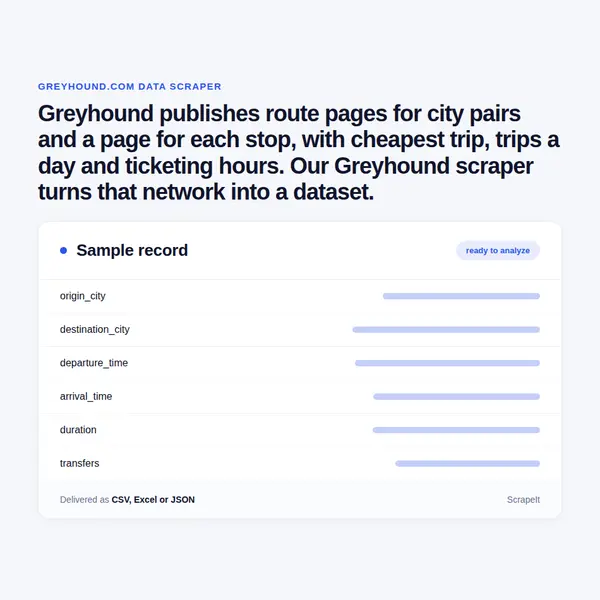
Greyhound publishes route pages for city pairs and a page for each stop, with cheapest trip, trips a day and ticketing hours. Our Greyhound scraper turns that network into a dataset.
Plans from €169 a month · Free project assessment · Reply within 1 business day
CSV · Excel · JSON · XML · FTP · SFTP · Amazon S3 · Google Cloud
API, JSON feed or CSV, XLSX and JSON files
ScheduleOne-time, monthly, weekly, daily or 3 times a day
Greyhound pages, filters, fields and a schedule
Built, monitored and repaired by our team
API, JSON feed or CSV, XLSX and JSON files
Tell us which part of the network you need - a handful of corridors such as New York to Boston, every route touching one state, or all city, route and stop pages across the US, Canada and Mexico - and how fresh it must be. We build the greyhound.com crawlers, run them on your schedule and fix them when page layouts change. Rendering, pacing, proxy rotation and CAPTCHA handling are covered by the service, since trip search results are drawn in the browser.
Fares are read from trip searches for a route and a date; no ticket is bought and no rider data is entered. You get a sample first, then scheduled deliveries with a data dictionary.
Greyhound's public layer has three page types, and each has its own fields. A route page such as New York to Boston summarises the corridor; a city page lists every boarding point in a city; a stop page describes a single location. Trip searches add the dated fares.
Addresses deserve their own column. Greyhound notes that the ticket carries the most current address of a stop, and many cities have more than one boarding point - New York alone runs from the Port Authority to curbside stops in Queens and Brooklyn. We keep each stop as a separate row keyed by its page address, so a moved stop shows up as a change, not a duplicate.
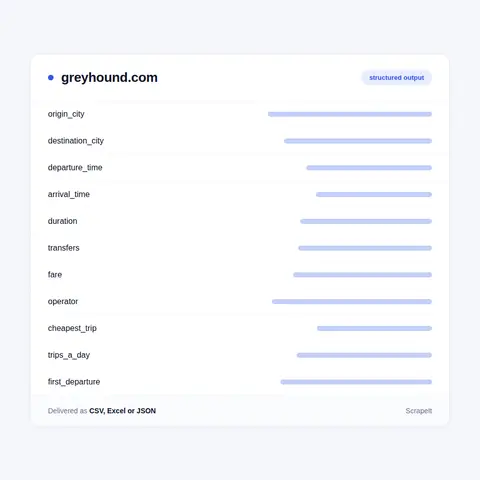
A single crawl maps the network; repeated crawls show how it behaves. Daily trip searches on fixed corridors build a price history per departure time, showing how far ahead a Dallas to Houston ticket starts to climb and which weekdays stay cheap. The same runs record how the number of trips a day and the first and last departures change between seasons.
The stop layer changes more quietly. Greyhound sorts its locations into Greyhound Stations, Partner Stations and curbside stops, and curbside stops are either get on and off or get off only, with no counter and no staff. Ticketing hours, addresses and location types are worth re-reading monthly: when a location changes type or its counter changes hours, every route through it is affected.
Cross-border coverage comes from the same site. The site comes in English, Spanish, French and Chinese, with Spanish route pages on es.greyhound.com and greyhound.com.mx, and corridors such as Toronto to New York or Montreal to Boston appear among its popular routes. Rider reviews are not part of the default dataset.
Greyhound is the long-standing intercity bus brand of the United States, today part of Flix, the group behind FlixBus. Its site sells both brands: a search on greyhound.com can return Greyhound and FlixBus trips on one corridor, and the operator of each ride is named during booking.
The site is organised the way a rider plans a trip. A destination index starts with Choose your country - Canada, Mexico or the United States - and then an A-Z list of cities. Each city page lists its bus stations and stops; each route page covers one pair of cities; each stop page holds the location's address, opening hours and nearby stops. A route map, an overnight bus section, Deals & Promos and dedicated pages for travel to and from Canada and Mexico sit alongside, plus Trip Tracker for following a bus live.
Greyhound also publishes what happens on the road. Scheduled breaks are rest stops of about a quarter of an hour, meal stops, layovers while the bus is serviced and transfers to another bus at a station. Baggage rules are one carry-on and one stowed bag per rider, with a free second checked bag on Flexible fares; seat reservation is offered on many trips, at a fee Greyhound says varies by route.
Delivery: CSV, JSON or XLSX files, our API or a JSON feed. MCP server on request.
Full plan detailsGreyhound's stop list reaches well beyond the big terminals to partner stations and curbside stops in smaller places, which makes its pages a working map of intercity bus service.
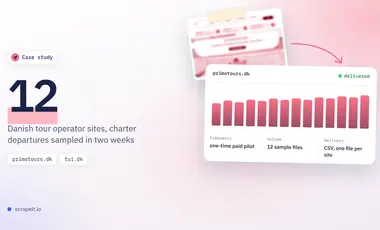
A paid pilot for a regional airport in Scandinavia: direct charter departures from 12 Danish tour operator sites, sampled in two weeks.
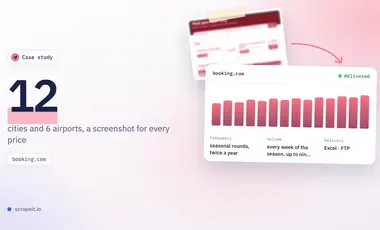
For several years, weekly car rental and, more recently, hotel prices from Booking.com for a tourism organization comparing its destination with rivals.
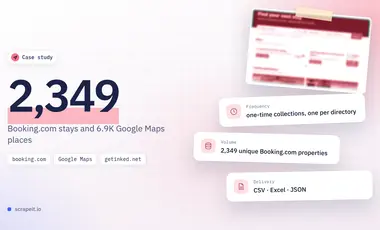
Four datasets for a studio that builds directory websites: Hawaii stays from Booking.com, UK schools and tattoo studios from Google Maps, GetInked profiles.
Learn how to use web scraping to solve data problems for your organization
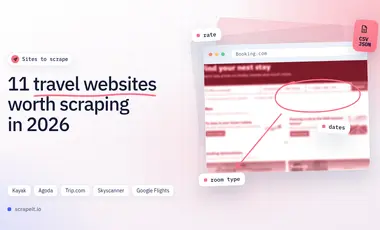
If you work in travel tech, an OTA, a hotel chain, or at an airport, you are in a price-and-availability arms race. Fares change by the hour, room inventory disappears in minutes, and competitors test new bundles and ancillaries constantly.

Data scraping is the wide term that includes documents, scans and old screens; web scraping is the part that works on websites. We compare sources, daily work, output and cost drivers, give a briefing checklist and walk through two of our projects.

Leveraging advances in technology, the AI-powered web scraper has skyrocketed in demand and is helping to expand capabilities by automating tedious daily tasks and speeding up data collection from thousands of websites several times over.

ScrapeIt is a managed scraping company: we run the crawlers and deliver the data, and you work with the result. Transport networks are a good match for that model, because the useful dataset is the whole network kept current - every stop and route with its own page, and fares that only exist for a date. Plans start from EUR 169 a month, or EUR 199 for a one-time extract.
Still unsure? Write to info@scrapeit.io
Yes. The ScrapeIt Greyhound API returns route, departure and arrival time, duration, fare, operator and stop address as JSON from an endpoint we host, refreshed as often as you need. The same data can arrive as CSV files on Google Drive, a JSON feed or a load into your own database.
Yes. City pages, route pages, stop pages and trip fares are shown to any visitor of greyhound.com without signing in. We collect only publicly available data - everything a visitor can see on greyhound.com - and we collect it legally.
Yes. We walk the country and city index for the US, Canada and Mexico and read every station and stop page it links to. Each stop comes with its address, Location Type, ticketing hours where published, and nearby stops, so staffed stations and curbside stops are easy to separate.
Dated fares move with demand and the time left before departure, so corridor pricing suits a daily run. Route summaries such as cheapest trip and trips a day change more slowly and fit a weekly run, while a monthly re-read is enough for stop details.
Yes. Greyhound sells its own trips and partner trips on one site and names the operator during booking, so the operator is a column in every trip row. Connections are listed with the transfer point, because a transfer on Greyhound means changing buses at a station with your under-bus baggage.
You share your needs, expectations, and desired timeframe. We'll suggest the best solution based on your request and budget.
Our specialists configure the crawlers and extract a sample dataset for your review before proceeding with the full-scale extraction.
Once you approve the sample, we launch the project and start full data collection. We gather, filter, and structure the data for easy use, delivering it on time in your preferred format.
Our team manages ongoing processes, monitors website changes, and supports all data extraction cycles. We can also help integrate data into your systems or create dashboards to simplify analysis.
Tell us which sites, which fields and how often. A couple of lines is enough to start.
Greyhound data from €169/month. Free project assessment, reply within 1 business day.