Charter Flight Data from 12 Danish Tour Operators: a Pilot in 2 Weeks
A paid pilot for a regional airport in Scandinavia: direct charter departures from 12 Danish tour operator sites, sampled in two weeks.
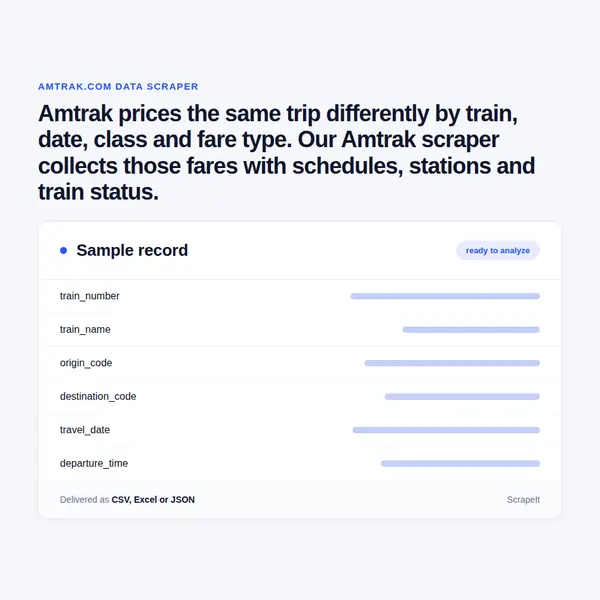
Amtrak prices the same trip differently by train, date, class and fare type. Our Amtrak scraper collects those fares with schedules, stations and train status.
Plans from €169 a month · Free project assessment · Reply within 1 business day
CSV · Excel · JSON · XML · FTP · SFTP · Amazon S3 · Google Cloud
API, JSON feed or CSV, XLSX and JSON files
ScheduleOne-time, monthly, weekly, daily or 3 times a day
Amtrak pages, filters, fields and a schedule
Built, monitored and repaired by our team
API, JSON feed or CSV, XLSX and JSON files
You tell us which station pairs, travel dates and classes matter - a handful of Northeast city pairs searched every morning, every long-distance route for the next few months, or a one-way and round trip comparison for a fixed list of cities - and we build the Amtrak scraper, run it and repair it when the booking flow changes. Fares only appear after a search with origin, destination and date, so each run is a planned grid of searches: nothing is booked and no traveller details are entered. Rendering, pacing, proxy rotation and the rest of anti-bot handling are part of the service.
Rows arrive keyed on train number, station codes and travel date, as CSV, JSON or Excel, to Amazon S3 or by e-mail, one-off or on the schedule you set. Every project starts with a free assessment and a sample.
Amtrak data comes from three kinds of pages that share one vocabulary: the fare search for a station pair and a date, the route page of each named service, and the station page at an address built on the three-letter station code, such as /stations/was for Washington Union Station. We join them on those station codes and on train numbers.
Field documentation comes with the dataset, and every column says which page and which search it was read from.
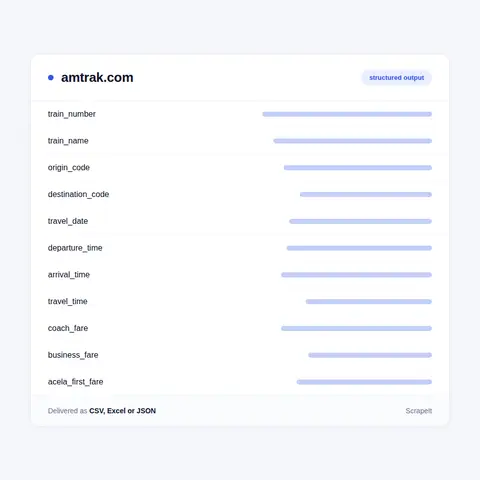
A fare search is a snapshot of one station pair on one date. The value comes from repeating it and from the pages around it.
Amtrak is the trading name of the National Railroad Passenger Corporation, the intercity passenger rail operator of the United States. Its site sorts the network into six regions - Northeast, California, Midwest, Northwest, South and West - and gives every named service a route page, from the Acela between Boston and Washington to the California Zephyr from Chicago to Emeryville.
Two kinds of travel sit side by side. Acela runs multiple departures daily and sells Business Class and Acela First; other services sell Coach, with non-Acela Business Class on the trains that carry it. Long-distance trains such as the California Zephyr leave once a day and add private rooms, priced by room type rather than by seat. Some journeys pair a train with a connecting bus, and the timetable builder shows those legs next to the rail ones.
Fares follow a published set of types. Flex fares can be changed and refunded without fees, Value fares cannot be changed, Sale fares appear only while a promotion runs, and Amtrak notes that fares bought on board usually cost more than advance ones. Child and senior discounts apply when the passenger type is chosen at the start of a search. The Deals section adds Night Owl Fares, Share Fares, the USA Rail Pass and the California Rail Pass, and BidUp lets travellers bid for an upgrade. The site runs in English, Spanish, French and Chinese.
Delivery: CSV, JSON or XLSX files, our API or a JSON feed. MCP server on request.
Full plan detailsAmtrak prices fluctuate by train, date and class, and a fare quoted for a train this week may not be there next week. That makes the fare search worth recording for anyone who prices against rail or sells it.
A paid pilot for a regional airport in Scandinavia: direct charter departures from 12 Danish tour operator sites, sampled in two weeks.
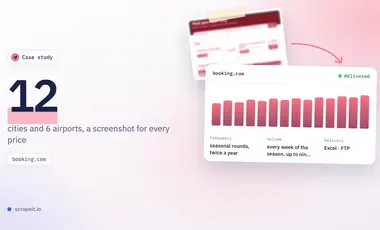
For several years, weekly car rental and, more recently, hotel prices from Booking.com for a tourism organization comparing its destination with rivals.
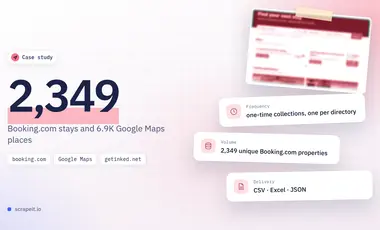
Four datasets for a studio that builds directory websites: Hawaii stays from Booking.com, UK schools and tattoo studios from Google Maps, GetInked profiles.
Learn how to use web scraping to solve data problems for your organization
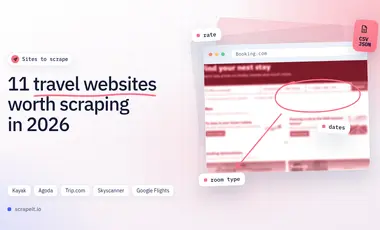
If you work in travel tech, an OTA, a hotel chain, or at an airport, you are in a price-and-availability arms race. Fares change by the hour, room inventory disappears in minutes, and competitors test new bundles and ancillaries constantly.
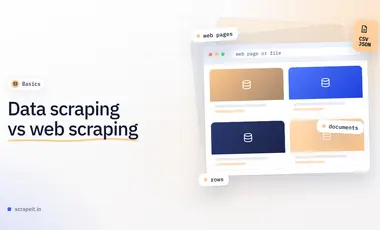
Data scraping is the wide term that includes documents, scans and old screens; web scraping is the part that works on websites. We compare sources, daily work, output and cost drivers, give a briefing checklist and walk through two of our projects.
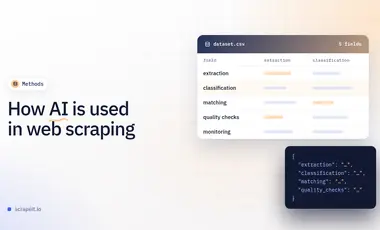
Leveraging advances in technology, the AI-powered web scraper has skyrocketed in demand and is helping to expand capabilities by automating tedious daily tasks and speeding up data collection from thousands of websites several times over.

ScrapeIt is a managed web scraping service: we build, run and repair the crawlers and deliver the data, so your team works with fare tables rather than with a booking engine. Rail and travel sites are a large part of that work - prices that exist only after a dated search, classes that sell out on some trains and not others, timetables that change with the season. Tell us the routes, dates and classes, and we plan the search grid and the schedule.
Still unsure? Write to info@scrapeit.io
Yes. The ScrapeIt Amtrak API returns train number, station codes, departure and arrival times, travel time and the lowest fare per class as JSON from an endpoint we host, updated as often as you need. The same rows also arrive as CSV or Excel files, a JSON feed or a load into your database.
Yes. Route pages, station pages, timetables and the fares a search returns are shown to any visitor without an account. We collect only publicly available data - everything a visitor can see on Amtrak - and we collect it legally. Nothing is booked and no passenger details are entered.
Each run is a grid of station pairs, departure dates and passenger types, searched one at a time the way a visitor would search. Results are stored per train and class together with the date of the search, so one project can follow a single city pair daily or a long-distance route across the coming months.
Amtrak fares vary with the day and time of travel and run higher around holidays and peak periods, so a price tracker needs repeated runs on fixed travel dates. Daily runs suit busy pairs such as New York to Washington, while weekly runs often cover long-distance rooms. Plans start from EUR 169 a month, or EUR 199 for a one-time extract.
Yes. Station pages give the address, the station code, the Features, Baggage, Parking, Accessibility and Hours tabs, gate closing time and lounge hours, and we refresh them on a slower cycle than fares. Train status from the Track a Train map - the train's position and its estimated arrival at the next station and the ones after it - can be collected through the day per train.
You share your needs, expectations, and desired timeframe. We'll suggest the best solution based on your request and budget.
Our specialists configure the crawlers and extract a sample dataset for your review before proceeding with the full-scale extraction.
Once you approve the sample, we launch the project and start full data collection. We gather, filter, and structure the data for easy use, delivering it on time in your preferred format.
Our team manages ongoing processes, monitors website changes, and supports all data extraction cycles. We can also help integrate data into your systems or create dashboards to simplify analysis.
Tell us which sites, which fields and how often. A couple of lines is enough to start.
Amtrak data from €169/month. Free project assessment, reply within 1 business day.