Dealer-Ready Datasets with Every Parameter That Matters
Daily monitoring of car listings on car.gr and autoscout24.com, collecting full technical specifications to support a European auto dealer.
Learn More
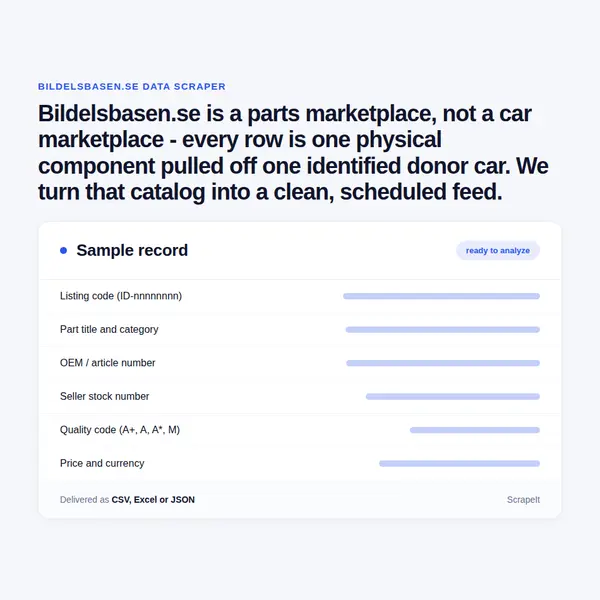
Bildelsbasen.se is a parts marketplace, not a car marketplace - every row is one physical component pulled off one identified donor car. We turn that catalog into a clean, scheduled feed.
Bildelsbasen publishes a read-only agent API of its own, and where that route covers what you need we simply run it properly: tokens, rate limits, paging, retries and normalisation into your schema. Where it does not reach, we agree the scope in writing with the platform first, because the terms of use restrict automated collection without permission.
The rest is our standard kit: anti-bot handling, proxy rotation and CAPTCHA solving, schedules from a one-off pull to hourly diffs, and delivery as CSV, JSON, JSONL, Parquet, a database load or a bucket drop. We reconcile OEM numbers, normalise quality codes, keep part photos apart from donor photos, and mark every row that vanished since the previous run. We stay out of logged-in areas, and we do not collect personal data on private individuals.
Each active listing has a public article code in the form ID- plus a number, and the address that holds it is itself a fitment statement: locale, vehicle branch, search mode, brand, brand-model, generation band written YYYY_YYYY, part category, article, position, then the code. Swap one segment and you are looking at a different fitment, which is why a Bildelsbasen scraper has to read the path as data and not as a link.
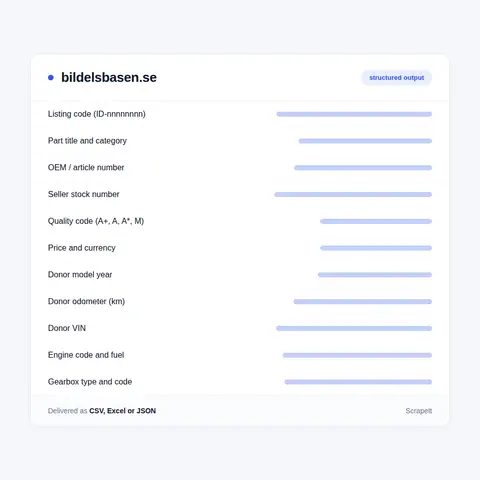
What a Bildelsbasen scraper can extract from one part listing:
Two of those blocks have no equivalent on a normal shop page. The donor block ties the part to one physical car with its own odometer and VIN, so two identical injector numbers are not interchangeable offers - one came off a car with far less wear. And the quality code is an industry grade set by the Swedish dismantlers' association, not a marketing adjective: M marks a donor that ran more km than average for its model year.
The dismantler is a first-class object here, not a byline under a price. Each affiliated company has its own page and record: name, street, postcode, city and country, phone, organisation number and VIES VAT id, the date it joined, shop and phone hours for every weekday, a holiday flag, a flag for whether live inventory is connected, plus currency and time zone.
Ratings hang off that record and are unusually strict - only a buyer who completed a digital purchase may leave one, answering five yes-or-no questions on handling time, the article, the photos, the payment methods offered and whether they would recommend the yard. Scores run per period - month, quarter, half-year, year and lifetime - beside a median handling time in days, hours and minutes.
Under the parts sit the donor vehicles. Dismantled cars are browsable by make with an in-stock and out-of-stock split, so you can see which models are being broken and when a fresh donor floods a generation with parts.
Above the parts sits the fitment tree: brand, model with its generation band, category, article, position - each article node carrying an approximate count of live listings. Engine and gearbox codes are their own entry points, returning the tree narrowed to cars built with that code. A Swedish plate resolves to brand, model, generation, model year, VIN, body type, engine code, fuel, power, cylinder volume and tyre sizes front and rear.
Worth knowing before mapping work: canonical identifiers stay Swedish even when you request English labels - category Motor carries the label Engine, article Motorfaste the label Motor-Bracket.
Bildelsbasen.se is where Swedish auto dismantlers sell what they pull off scrapped vehicles. It is operated by Bildelsbasen Nordic AB out of Kungsbacka, and the operator never owns the stock: every part belongs to a subscribing dismantler, recycler or parts shop that sets its own price, warranty, payment method and shipping terms and answers the buyer directly.
That makes Bildelsbasen data behave unlike the car-sales portals it sits beside. The unit here is not a vehicle for sale but a single component - an injector, a gearbox, a tailgate - harvested from one identified donor car and sold exactly once. The platform's own published figures put the catalog at about 9.5 million listed parts spread across about 131 affiliated companies in September 2026.
The catalog splits two ways at once. By part, there are 27 top-level categories running from Airbag, Bromsar and Bransle through Kaross, Inredning and Glasrutor, including two that no ordinary shop has: Demonteringsobjekt, a whole dismantling object, and Reparerbara Fordon, repairable vehicles. By vehicle, passenger cars sit alongside 14 further branches - truck, motorcycle and scooter, motorhome and caravan, snowmobile, tyre and rim, bus, tractor, ATV, EU-moped, trailer, construction equipment, car accessory, boat accessory and uncoded other cars.
The interface is Swedish first, with 13 language codes and 13 country settings, and prices follow the country you browse as rather than a single fixed currency. Bildelsbasen Nordic also runs sibling boards - skrotauktion.se for auctions, plus lastbilstorget.se, mctorget.se, husvagnstorget.se, biltorget.se and verkstadstorget.se - and sits in a Nordic network with Varaosahaku.fi in Finland.
Get a Quote
Developers

Customers worldwide

Pages extracted

Hours saved for our clients
€199 / one-time
setup fee - included
€169 / mo
setup fee €499
€229 / mo
setup fee €499
€349 / mo
setup fee €499
€549 / mo
setup fee €799
A used part has no list price. There is no manufacturer figure to discount from, so the only honest reference for what a turbo or a tailgate is worth this week is what other yards are asking for the same OEM number at the same grade. That is what Bildelsbasen price data supplies, and it is why dismantlers, workshops and parts platforms watch it.
Look up a single OEM number and the answer is rarely one row. The same injector code comes back on a Polo, a Caddy and a Golf Plus, offered by different yards in different towns, at different asks, on donors whose odometers differ by a hundred thousand km. The dispersion inside one OEM code is the signal - and you only see it if you extract Bildelsbasen data across the whole result set instead of the first page.
Stock behaves differently here too. Each row is one physical object: when it sells it does not restock, the row simply leaves. Turnover, shelf life and which grades move fastest can only be read from diffs between runs, because there is no quantity field to watch.
Landed cost is the second axis. Freight is set per seller and per carrier product, and on a cheap bracket or sensor it can outweigh the part itself. Any pricing model that ignores the shipping block misreads the market.
One more thing to hold on to when scraping Bildelsbasen: the site asks each visitor to browse as Private or Business, and that choice changes which prices, warranties and commercial terms are shown. A feed is only comparable over time if it records which profile produced it.

Daily monitoring of car listings on car.gr and autoscout24.com, collecting full technical specifications to support a European auto dealer.
Learn MoreLearn how to use web scraping to solve data problems for your organization

Leveraging advances in technology, the AI-powered web scraper has skyrocketed in demand and is helping to expand capabilities by automating tedious daily tasks and speeding up data collection from thousands of websites several times over.

Web scraping is a method of obtaining web data by extracting it from pages of web resources with the help of a program, that is, in automatic mode. It is used to syntactically convert web pages into more usable forms.

If you specialize in machine learning, you need to feed large amounts of data to the algorithms. Web scraping is the easiest and the most efficient method of collecting the data from all over the Internet.
ScrapeIt is a managed scraping agency, not a tool you have to operate yourself. You describe the Bildelsbasen data you need - an OEM watchlist, one brand and generation band, a single yard's whole shelf - and we return it on a schedule, in the shape your systems already read.
Nordic marketplaces are familiar ground: Swedish-language taxonomies, SEK and VAT handling, and identifiers that have to survive translation without losing their meaning. Ask for a sample batch before you commit to anything.
Yes, and it is unusually open. Bildelsbasen publishes an agent-facing OpenAPI 3.1 specification alongside an MCP endpoint, with read-only discovery and search: brands, models with generation bands, part categories and articles, plus direct lookup by OEM number, seller stock number, engine code, gearbox code and registration plate. A bearer token and a per-minute rate limit are published in the API root so agents can query search without setup. What it will not give you is a bulk dump - there is no full-catalog export, results are paged, and the current version carries no write operations beyond creating a cart. For a full feed it is a starting point, not the finish.
Article id and public ID- code, listing address, part title and description, condition and quality code (A+, A, A*, M) with any remark, price, currency and formatted price, OEM or original number plus cross-references, the seller's stock number, and the position value Hoger, Vanster or Alla. The donor block adds model year, odometer in km, VIN, engine type and code, fuel, gearbox type and code. The seller block adds company name, city, country, phone and recommendation share; the shipping block adds carrier, carrier product, amount, delivery window and origin city. Part photos and donor-vehicle photos come as two separate sets.
Constantly, because each row is a single physical part. A yard breaking one car can add hundreds of listings in a day, and every sale removes a row rather than decrementing a counter, so there is no stock number to watch. For price tracking on a defined OEM watchlist, daily runs are usually enough. For availability and turnover work - measuring how long a grade sits before it sells - we go hourly on the segments that matter and keep a full diff so appearances and disappearances are both recorded. Shipping quotes and seller recommendation shares move more slowly and are normally refreshed weekly.
The marketplace is Swedish and the sellers are concentrated in Sweden, with reach into the Nordics and northern Europe. The site ships 13 interface language codes - Swedish, English, Danish, Norwegian, Finnish, German, French, Spanish, Italian, Icelandic, Estonian, Russian and Farsi - and 13 country settings that carry their own currency, with SEK as the default. OEM landing pages are generated per locale, so the same part number has a Swedish, Norwegian, Danish, German, Spanish, French, Italian, Icelandic and English address. We collect whichever locale you need and keep the locale on every row.
The terms of use restrict automated collection, indexing or reuse of the service without written permission, and they lean on Swedish copyright plus the database right. So we do not treat this as an open field. Where the platform's own agent API covers the request, that is the sanctioned route and we use it inside its published limits. Where it does not, we scope the work with the platform in writing before anything runs. We stay on public pages, never behind a login, and we do not collect personal data about private individuals - the sellers here are registered companies and their trading details are published by design.
Step 1 - Make a Request
You share your needs, expectations, and desired timeframe. We’ll suggest the best solution based on your request and budget.
Step 2 - Configuring Custom Web Crawlers
Our specialists configure the crawlers and extract a sample dataset for your review before proceeding with the full-scale extraction.
Step 3 - Collect and Deliver
Once you approve the sample, we launch the project and start full data collection. We gather, filter, and structure the data for easy use, delivering it on time in your preferred format.
Step 4 - Maintain and Support
Our team manages ongoing processes, monitors website changes, and supports all data extraction cycles. We can also help integrate data into your systems or create dashboards to simplify analysis.

Scrapeit Sp. z o.o.
10/208 Legionowa str., 15-099, Bialystok, Poland
NIP: 5423457175
REGON: 523384582