Dealer-Ready Datasets with Every Parameter That Matters
Daily monitoring of car listings on car.gr and autoscout24.com, collecting full technical specifications to support a European auto dealer.
Learn More
CarGurus labels its listings against its own estimate of what a car should cost. That single habit turns the marketplace into a running record of asking prices, market values and the distance between the two. We build scrapers to order that turn it into a structured dataset you can actually query.
Plans from €169/month · Free project assessment · Reply within 1 business day
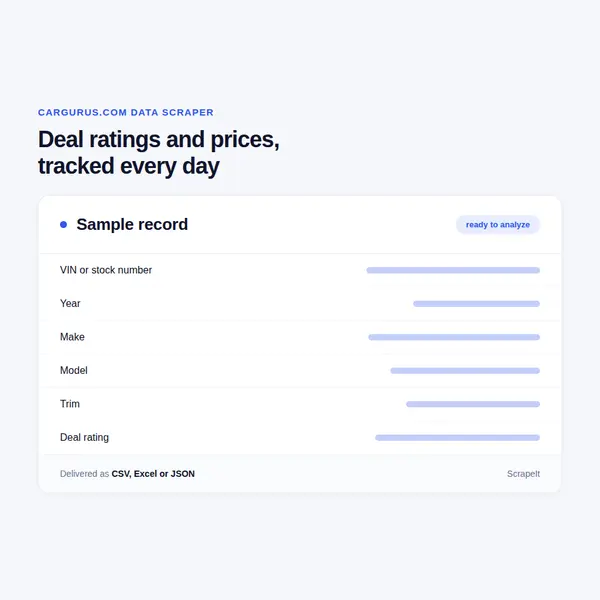
You set the scope: makes, models, ZIP or postal codes, radius, which country sites, which filters matter. We write the crawler, work through the full depth of results so rows are not lost, normalize trims and dealer names, and hand back CSV, Excel or JSON. Collection runs once or on a schedule - daily, weekly or monthly. Plans start at 169 EUR per month with a limit from 100,000 rows.
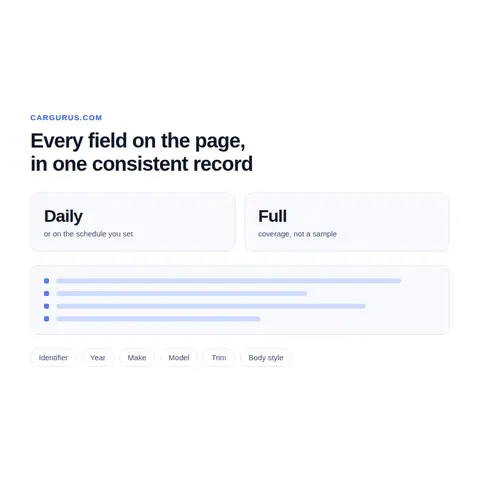
A typical export carries the listing URL and identifier, year, make, model, trim, body style, mileage, exterior and interior color, transmission, drivetrain, fuel type and engine, plus the options and features shown on the card where the listing publishes them. Alongside those sit the asking price, the Instant Market Value figure, the deal rating tier, days on lot, price drop history, photo URLs, seller name, dealer rating, city, state or province, postal code, and the timestamp of the run that captured each row.
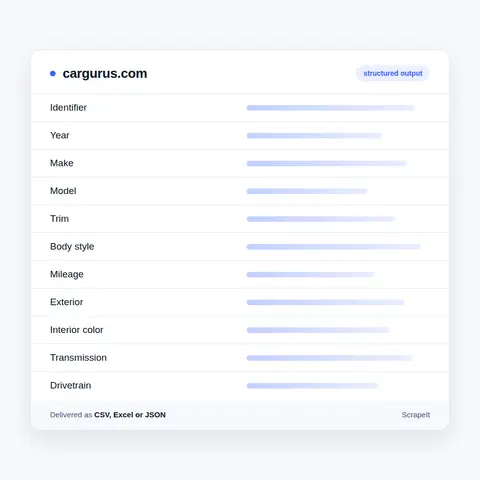
The interesting columns are the ones CarGurus computes, not the ones a dealer typed in. Instant Market Value is an estimated fair retail price built from comparable current and recent listings, factoring make, model, year, trim, mileage, options, vehicle history and regional supply and demand. The deal rating condenses that into a label - Great Deal, Good Deal, Fair Price, High Price or Overpriced - so you can count how an entire segment is priced without recomputing anything yourself. Days on lot and price drop history show how long stock sits and how quickly sellers react. Dealer listings also carry a dealer rating. Follow the same model across cargurus.com, cargurus.ca and cargurus.co.uk and the gaps between markets become measurable.
CarGurus was launched in 2006 by Langley Steinert, who had earlier co-founded TripAdvisor, and is run from Boston, Massachusetts. The company has traded on Nasdaq under the ticker CARG since its October 2017 IPO, and its revenue comes from dealer subscriptions and advertising.
Consumer marketplaces run in three countries: the United States on cargurus.com, Canada on cargurus.ca and the United Kingdom on cargurus.co.uk. The group also owns two brands it keeps deliberately separate - Autolist in the US and PistonHeads in the UK. Earlier marketplaces in Germany, Spain and Italy were wound down.
Inventory covers new and used vehicles, with certified pre-owned kept as a distinct category sourced from franchise dealers. Peer-to-peer listings by private owners were retired in June 2024; owners who want to sell are routed instead to a Sell My Car flow that collects instant offers from local dealers.
Search is unusually granular. Beyond make, model and trim, results narrow by price, mileage, year, body style, drivetrain, transmission, fuel type, engine, color, options, dealer rating, NHTSA overall safety rating, days on lot, single-owner status, recent price drops, financing availability and a distance radius that stretches to nationwide.
Get a Quote
Developers

Customers worldwide

Pages extracted

Hours saved for our clients
€199 / one-time
setup fee - included
€169 / mo
setup fee €499
€229 / mo
setup fee €499
€349 / mo
setup fee €499
€549 / mo
setup fee €799
Delivery: CSV, JSON or XLSX files, our API or a JSON feed. MCP server on request.
Full plan details →Dealers use it to see where their own asking prices sit against the tier assigned to nearby stock, and how long comparable cars linger before they move. Remarketing and wholesale teams read the same rows in reverse, hunting for models where retail asking prices drift away from the platform valuation. Lenders and insurers want residual curves by trim and mileage band. Manufacturers and importers track how their nameplates are priced across the three markets. Price comparison products and researchers need a clean, repeatable feed instead of a screenshot of a search page.

Daily monitoring of car listings on car.gr and autoscout24.com, collecting full technical specifications to support a European auto dealer.
Learn MoreLearn how to use web scraping to solve data problems for your organization

Leveraging advances in technology, the AI-powered web scraper has skyrocketed in demand and is helping to expand capabilities by automating tedious daily tasks and speeding up data collection from thousands of websites several times over.

Web scraping is a method of obtaining web data by extracting it from pages of web resources with the help of a program, that is, in automatic mode. It is used to syntactically convert web pages into more usable forms.

If you specialize in machine learning, you need to feed large amounts of data to the algorithms. Web scraping is the easiest and the most efficient method of collecting the data from all over the Internet.
ScrapeIt builds scrapers to order rather than handing you a tool to learn. The scope, the field list and the schedule are agreed before work starts, and the crawler is written for your task, including the differences between the US, Canadian and UK layouts. A 9.99 EUR data sample lets you check the columns before committing. Listed plans run from 169 EUR to 549 EUR per month, with larger volumes quoted individually. Support replies within 48 to 72 hours.
Yes. The deal rating tier and the Instant Market Value estimate are read from the listing the same way price and mileage are, so every row shows both the asking price and the platform's own verdict on it.
We do. cargurus.co.uk and cargurus.ca are separate marketplaces with their own inventory and currencies. They can be handled in one project so results land in a single file with a country column for splitting later.
No, and that is a limit of the platform rather than the scraper. CarGurus retired peer-to-peer listings in June 2024, so the marketplace now carries dealer stock only.
Once, or on a repeating schedule - daily, weekly or monthly. Fast-moving segments usually justify daily runs, because days on lot and price drops only tell you anything when the snapshots sit close together.
Plans begin at 169 EUR per month for a limit from 100,000 rows and reach 549 EUR in the published range, with bigger jobs priced individually. Order a 9.99 EUR sample first if you want to inspect the fields.
Step 1 - Make a Request
You share your needs, expectations, and desired timeframe. We’ll suggest the best solution based on your request and budget.
Step 2 - Configuring Custom Web Crawlers
Our specialists configure the crawlers and extract a sample dataset for your review before proceeding with the full-scale extraction.
Step 3 - Collect and Deliver
Once you approve the sample, we launch the project and start full data collection. We gather, filter, and structure the data for easy use, delivering it on time in your preferred format.
Step 4 - Maintain and Support
Our team manages ongoing processes, monitors website changes, and supports all data extraction cycles. We can also help integrate data into your systems or create dashboards to simplify analysis.
CarGurus data from €169/month. Free project assessment, reply within 1 business day.

Scrapeit Sp. z o.o.
10/208 Legionowa str., 15-099, Bialystok, Poland
NIP: 5423457175
REGON: 523384582