RVUSA Data for 2 Model Years Plus RV Model Tags Rebuilt from Filters
RVUSA catalogs by model year and a full feature-tag list per RV model on RVing Planet, rebuilt from its filters, for a returning client.
Every CarMax car belongs to a store, and what it costs to get it - nothing, or a shipping fee - depends on where the shopper is. Our CarMax scraper records both.
Plans from €169 a month · Free project assessment · Reply within 1 business day
CSV · Excel · JSON · XML · FTP · SFTP · Amazon S3 · Google Cloud
API, JSON feed or CSV, XLSX and JSON files
ScheduleOne-time, monthly, weekly, daily or 3 times a day
CarMax pages, filters, fields and a schedule
Built, monitored and repaired by our team
API, JSON feed or CSV, XLSX and JSON files
This is a done-for-you service. You name the scope - nationwide inventory, the stores of one state, a radius around a ZIP code, or a watchlist of makes and models - and the refresh rate. We write the crawlers, operate them and fix them when CarMax changes its search or its car pages.
CarMax tailors results to the visitor's location and filters automated traffic, so US proxy rotation, pacing, rendering and CAPTCHA handling are included; you arrange none of it. Each row is keyed on the stock number and carries the VIN, the home store and the run date. Files arrive as CSV, Excel or JSON on a stable schema by SFTP, Amazon S3 or e-mail, or the rows go into your database. Runs are one-off, weekly, daily or on demand; order a sample first if you want to see the columns.
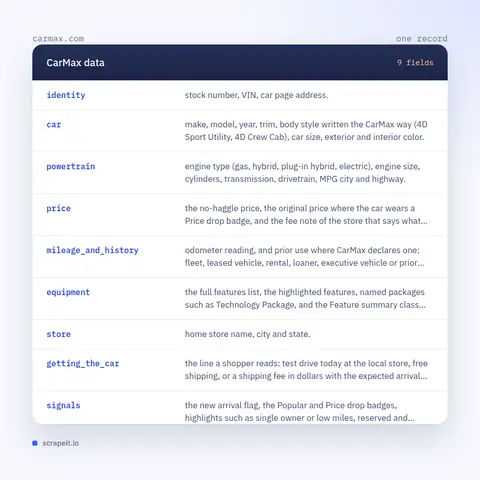
CarMax identifies a car by its stock number and gives the VIN with it: the stock number is what the site's own search understands, the VIN is what joins the row to anything outside CarMax. The fields below are read from the search results and the car page.
The documentation delivered with the files marks which columns depend on the ZIP code the run was made from.
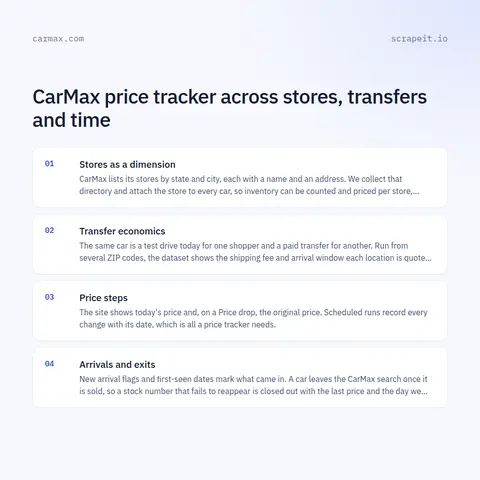
A car page describes one car in one place. The questions buyers of this data ask are about the network.
The model rating on a car is an aggregate figure; the names of individual reviewers are personal details and stay out of the dataset.
CarMax is a United States used car retailer that owns what it sells and sells it at no-haggle prices. Unlike an online-only seller it is built on physical stores: the site lists them state by state, and every car in the inventory stands at one of them.
That shapes the site. Search starts from the visitor's location: results are arranged around the nearest store, a Distance or Shipping filter widens the circle step by step to Nationwide, and each car states how it reaches the shopper - a test drive today at the store, free shipping, or shipping for a stated fee with an arrival window. The listed price leaves out tax, title and tags, and store-level notes add what else applies in that state.
CarMax also discloses things a classifieds site leaves to the seller. Prior use is labeled - fleet, rental, leased vehicle, loaner - and equipment is normalized into one vocabulary across makes, which is what makes a car in one store comparable with a car in another. Each one is sold as CarMax Certified, with a limited warranty, a money-back guarantee and a free vehicle history report.
Delivery: CSV, JSON or XLSX files, our API or a JSON feed. MCP server on request.
Full plan detailsCarMax describes its prices as no-haggle, so the figure on a listing is the price of the car and not an opening bid, which makes it easy to compare and informative to follow.
RVUSA catalogs by model year and a full feature-tag list per RV model on RVing Planet, rebuilt from its filters, for a returning client.
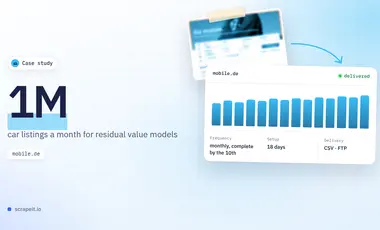
A monthly snapshot of mobile.de for an automotive data company: cars and vans up to 12 years old, delivered in the client's own CSV template.
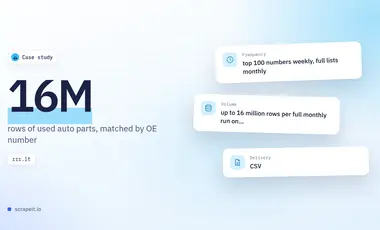
Weekly and monthly prices of used parts by OE number from rrr.lt and a Scandinavian marketplace, for a car dismantling business.
Learn how to use web scraping to solve data problems for your organization
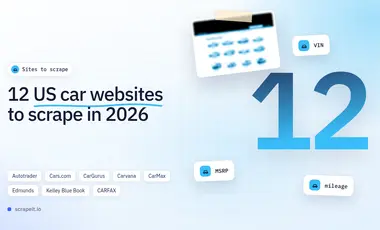
Twelve US car websites compared as data sources, from Autotrader and CarGurus to Copart, IAA and the RV sites: what each shows, which fields need care - VIN, trim, deal labels, damage codes - and how to merge them into one dataset.
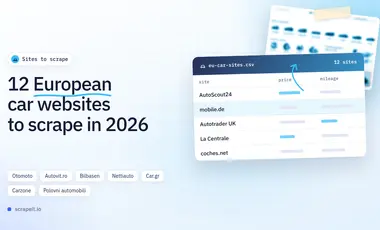
Twelve car marketplaces across Europe compared as data sources, from AutoScout24 and mobile.de to Otomoto, Bilbasen and Car.gr: what each shows, how VAT, mileage, inspection and seller fields differ by market, and how to merge them into one schema.

Data scraping is the wide term that includes documents, scans and old screens; web scraping is the part that works on websites. We compare sources, daily work, output and cost drivers, give a briefing checklist and walk through two of our projects.

ScrapeIt builds and runs web crawlers as a service and hands over the data, not a tool. Plans start from EUR 169 a month, or EUR 199 for a one-time extract.
Store-based retailers like CarMax need two things done well: location handled on purpose, so that a price or a shipping fee is always tied to the ZIP code it was quoted for, and identifiers kept stable, so that a stock number means the same car in every run. We collect what the public pages show and never sign in to an account.
Still unsure? Write to info@scrapeit.io
No, and in that it mirrors the site. What CarMax prints is the no-haggle vehicle price, which leaves out tax, title and tags, and its store notes list further charges that depend on the state of purchase. A transfer or shipping fee is a separate amount due before delivery. We deliver the price, the store's fee note and the shipping fee as separate columns, so nothing is blended.
Yes. The ScrapeIt CarMax API returns stock number, VIN, price, original price, mileage, home store and the shipping line as JSON from an endpoint we host, refreshed on the schedule you set. The same rows are also delivered as CSV or XLSX files, as a JSON feed or straight into your database.
By repetition. A CarMax listing carries today's price and, while a Price drop is flagged, the original price; the steps in between are not shown. Each scheduled run stores the price against the stock number with a date, so after a few weeks every car has its own sequence of prices and the day it left the inventory.
Either. A nationwide run takes the whole inventory with the home store on each row; a regional run takes the stores of chosen states or everything within a radius of your ZIP codes. For shipping fees the starting point matters, so tell us which locations the cars should be quoted for.
Yes. CarMax publishes its inventory, prices, store locations and shipping options on pages open to every visitor. We collect only publicly available data - everything a visitor can see on CarMax - and we collect it legally. Nothing behind a sign-in is touched, and customer accounts are never part of the job.
You share your needs, expectations, and desired timeframe. We'll suggest the best solution based on your request and budget.
Our specialists configure the crawlers and extract a sample dataset for your review before proceeding with the full-scale extraction.
Once you approve the sample, we launch the project and start full data collection. We gather, filter, and structure the data for easy use, delivering it on time in your preferred format.
Our team manages ongoing processes, monitors website changes, and supports all data extraction cycles. We can also help integrate data into your systems or create dashboards to simplify analysis.
Tell us which sites, which fields and how often. A couple of lines is enough to start.
CarMax data from €169/month. Free project assessment, reply within 1 business day.