RVUSA Data for 2 Model Years Plus RV Model Tags Rebuilt from Filters
RVUSA catalogs by model year and a full feature-tag list per RV model on RVing Planet, rebuilt from its filters, for a returning client.
RVUSA keeps two catalogues side by side: RVs that dealers have for sale and a Specs Guide of floorplans by year, make and model. Our RVUSA scraper delivers both as tables.
Plans from €169 a month · Free project assessment · Reply within 1 business day
CSV · Excel · JSON · XML · FTP · SFTP · Amazon S3 · Google Cloud
API, JSON feed or CSV, XLSX and JSON files
ScheduleOne-time, monthly, weekly, daily or 3 times a day
RVUSA pages, filters, fields and a schedule
Built, monitored and repaired by our team
API, JSON feed or CSV, XLSX and JSON files
RVUSA is two jobs in one site, and most projects need only one of them. A specification project walks the Specs Guide from RV type to make, model, model year and floorplan. An inventory project walks the for-sale pages by type, make, state or dealer. You choose the scope and the refresh rate; we write the crawlers, operate them and fix them when a template changes.
Rendering, pacing, proxy rotation and CAPTCHA handling are included, because the site screens automated traffic before it shows a page. We begin with a free project assessment and can cut a sample from the types or makes you care about. Files come as CSV, Excel, JSON or XML with a description of every column, by SFTP, Amazon S3, e-mail or our API. Plans start from EUR 169 a month, or EUR 199 for a one-time extract.
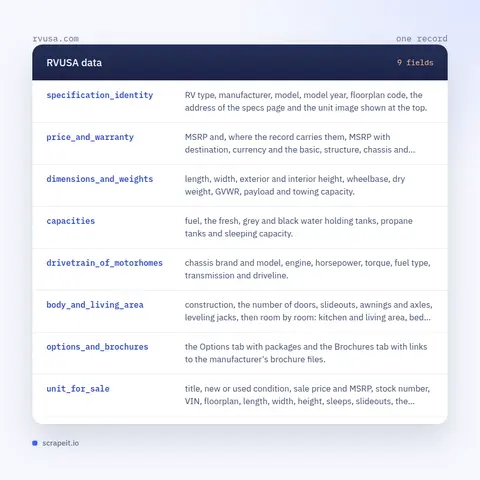
A Specs Guide record describes one floorplan of one model year, and a for-sale record describes one physical unit on a dealer's lot. We deliver them as two tables linked by make, model, year and floorplan.
How deep a specification goes depends on the record. Some list dozens of labelled values down to tire sizes and the number of emergency exits; others give the core measurements followed by feature lists for chassis, construction, interior, kitchen, bedroom, bathroom and utilities. We keep both shapes and state in the field documentation which columns each one fills.
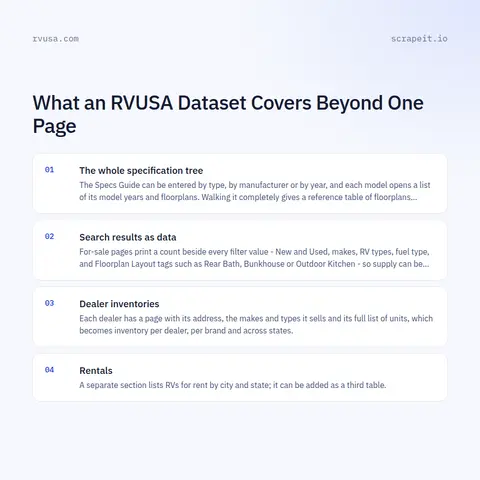
One page is the easy part. The structure around it is what makes the data usable.
Units marked For Sale By Owner are collected as vehicles; the names and phone numbers of private sellers are personal data and are left out by default.
RVUSA is a US marketplace and research site for recreational vehicles. It is run from Ocala, Florida, as a subsidiary of NetSource Media, and its footer dates the site from the mid-nineties. Listings come from dealers across the United States and Canada and from private owners, new and used together, and the browse page counts units per make in the thousands for the largest manufacturers.
The menu splits into Shop RVs, Rent an RV, View Specs, Find Dealers, Research, Finance and Insurance, and Lifestyle. For data work three of them matter. Shop RVs is the inventory, reachable by type, make, state and city, with separate entries for vintage and consignment units. Find Dealers is the directory of sellers by state. View Specs opens the Specs Guide, which RVUSA describes as specifications and floorplans for the brands, makes and models in its dealers' inventories.
RV types are the backbone of both catalogues: Class A, Class B, Class C, Super C and Diesel Pusher motorhomes on one side; Travel Trailer, Fifth Wheel, Toy Hauler, Destination Trailer, Popup, Teardrop Trailer, Truck Camper and Park Model on the other. A unit address spells out year, make, model, floorplan and type before a numeric id, so a listing can be classified before its page is opened.
Delivery: CSV, JSON or XLSX files, our API or a JSON feed. MCP server on request.
Full plan detailsRV pricing is hard to read from the outside: one floorplan is listed by many dealers at different discounts from MSRP, and specifications are scattered over manufacturer brochures. RVUSA brings both together.
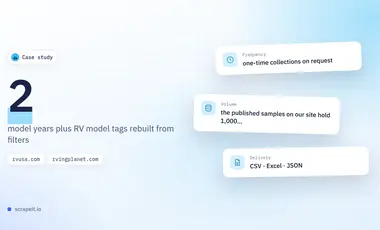
RVUSA catalogs by model year and a full feature-tag list per RV model on RVing Planet, rebuilt from its filters, for a returning client.
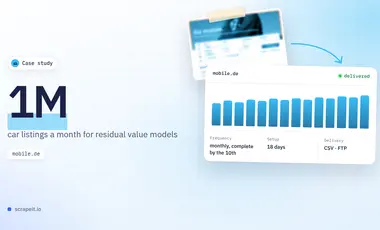
A monthly snapshot of mobile.de for an automotive data company: cars and vans up to 12 years old, delivered in the client's own CSV template.
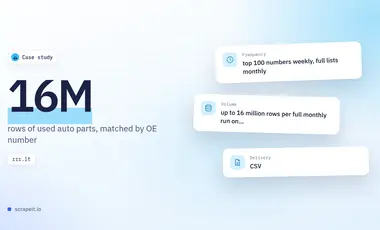
Weekly and monthly prices of used parts by OE number from rrr.lt and a Scandinavian marketplace, for a car dismantling business.
Learn how to use web scraping to solve data problems for your organization
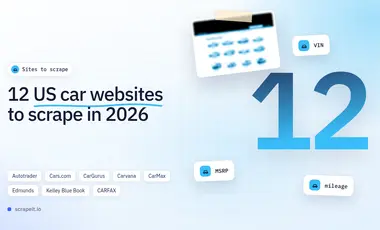
Twelve US car websites compared as data sources, from Autotrader and CarGurus to Copart, IAA and the RV sites: what each shows, which fields need care - VIN, trim, deal labels, damage codes - and how to merge them into one dataset.
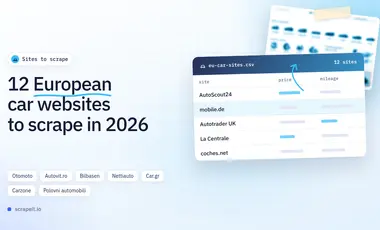
Twelve car marketplaces across Europe compared as data sources, from AutoScout24 and mobile.de to Otomoto, Bilbasen and Car.gr: what each shows, how VAT, mileage, inspection and seller fields differ by market, and how to merge them into one schema.
Data scraping is the wide term that includes documents, scans and old screens; web scraping is the part that works on websites. We compare sources, daily work, output and cost drivers, give a briefing checklist and walk through two of our projects.

ScrapeIt collects web data as a managed service. We take a description of the data a client needs, build and operate the crawlers, and deliver the result as a documented dataset - once or on a schedule.
A vehicle catalogue like RVUSA combines a slow reference layer with a fast market layer, and we collect them at different speeds: specifications when a new model year is published, units for sale daily or weekly. We never log in to dealer or member accounts, and we treat personal data as GDPR requires.
Still unsure? Write to info@scrapeit.io
Yes. The ScrapeIt RVUSA API returns year, make, model, floorplan, RV type, MSRP, sale price, stock number and dealer for each record as JSON from an endpoint we host, updated as often as you decide. The tables can equally be delivered as CSV or XLSX files, a JSON feed or a load into your database.
Yes. Specification pages, units for sale, prices, VINs, stock numbers and dealer addresses can be opened by any visitor, no sign-in needed. We collect only publicly available data - everything a visitor can see on RVUSA - and we collect it legally. Dealers are businesses; contact details of private sellers are left out by default.
MSRP, exterior and interior dimensions, dry weight and GVWR, fuel, water and propane capacities, sleeping capacity, counts of slideouts, awnings and axles, and for motorhomes the chassis, engine and transmission. Many records continue room by room through kitchen, beds, bathroom, heating and electronics, and add an options list and a brochure link. An empty cell means the guide does not give that value for the floorplan.
Yes. Inventory can be cut by state, city, RV type, make or a single dealer, new and used together or apart. Each row carries the unit, its sale price, stock number and VIN where shown, plus the dealer's name and address, so the export groups by location or by brand without extra work.
Dealers add stock, reprice and remove sold units all the time - the for-sale pages can be sorted by Newly Listed - so inventory projects usually run daily or weekly. The Specs Guide moves on a different clock: it grows when manufacturers release a model year. A sensible setup is a weekly inventory run with a specification refresh once a quarter.
You share your needs, expectations, and desired timeframe. We'll suggest the best solution based on your request and budget.
Our specialists configure the crawlers and extract a sample dataset for your review before proceeding with the full-scale extraction.
Once you approve the sample, we launch the project and start full data collection. We gather, filter, and structure the data for easy use, delivering it on time in your preferred format.
Our team manages ongoing processes, monitors website changes, and supports all data extraction cycles. We can also help integrate data into your systems or create dashboards to simplify analysis.
Tell us which sites, which fields and how often. A couple of lines is enough to start.
RVUSA data from €169/month. Free project assessment, reply within 1 business day.