Kaggle Scraper for Datasets, Competitions and Leaderboards

Kaggle stamps every dataset with a Usability score and an Updated age, and every competition with a live leaderboard. Our Kaggle scraper turns both into tables.

Plans from €169 a month · Free project assessment · Reply within 1 business day

CSV · Excel · JSON · XML · FTP · SFTP · Amazon S3 · Google Cloud

kaggle.com
Kaggle Scraper for Datasets, Competitions and Leaderboards
kaggle.comwhat you get
Typical fields for education sites
course_titleproviderpricedurationstart_daterating
Delivery

API, JSON feed or CSV, XLSX and JSON files

Schedule

One-time, monthly, weekly, daily or 3 times a day

Kaggle data scraping as a managed service

  1. You send

    Kaggle pages, filters, fields and a schedule

  2. We run the scrapers

    Built, monitored and repaired by our team

  3. You receive the data

    API, JSON feed or CSV, XLSX and JSON files

You tell us which part of Kaggle matters - search results for a list of keywords, every contest in the Featured and Research tracks, the leaderboards of a few competitions, the Models catalog or the Benchmarks pages - and how often. We build the crawler, run it and repair it when Kaggle reshapes its pages. The catalog is drawn by scripts in the browser, so page rendering, pacing and proxy rotation are part of the service rather than a job for your team.

Each row keeps the slug from its Kaggle address - owner and dataset name, or the competition name - so repeated runs join cleanly. Runs are one-off or scheduled daily or weekly, and the files arrive with field documentation as CSV, Excel or JSON, through our API or loaded into your database.

Fields from Kaggle datasets, competitions and notebooks

Kaggle prints most of what matters on its cards, and the detail pages add the rest. We collect both levels and keep the card and the page in one row.

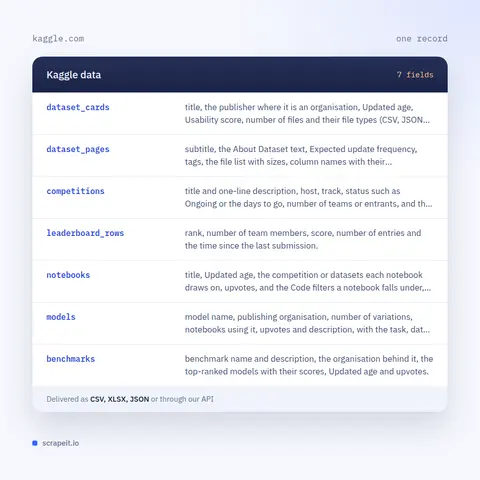
  • Dataset cardstitle, the publisher where it is an organisation, Updated age, Usability score, number of files and their file types (CSV, JSON and others), total size, upvotes, the count of notebooks built on it and the Gold, Silver or Bronze medal where one is shown.
  • Dataset pagessubtitle, the About Dataset text, Expected update frequency, tags, the file list with sizes, column names with their descriptions and the summary statistics Kaggle draws for each column, plus the Code, Discussion and Suggestions counts.
  • Competitionstitle and one-line description, host, track, status such as Ongoing or the days to go, number of teams or entrants, and the reward: a cash prize, Swag, Knowledge or Kudos.
  • Leaderboard rowsrank, number of team members, score, number of entries and the time since the last submission.
  • Notebookstitle, Updated age, the competition or datasets each notebook draws on, upvotes, and the Code filters a notebook falls under, such as Python, R, GPU or TPU.
  • Modelsmodel name, publishing organisation, number of variations, notebooks using it, upvotes and description, with the task, data type, framework, language and size Kaggle files it under.
  • Benchmarksbenchmark name and description, the organisation behind it, the top-ranked models with their scores, Updated age and upvotes.

A Kaggle dataset search returns the number of matching datasets and sorts by Hotness unless told otherwise, so the position of each dataset for your keyword becomes a column as well. That turns a query such as hotel reviews into a ranked list of candidates with their Usability, formats and age side by side.

Fields from Kaggle datasets, competitions and notebooks
A Kaggle database built from repeated runs

A Kaggle database built from repeated runs

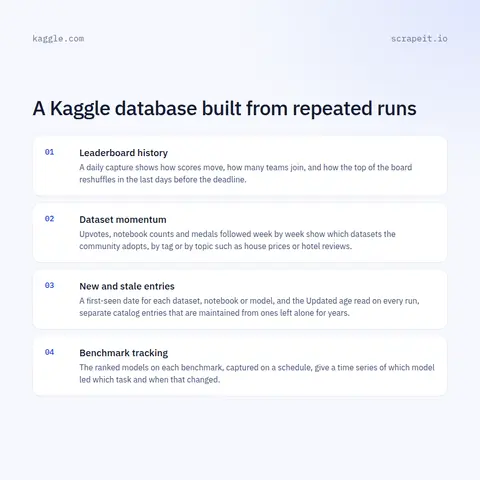
One pass is a snapshot of the catalog. The value comes from running the same searches and competition lists again and keeping what changed between runs.

  • Leaderboard historya daily capture shows how scores move, how many teams join, and how the top of the board reshuffles in the last days before the deadline.
  • Dataset momentumupvotes, notebook counts and medals followed week by week show which datasets the community adopts, by tag or by topic such as house prices or hotel reviews.
  • New and stale entriesa first-seen date for each dataset, notebook or model, and the Updated age read on every run, separate catalog entries that are maintained from ones left alone for years.
  • Benchmark trackingthe ranked models on each benchmark, captured on a schedule, give a time series of which model led which task and when that changed.

Kaggle profiles belong to individuals, so usernames, team names and avatars are left out by default; ranks, scores and counts stay. Publishing organisations are kept by name. Where a project needs personal data, it is handled under GDPR.

About Kaggle and how its sections connect

Source
kaggle.com
Category
education sites
Delivery
API, JSON feed, CSV, XLSX
Plans
From €169 a month
Get a quote

Kaggle is a community site for data science and machine learning. Its menu reads Competitions, Benchmarks, Arenas, Game Arena and Data Hub; behind them sit the datasets catalog, the Code section of public notebooks, the Models catalog and Learn, a set of free short courses with certificates - Intro to Programming, Python, Intro to Machine Learning, Pandas and more - next to guides written by the community.

For someone who needs data, Kaggle is several catalogs pointing at each other. A dataset page counts the notebooks built on it, a notebook card names the competition or datasets it uses, and a competition has its own Overview, Data, Code, Models, Discussion, Leaderboard and Rules tabs. Addresses are readable: /datasets/ followed by owner and dataset slug, /competitions/ followed by the competition slug, and /code/ and /models/ built the same way.

Competitions come in tracks. Getting Started holds permanent practice contests such as Titanic - Machine Learning from Disaster and House Prices - Advanced Regression Techniques, both rewarded with Knowledge and marked Ongoing. Featured competitions carry cash prizes, Playground runs a numbered series of practice episodes, Research and Community hold scientific and member-created contests, and Simulations ask entrants to train bots. Hackathons are listed apart with their own team or entrant counts.

25Developers
500+Customers
1.5BPages extracted
15,000+Hours saved for our clients

Kaggle scraping plans and pricing

Airplane

€199one-time

Setup fee included

100,000
One-time
Up to 5 days
7 days

Helicopter

€169/ mo

Setup fee €499

250,000
Monthly
Up to 5 days
14 days

Glasses

€229/ mo

Setup fee €499

1,000,000
Weekly
Up to 5 days
30 days

Microscope popular

€349/ mo

Setup fee €499

2,000,000
Daily
Same day
60 days

DNA

€549/ mo

Setup fee €799

3,000,000
3 times daily
Same day
90 days

Delivery: CSV, JSON or XLSX files, our API or a JSON feed. MCP server on request.

Full plan details

Why scrape Kaggle

Many machine learning teams look at Kaggle first, for data and for proof of what works, so the catalog itself is a signal worth measuring.

  • Data vendors and publishers see which topics draw upvotes and notebooks, which file types dominate, and where popular entries have not been updated for years - a gap a maintained product can fill.
  • AI and research teams follow benchmark rankings and competition leaderboards to see which approaches and models lead a task and how quickly a field moves.
  • Competition hosts and sponsors compare their contest with similar ones: track, prize, teams, entries per team and time to deadline.
  • Education providers line up the Learn courses and guides against their own syllabus, and watch which competition tracks pull in newcomers.
  • Analysts hunting for a reviews or price dataset get a shortlist ranked for their keywords, with Usability score, formats and Updated age in columns, instead of paging through search by hand.

About ScrapeIt

ScrapeIt is a managed web scraping service. We build, run and repair crawlers for data catalogs, learning platforms and community sites and deliver the results as files or through our API. On Kaggle the work is in script-drawn pages, catalogs that link to each other and counters that change daily, so rows have to stay joined from run to run. A free project assessment comes first and a sample before the full run. Plans start from EUR 169 a month, or EUR 199 for a one-time extract.

FAQ

Still unsure? Write to info@scrapeit.io

Do you offer a Kaggle API for dataset and competition data?

Yes. The ScrapeIt Kaggle API returns dataset titles, Usability scores, file types, upvotes and leaderboard ranks with scores as JSON from an endpoint we host, refreshed on the schedule you set. The same data also comes as CSV or XLSX files, a JSON feed or straight into your database.

Is it legal to scrape Kaggle?

Yes. Dataset cards, competition pages, leaderboards, notebook listings, models and benchmarks are open to any visitor without signing in. We collect only publicly available data - everything a visitor can see on Kaggle - and we collect it legally. Usernames and team names stay out unless your project needs them.

Can you scrape Kaggle competition leaderboards over time?

Yes. We capture the leaderboard of each competition you name on a schedule - daily for live contests - with rank, score, entries and time since the last submission. Kaggle shows the top rows and folds the rest behind a See More control, and we collect the board in full. Every capture is dated, so score moves and new teams read as a history.

Can you refresh an old Kaggle reviews dataset?

Often, yes. Every Kaggle dataset card shows how long ago it was updated, and many popular review and price sets read Updated several years ago. When the original source is a public site, we can collect the same kind of records from it fresh as a separate project and keep the columns close to the Kaggle set your models already use.

Can you run a Kaggle dataset search for our keyword list?

Yes. Each keyword goes through Kaggle search; we record the result count and every dataset's position under the default Hotness sort, then open the dataset pages for files, columns and tags. Results from many keywords are merged on the dataset slug, with each matching keyword kept in a column.

How it works

  1. 1

    Make a request

    You share your needs, expectations, and desired timeframe. We'll suggest the best solution based on your request and budget.

  2. 2

    We configure the crawlers

    Our specialists configure the crawlers and extract a sample dataset for your review before proceeding with the full-scale extraction.

  3. 3

    Collect and deliver

    Once you approve the sample, we launch the project and start full data collection. We gather, filter, and structure the data for easy use, delivering it on time in your preferred format.

  4. 4

    Maintain and support

    Our team manages ongoing processes, monitors website changes, and supports all data extraction cycles. We can also help integrate data into your systems or create dashboards to simplify analysis.

Request a quote

Tell us which sites, which fields and how often. A couple of lines is enough to start.

  • We reply within 1 business day
  • A sample dataset before the full run
  • We sign an NDA on request
  • Delivery by API, JSON feed or files
Which sites, which fields, how often. A couple of lines is enough.

This form is protected by Google reCAPTCHA, which loads when you start filling it in; the Google Privacy Policy and Terms of Service apply. If you prefer not to use it, email us at info@scrapeit.io. Privacy & Cookie Policy

We reply within 1 business day. No obligation.

Kaggle data from €169/month. Free project assessment, reply within 1 business day.