How ScienceDirect Is Shelved: Journals, Book Series, Handbooks and Reference Works
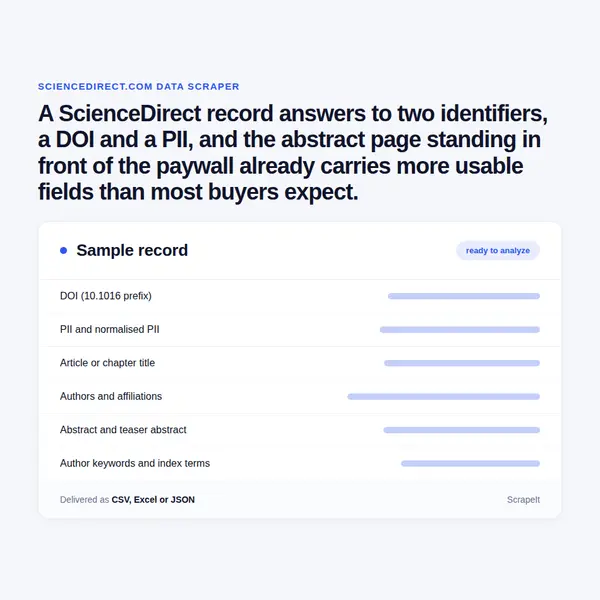
ScienceDirect is Elsevier's full-text platform, and its shelves are sorted before its search box is. Five content classes carry everything the site publishes: journals, book series, handbook series, ebooks and major reference works. Elsevier's own query language codes them JL, BS, HB, BK and RW, and a separate switch splits the catalogue into serial and nonserial. A ScienceDirect scraper is scoped by content class first and by subject second, because that is the order the platform itself uses.
Addresses follow the same split. Journals answer at /journal/ plus a title slug, book series at /bookseries/, handbook series at /handbook/, single books at /book/ and encyclopedias at /referencework/. Articles have two front doors: /science/article/pii/ for the document and /science/article/abs/pii/ for the abstract-only page a reader without entitlement lands on. Term pages sit under /topics/, the catalogue browse under /browse/, and every family carries a sitemap of its own.
Counted in September 2026 the platform currently carries more than 3,000 peer-reviewed journals, 24 million articles and book chapters, up to 50,000 books from more than 50 imprints and more than 350,000 Topics pages. Browsing narrows that by domain and subdomain, publication type, journal status - whether the title still accepts submissions - access type and first letter.
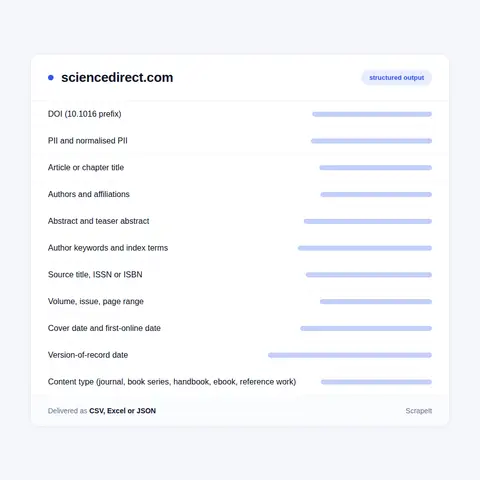
Publication stage matters as much as subject. An item appears first in Articles in Press as an uncorrected proof or a journal pre-proof, becomes a corrected proof, and only then is assigned to a volume and issue as the version of record. The first-online date carries over, so identity survives the move while volume, issue and pages arrive late.
Get a Quote