Udacity Scraper for Programs, Skills and Prerequisites

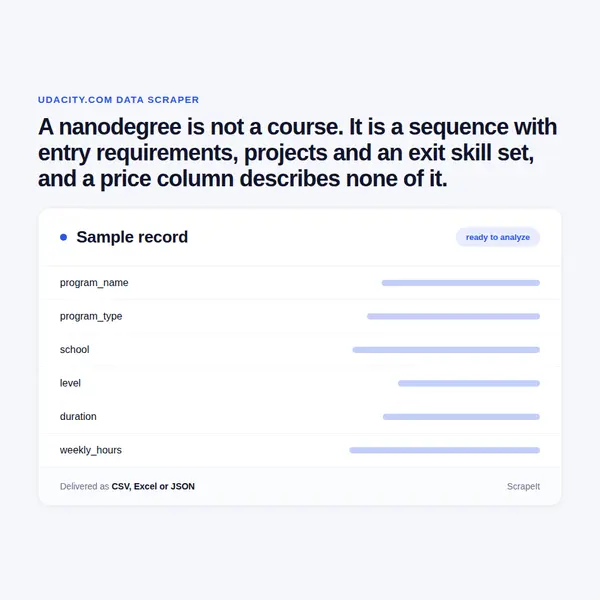
A nanodegree is not a course. It is a sequence with entry requirements, projects and an exit skill set, and a price column describes none of it.

Udacity Scraper
Solutions

Managed course catalogue data, run end to end by us

ScrapeIt runs the collection as a managed service. You name the subject areas or take the full catalogue; we build the pipeline with skills and prerequisites as rows, keep programme structure intact, record the pricing model alongside the price, and hand back CSV, JSON, Excel or a push into your warehouse.

Where vocabulary change matters we run repeat collection and keep every observation, because a skill that stopped being named leaves no trace of having been named.

We collect published catalogue data only, honour the crawl rules the site publishes and pace requests. No learner data, no account access. Content is copyrighted and terms restrict reuse, so the dataset is for analysis rather than republication, and your counsel should see the use case before the project starts.

Udacity fields in every export

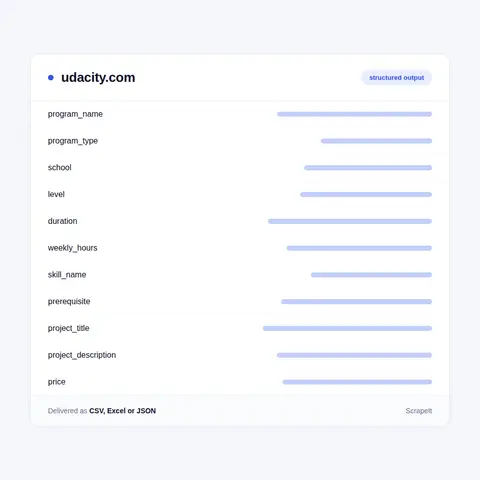
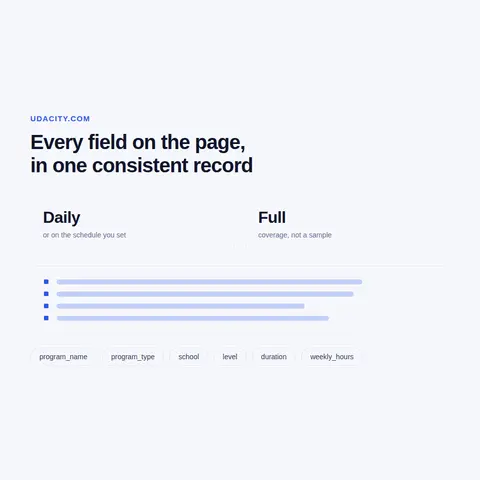
The programme record covers the programme name, type, school or subject area, level, stated duration, estimated weekly commitment, the summary description and the enrolment or availability state.

Skills are delivered as rows rather than a comma separated field. A programme declaring twelve skills is twelve relationships, and only in that form can anyone ask which skills appear across how many programmes or how the vocabulary shifts over time.

Prerequisites are their own records too, since they are what determine who a programme is actually for. A beginner label on a programme that assumes prior programming experience is marketing; the prerequisite list is the fact.

Projects are captured where published, with their titles and descriptions, because for a competitor or an employer the projects say more about the real content than the syllabus summary does.

Pricing is recorded as published with its model, since programme and subscription pricing are different things and a single number that does not say which is not usable.

Udacity fields in every export
Skill tracking, curriculum benchmarking and limits

Skill tracking, curriculum benchmarking and limits

Skill vocabulary tracking is the output that rewards repeat collection. Which skills appear, how many programmes name each one, and when a term first shows up or disappears is a time series, and it only exists from the point collection starts.

Curriculum benchmarking against your own programmes is the most direct commercial use: duration, prerequisites, project count and declared outcomes side by side, which usually reframes a roadmap discussion faster than any market report.

Cross provider comparison is the wider brief and needs a shared skill vocabulary to work at all. Providers name the same skill differently, so the matching is a resolution step that ships with a confidence value rather than a silent join.

What we do not collect is learners. No enrolment numbers inferred from reviews, no student profiles, no account access. Programme, skill, prerequisite and project data needs none of it, and the crawl rules give no reason to go anywhere near it.

Programs rather than a course shelf

Udacity is a technology skills platform whose central product is the nanodegree: a structured programme running over months, built from lessons and assessed projects, aimed at a specific job outcome rather than a topic.

That structure is the reason a marketplace schema does not fit. On a course marketplace a course is an atom with a title, a length and a price. Here the atom is a programme containing courses, with prerequisites at the entry, projects inside and a declared set of skills at the exit. Collapsed into a single row with a duration and a price, everything that distinguishes it disappears.

The skills declaration is the most commercially interesting part and the one most often lost. Programmes state what a learner will be able to do, in the vocabulary of the industry, which makes the catalogue a readable map of what the market is being told it needs.

The catalogue responds directly with substantial content and crawl rules are published and permissive, allowing the site generally and disallowing only administrative paths on the blog.

Get a Quote
dev_w
25

Developers

customers
500+

Customers worldwide

pages
1 500 000 000+

Pages extracted

stime
15000+

Hours saved for our clients

Plans

Airplane

€199 / one-time

setup fee - included

Data limits100,000
Frequencyone-time
Run timeup to 5 days
Data storing7 days

Helicopter

€169 / mo

setup fee €499

Data limits250,000
Frequencymonthly
Run timeup to 5 days
Data storing14 days

Glasses

€229 / mo

setup fee €499

Data limits1,000,000
Frequencyweekly
Run timeup to 5 days
Data storing30 days

DNA

€549 / mo

setup fee €799

Data limits3,000,000
Frequency3 times daily
Run timesame day
Data storing90 days

Why the skills vocabulary is the real dataset

The catalogue is small compared with a marketplace and the usual instinct is to treat it as a short list. That misjudges what it is for.

The value is not volume, it is vocabulary. A platform built around job outcomes has to name the skills it teaches in terms employers recognise, and the aggregate of those names across a catalogue is a picture of what the technology skills market currently rewards. Tracked over time it shows entries and exits - which skills a serious provider started naming, and which quietly stopped appearing.

The second reason is programme structure. Anyone building or benchmarking a curriculum needs to know how long a comparable programme runs, what it assumes on entry and what it assesses. Those are three separate fields and they are the ones a price comparison ignores.

The third is that prerequisites reveal positioning. Two providers can both call a programme beginner level while assuming completely different starting points, and the prerequisite list is where that becomes visible rather than arguable.

The fourth is scope honesty. This is one provider with a defined technology focus, so it is a strong signal about that market and not a survey of online education. We scope it that way rather than letting a small catalogue stand in for a large field.

Our Blog

Reads Our Latest News & Blog

Learn how to use web scraping to solve data problems for your organization

How Artificial Intelligence Is Used In Web Scraping

How Artificial Intelligence Is Used In Web Scraping

Leveraging advances in technology, the AI-powered web scraper has skyrocketed in demand and is helping to expand capabilities by automating tedious daily tasks and speeding up data collection from thousands of websites several times over.

What is Web Scraping and What is it Used For?

What is Web Scraping and What is it Used For?

Web scraping is a method of obtaining web data by extracting it from pages of web resources with the help of a program, that is, in automatic mode. It is used to syntactically convert web pages into more usable forms.

Web Scraping for Machine Learning

Web Scraping for Machine Learning

If you specialize in machine learning, you need to feed large amounts of data to the algorithms. Web scraping is the easiest and the most efficient method of collecting the data from all over the Internet.

scrapeit logo

Who builds and keeps your Udacity feed

ScrapeIt is a managed extraction company, not a tool you have to learn. Our team builds the pipeline, watches it as the catalogue is restructured, and repairs it before a vocabulary series develops a gap.

You see a sample first, in your format, over the subject areas you actually track, with skills and prerequisites expanded so you can judge the structure on a real programme.

FAQ

Why not just collect courses and prices?

Because the product here is a months-long programme with entry requirements, projects and a declared skill set, and a row with a duration and a price describes none of that. The structure is what a curriculum team or a competitor is actually buying.

What makes the skill list valuable?

It is the catalogue in the vocabulary employers use. Aggregated it shows what the technology skills market currently rewards, and tracked over time it shows which terms a serious provider started naming and which quietly stopped appearing.

Why collect prerequisites separately?

Because they determine who a programme is really for. Two providers can both say beginner while assuming completely different starting points, and the prerequisite list is where that becomes a fact rather than an argument.

Can you compare several providers?

Yes, and it needs a shared skill vocabulary to mean anything, since providers name the same skill differently. We build that as a resolution step with a confidence value rather than joining on strings and hoping.

Do you collect enrolment or student data?

No. No student profiles, no account access, and no enrolment figures inferred from review counts - an inference dressed as a measurement is worse than a missing column. Programme and skill data needs none of it.

How does it Work?

Step 1 - Make a Request

You share your needs, expectations, and desired timeframe. We’ll suggest the best solution based on your request and budget.

Step 2 - Configuring Custom Web Crawlers

Our specialists configure the crawlers and extract a sample dataset for your review before proceeding with the full-scale extraction.

Step 3 - Collect and Deliver

Once you approve the sample, we launch the project and start full data collection. We gather, filter, and structure the data for easy use, delivering it on time in your preferred format.

Step 4 - Maintain and Support

Our team manages ongoing processes, monitors website changes, and supports all data extraction cycles. We can also help integrate data into your systems or create dashboards to simplify analysis.

Request a Quote

Tell us more about you and your project information.
Which sites, which fields, how often. A couple of lines is enough.

We reply within 1 business day. No obligation.

scrapiet

Scrapeit Sp. z o.o.
10/208 Legionowa str., 15-099, Bialystok, Poland
NIP: 5423457175
REGON: 523384582