Udemy Scraper: Course, Price and Curriculum Data Extraction

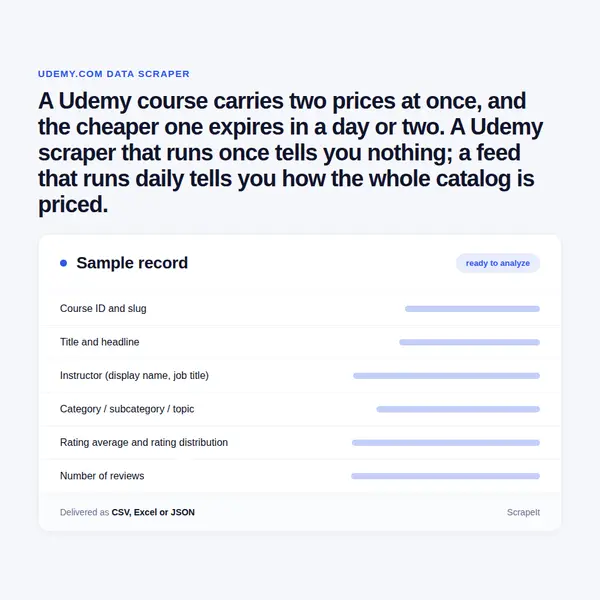
A Udemy course carries two prices at once, and the cheaper one expires in a day or two. A Udemy scraper that runs once tells you nothing; a feed that runs daily tells you how the whole catalog is priced.

Udemy Scraper
Solutions

How ScrapeIt Runs Udemy Scraping and Ships the Feed

ScrapeIt writes the collector, runs it on our machines and repairs it when the platform moves. Anti-bot handling, proxy rotation and CAPTCHA solving are part of the managed service, and they earn their keep here: the site puts a browser check in front of the markup, and no single address holds a steady rate across a catalog this size.

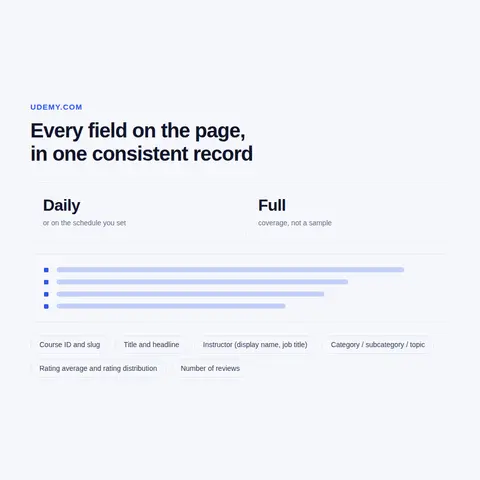
We plan collection the way the site invites it, from the sitemap and from category, subcategory and topic listings, not from faceted search robots.txt closes. Course pages, curriculum trees and review pages run on separate cadences: a price changes weekly, a syllabus does not. A sample extract comes first, so field names and coverage can be checked before the full run. After sign-off we run to your schedule and watch for layout changes so the feed does not go stale. Delivery is CSV, JSON, XLSX or an endpoint you call, pushed to S3, SFTP or your warehouse.

What a Udemy Course Record Holds, Field by Field

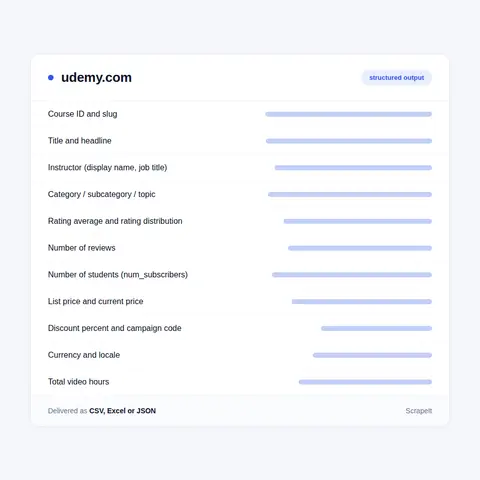
A Udemy course page is denser than it looks. These are the fields we extract Udemy data into, in the platform's own names.

  • Identity. Numeric course id, published_title slug, canonical url, title, headline (the one-line pitch under it), the full HTML description, and locale, the teaching language.
  • People. visible_instructors with id, display_name and job_title, plus the owner record; the instructor panel adds a lifetime rating, review total, student total and course count.
  • Placement. primary_category and primary_subcategory with id, title and slug, plus course_has_labels, the topic list, one entry of which is flagged is_primary.
  • Ratings. Three averages sit on one course, avg_rating, avg_rating_recent and a weighted variant, all to seven decimals while the page shows one, plus num_reviews, num_reviews_recent and rating_distribution, the one to five star histogram.
  • Audience. num_subscribers is the exact enrolment count, with a rounded count beside it, so one course reads 1,589,426 students in one block and one million learners in the next.
  • Size. content_info as text, content_length_video in seconds, num_published_lectures against num_lectures (drafts inflate the latter), num_curriculum_items, num_quizzes, num_coding_exercises, num_article_assets and num_additional_assets.
  • Level, language and dates. instructional_level as All Levels, Beginner, Intermediate or Expert; caption_languages and caption_locales, each track tagged Auto for machine translation or CC for a human track; created, published_time and last_update_date.
  • Curriculum. Sections and lectures with sort_order, durationInSeconds, asset type (video, article, quiz, coding exercise), is_free and can_be_previewed flags, a transcript field, and aiSummary, a machine-written recap per lecture.
  • Author copy. objectives (What you will learn), prerequisites (Requirements), target_audiences (Who this course is for) and a course-level FAQ.
  • Status flags. has_certificate, available_features, is_paid, is_practice_test_course, quality_status, and badges like Bestseller, Highest Rated, Premium and Role Play, each stamped with the category and topic it won in.

What a Udemy Course Record Holds, Field by Field
Udemy Data by Country: Currency, Interface Locale and Subtitle Tracks

Udemy Data by Country: Currency, Interface Locale and Subtitle Tracks

Udemy runs one catalog behind nineteen interface locales, as path prefixes such as /de/, /ja/ and /zh-tw/. Currency follows the storefront, and so does number formatting, which is where feeds quietly break: the same course prints 474,422 ratings in one block and 474.422 in another on one page. Enum fields localise too, so a record pulled from a German storefront returns the level as Einsteiger:innen, not Beginner, and a free course prices as Kostenlos. Anything you group by has to be normalised on the way in.

Language is two separate facts. Teaching language is one value per course, and the filter lists roughly thirty-seven of them, from English down to single-course entries in Georgian and Uzbek. Subtitles are a second list, and the filter splits machine tracks from human closed captions with an explicit CC suffix, so a course can advertise thirty subtitle languages and hold one real caption track.

Udemy Business is a separate storefront, not a second catalog: its sitemap file holds a single demo request page, so the seat-based library is not public. What is public is the collection flag on each course. Plan pages put the subscription collections at close to thirty thousand curated courses against a marketplace of more than 250,000. Around them sit further surfaces: certification voucher listings, a certification browse hub, thirteen Career Accelerator tracks, and topic pages carrying learner totals, course counts and an average rating per subject. Instructors and review authors we treat as a data type, taking the display name Udemy publishes and building no named profiles or contact lists.

How the Udemy Catalog Is Organised: Categories, Subcategories and Topics

Udemy sorts its catalog on three levels, and a Udemy scraper has to respect all three. Thirteen subject categories sit at the top, among them Development, Business, IT and Software, Design and Marketing. Under them run 128 subcategories, from Web Development to Esoteric Practices and Money Management Tools. A fourteenth branch is not a subject at all: /courses/free/ is a price bucket split into Essential Tech, Personal Growth and Wellness, and Productivity and Professional Skills. Below the subcategory sits the topic, and topics are what the filters run on, each carrying a numeric label ID: 8322 is Web Development, 6368 is JavaScript, 7380 is Python.

Addresses are short and stable. A course lives at /course/ plus its published title and carries a numeric ID that reappears in the enrollment path, the mobile deep link and the CDN image name. Instructor pages answer to two forms, /user/ plus a handle and /user/ plus a UUID. Topics live at /topic/ plus a slug, with a free-only variant ending in /free/, and single preview lessons get their own pages under /tutorial/.

The sitemap index is the way in. It lists 34 files: navigation, category, subcategory, sixteen topic files, three instructor files, seven course files, preset topics, Udemy Business, aggregators and certification vouchers. Each course file holds up to fifty thousand addresses with a lastmod date, roughly 334,000 course URLs in all in September 2026. robots.txt then sets the rules: any URL with a query string is closed, with one exception for the ?p= page parameter, so pagination is open and faceted search is not. Nineteen interface locales exist as path prefixes, but a locale course page points its canonical at the plain English address, so one course stays one record instead of nineteen.

Get a Quote

dev_w
25

Developers

customers
500+

Customers worldwide

pages
1 500 000 000+

Pages extracted

stime
15000+

Hours saved for our clients

Plans

Airplane

€199 / one-time

setup fee - included

Data limits100,000
Frequencyone-time
Run timeup to 5 days
Data storing7 days

Helicopter

€169 / mo

setup fee €499

Data limits250,000
Frequencymonthly
Run timeup to 5 days
Data storing14 days

Glasses

€229 / mo

setup fee €499

Data limits1,000,000
Frequencyweekly
Run timeup to 5 days
Data storing30 days

DNA

€549 / mo

setup fee €799

Data limits3,000,000
Frequency3 times daily
Run timesame day
Data storing90 days

Udemy Price Monitoring: List Price, Deal Code and an 86 Percent Cut

Every paid course carries two prices at the same moment, and Udemy price monitoring only makes sense once you record both. list_price is the tier the instructor set. price is what the buyer pays today. Between them sits a discount object with saving_price, has_discount_saving and discount_percent, and under that a campaign block naming the code that produced the cut, its start_time and end_time, whether it is public, whether the instructor created it, and how many uses remain. On a bestselling course the gap runs to 86 percent off, the campaign lasts a handful of days, and the checkout link already carries the code.

That is why a single pull is worthless. The deal window closes, a new campaign code opens, and the same course sits at a different number. A stored Udemy data feed turns that churn into a series: how deep the cut goes by category, how long a campaign runs, which instructors opt into platform deals and which hold their list price.

Three more prices hide behind the first two. The record keeps a list price string in US dollars next to the local currency amount, so a course reading 139.99 euro on the page still carries a 199.99 dollar tier underneath. Separate Apple and Google in-app price fields quote a third, lower figure for buying inside the mobile apps. Subscription changes the maths again, because a course in the Personal Plan collection is reachable for a monthly fee rather than a purchase. Free courses close the set: is_paid turns false, the price string localises, certificates switch off and the feature list empties.

Our Blog

Reads Our Latest News & Blog

Learn how to use web scraping to solve data problems for your organization

How Artificial Intelligence Is Used In Web Scraping

How Artificial Intelligence Is Used In Web Scraping

Leveraging advances in technology, the AI-powered web scraper has skyrocketed in demand and is helping to expand capabilities by automating tedious daily tasks and speeding up data collection from thousands of websites several times over.

What is Web Scraping and What is it Used For?

What is Web Scraping and What is it Used For?

Web scraping is a method of obtaining web data by extracting it from pages of web resources with the help of a program, that is, in automatic mode. It is used to syntactically convert web pages into more usable forms.

Web Scraping for Machine Learning

Web Scraping for Machine Learning

If you specialize in machine learning, you need to feed large amounts of data to the algorithms. Web scraping is the easiest and the most efficient method of collecting the data from all over the Internet.

scrapeit logo

Working With ScrapeIt on Udemy Data

ScrapeIt is a managed data collection agency. We write the crawlers, run them on our machines, fix them when a site changes and hand over clean files. You do not maintain code and you do not manage proxies.

We also say no. If a smaller scope answers your question, you hear that on the first call. We do not sign in as a student to reach paid lecture video, we do not touch Udemy Business seats, and we do not assemble personal profiles of instructors or reviewers. What is public we collect well; what is not, we tell you about before anyone signs.

FAQ

Does Udemy have a public API, and what does it return?

Not a usable one for catalog work. The Udemy Affiliate API v2.0 still has a docs page, but it is marked deprecated and access was discontinued on 1 January 2025; the affiliate program now runs on the Impact network and gives tracking and deep links, not a data feed. The Instructor API v1.0 is live at instructor-api/v1 with a bearer token, but it reaches only courses you teach, plus their questions, reviews and message threads. It is throttled to 100 requests per 10 seconds, caps page_size at 100, and its own overview calls it maintenance mode. A per-course read endpoint answers without a key, but nothing public lists or searches courses, which is the gap a Udemy scraper fills.

Can you scrape Udemy reviews, and how many will I get per course?

Yes, with one hard ceiling worth knowing before you budget. The review listing stops at ten thousand items per course no matter how many ratings the course holds, and it is ordered newest first, so a course with 474,422 ratings yields its most recent ten thousand and nothing older. Most of those entries are a star rating with no text at all; written reviews are the minority. Each one carries a rating on the half-star scale, a created and modified timestamp, the review body and the reviewer's public display name. We deliver ratings, dates and text, and leave named private individuals and contact details out by default.

How often should a Udemy price feed refresh?

Daily at minimum for anything price-driven. Udemy discount campaigns are short: a campaign block on a live course typically spans a few days, the site counts the remaining time down in the buy box, and a new code takes over when the old one expires. Refresh weekly and you will record only a handful of the year's price points and miss the depth of most cuts. Ratings, enrolment counts and the last-updated date move slowly enough for a weekly pass, and the curriculum tree can be refreshed monthly. We usually split a Udemy project into those three cadences so you are not paying to re-collect a syllabus that has not changed.

Do you cover Udemy prices and courses in other countries and languages?

Yes, and it needs to be asked for explicitly, because a single collection run sees one storefront. Udemy serves nineteen interface locales as path prefixes and quotes the price in the currency of the market it thinks you are in, so a course reads one figure in euro and another in dollars. Teaching language is a separate field from subtitle tracks, and subtitle tracks are split between machine translations and human closed captions. We set the target markets up front, normalise currency, level and decimal formatting into one schema, and keep the original strings in a raw column so nothing is lost in the conversion.

Is it legal to extract Udemy data, and what will you not collect?

Udemy's terms of use restrict automated access to the platform, so this is a scoping question, not a checkbox. We work only with pages Udemy publishes to anonymous visitors, follow the robots.txt rules on query strings and pagination, and we do not sign in, share accounts or reach behind a purchase to lecture video, quizzes or Udemy Business seats. Course authors and review authors are collected as a data type: the display name Udemy itself publishes, nothing appended from elsewhere, and no contact lists. Where a requirement sits outside that line we say so before the project starts, and the compliance call stays with you and your counsel.

How does it Work?

Step 1 - Make a Request

You share your needs, expectations, and desired timeframe. We’ll suggest the best solution based on your request and budget.

Step 2 - Configuring Custom Web Crawlers

Our specialists configure the crawlers and extract a sample dataset for your review before proceeding with the full-scale extraction.

Step 3 - Collect and Deliver

Once you approve the sample, we launch the project and start full data collection. We gather, filter, and structure the data for easy use, delivering it on time in your preferred format.

Step 4 - Maintain and Support

Our team manages ongoing processes, monitors website changes, and supports all data extraction cycles. We can also help integrate data into your systems or create dashboards to simplify analysis.

Request a Quote

Tell us more about you and your project information.
Which sites, which fields, how often. A couple of lines is enough.

We reply within 1 business day. No obligation.

scrapiet

Scrapeit Sp. z o.o.
10/208 Legionowa str., 15-099, Bialystok, Poland
NIP: 5423457175
REGON: 523384582