Codecademy Scraper for Catalog, Paths and Skill Coverage

Every provider names the same technology differently. Without a shared vocabulary, comparing catalogues is comparing two lists of words.

Codecademy Scraper
Solutions

Managed catalog collection, run end to end by us

ScrapeIt runs the collector as a managed service. You name the technologies, roles and the providers you want compared; we build the pipeline, normalise everything onto one vocabulary, and hand back CSV, JSON, Excel or a push into your warehouse with paths as parents and access tiers dated.

Because catalogues change slowly, we run this monthly or quarterly with change records, which keeps both the request volume and the cost proportionate.

We collect what the public catalog renders. There is no learner content in the output: no exercises, no solutions, no lesson material, all of which belong to the platform. The dataset is catalogue metadata for analysis rather than material for republication. Bring the use case to your own counsel before the project starts.

Codecademy fields in every export

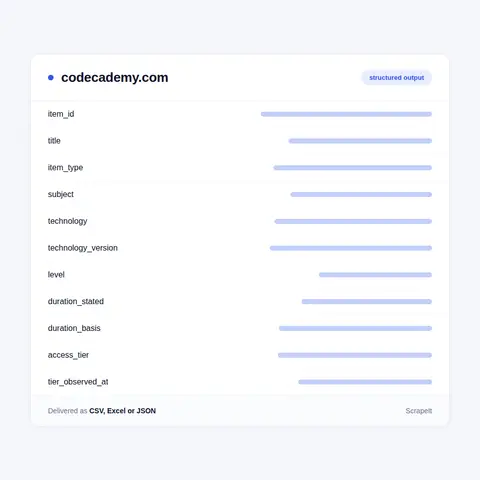
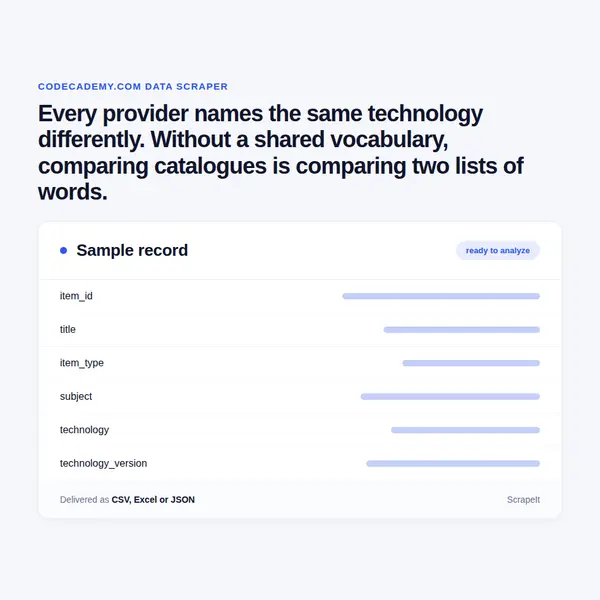
The catalog record covers item identifier, title, item type distinguishing career path, skill path and course, canonical URL, subject, programming language or technology, level, stated duration and description.

Path structure is preserved as a parent with ordered components, because the route is the unit buyers compare. Components are frequently shared between paths, which is invisible in a flat export and material when totalling hours or assessing overlap.

Access tier is recorded per item: free, subscription or trial, with the date observed. Which content sits behind the subscription moves, and tracking that over time shows how a provider is repositioning without announcing it.

Technology and version tagging is collected carefully because it is where staleness hides. A course teaching a framework two major versions behind exists in the catalog and is a coverage gap in practice, and only the tag plus the update date reveals it.

Then the context fields: prerequisites where stated, certificate offering, ratings and enrolment signals where published, and the collection timestamp on every row.

Codecademy fields in every export
Free tier movement, path overlap and labour market joins

Free tier movement, path overlap and labour market joins

Free tier movement is one of the more interesting signals available here. Providers shift content between free and paid to compete for beginners, and tracking which items cross that line, and when, shows strategy that nobody publishes.

Path overlap analysis falls out of preserved structure. Components shared between paths mean the catalogue is smaller than its item count suggests, and totalling hours across paths without accounting for overlap overstates the offering - including your own, which is worth knowing before a competitor points it out.

Labour market joins are the standard extension: catalogue coverage on one side, technologies named in job postings on the other, joined on the same normalised vocabulary, answering where training supply lags hiring demand. That is the same pipeline as our job data work and the two are frequently bought together.

Refresh is slow. Catalogues move on release cycles rather than daily, so monthly or quarterly collection with change records is the sensible arrangement: new items, retired items, tier changes and path restructures delivered as differences.

A catalog organised around paths, not individual courses

Codecademy teaches programming through interactive exercises rather than video, and its catalog is organised around routes: career paths that run from beginner to job ready, skill paths that cover one competency, and individual courses that sit inside them.

The path is the unit that matters commercially. Corporate buyers and career switchers do not buy a course, they buy a route to competence, and whether a provider offers a complete route in a technology is the procurement question. A flat course list cannot answer it.

The catalog surface responds directly, and content is tagged by language, subject and level. Access is split between free and subscription, and which parts sit on which side moves over time - itself a signal about how a provider is positioning against competitors.

Because teaching is interactive rather than video, duration is expressed differently from platforms built on lectures. Comparing hours across providers without accounting for that produces a number that flatters whichever one measures most generously.

Get a Quote
dev_w
25

Developers

customers
500+

Customers worldwide

pages
1 500 000 000+

Pages extracted

stime
15000+

Hours saved for our clients

Plans

Airplane

€199 / one-time

setup fee - included

Data limits100,000
Frequencyone-time
Run timeup to 5 days
Data storing7 days

Helicopter

€169 / mo

setup fee €499

Data limits250,000
Frequencymonthly
Run timeup to 5 days
Data storing14 days

Glasses

€229 / mo

setup fee €499

Data limits1,000,000
Frequencyweekly
Run timeup to 5 days
Data storing30 days

DNA

€549 / mo

setup fee €799

Data limits3,000,000
Frequency3 times daily
Run timesame day
Data storing90 days

Why catalogue comparison needs a shared vocabulary first

The brief is almost always comparative: how does our catalogue compare with theirs, where are the gaps, who moved first on a new technology. And it fails almost always for the same reason, which is that every provider names things differently.

One calls it JavaScript, another calls it Front End Development, a third calls it Web Foundations. One lists a cloud service under its current name, another under the name it had three years ago. Comparing those lists without mapping them first is comparing vocabularies rather than coverage, and the answer comes out wrong in whichever direction the naming happens to favour.

So the mapping is the work. We normalise technologies, roles and levels onto one vocabulary across every provider in the comparison, aligned where a client wants to their internal competency framework. That is built during collection, because reconciling three vendor exports afterwards is the failure mode we see most.

The second issue is duration incomparability. Interactive platforms and video platforms measure hours differently, and a straight comparison flatters whichever measures loosest. We record the stated figure and the measurement basis rather than silently treating them as equivalent.

The third is staleness, which matters more in technology training than anywhere: a course two major versions behind is worse than absent, because a learner follows it and produces code that does not work.

Our Blog

Reads Our Latest News & Blog

Learn how to use web scraping to solve data problems for your organization

How Artificial Intelligence Is Used In Web Scraping

How Artificial Intelligence Is Used In Web Scraping

Leveraging advances in technology, the AI-powered web scraper has skyrocketed in demand and is helping to expand capabilities by automating tedious daily tasks and speeding up data collection from thousands of websites several times over.

What is Web Scraping and What is it Used For?

What is Web Scraping and What is it Used For?

Web scraping is a method of obtaining web data by extracting it from pages of web resources with the help of a program, that is, in automatic mode. It is used to syntactically convert web pages into more usable forms.

Web Scraping for Machine Learning

Web Scraping for Machine Learning

If you specialize in machine learning, you need to feed large amounts of data to the algorithms. Web scraping is the easiest and the most efficient method of collecting the data from all over the Internet.

scrapeit logo

Who builds and keeps your catalog feed

ScrapeIt is a managed extraction company, not a tool you have to learn. Our team builds the pipeline, maintains the vocabulary mapping as technologies and naming change, and repairs the collector before your comparison goes stale.

You see a sample first, in your format, across the technologies you actually care about, with the mapping applied so you can check it against your own competency framework on real rows.

FAQ

Why does comparison need a vocabulary mapping?

Because every provider names things differently: one says JavaScript, another Front End Development, a third Web Foundations, and cloud services appear under names that changed years ago. Comparing those lists without mapping them is comparing vocabularies rather than coverage, and the answer comes out wrong in whichever direction the naming happens to favour.

Can you compare stated course hours across providers?

Only with the measurement basis recorded alongside. Interactive platforms and video platforms count hours differently, so a straight comparison flatters whichever measures loosest. We record the stated figure and how it was measured rather than silently treating them as equivalent.

Do you track what moves between free and paid?

Yes, with the date observed, and it is one of the more interesting signals here. Providers shift content across that line to compete for beginners, and tracking which items cross and when shows positioning strategy that nobody announces.

Why does path structure matter?

Because buyers compare routes to competence, not individual courses, and because components are frequently shared between paths. A flat export hides that overlap, so totalling hours across paths overstates the offering - including your own, which is worth knowing before a competitor points it out.

Do you collect the exercises or solutions?

No. Exercises, solutions and lesson material belong to the platform and sit behind the product. We collect catalogue metadata from the public surfaces: titles, technologies, levels, paths, tiers and dates. The dataset is for analysis rather than republication.

How does it Work?

Step 1 - Make a Request

You share your needs, expectations, and desired timeframe. We’ll suggest the best solution based on your request and budget.

Step 2 - Configuring Custom Web Crawlers

Our specialists configure the crawlers and extract a sample dataset for your review before proceeding with the full-scale extraction.

Step 3 - Collect and Deliver

Once you approve the sample, we launch the project and start full data collection. We gather, filter, and structure the data for easy use, delivering it on time in your preferred format.

Step 4 - Maintain and Support

Our team manages ongoing processes, monitors website changes, and supports all data extraction cycles. We can also help integrate data into your systems or create dashboards to simplify analysis.

Request a Quote

Tell us more about you and your project information.
Which sites, which fields, how often. A couple of lines is enough.

We reply within 1 business day. No obligation.

scrapiet

Scrapeit Sp. z o.o.
10/208 Legionowa str., 15-099, Bialystok, Poland
NIP: 5423457175
REGON: 523384582