How Can Web Scraping Technology Help the Finance Industry?
Web scraping automates the extraction and aggregation of financial data, makes it easier to find stocks, and allows you to predict the market based on the information.
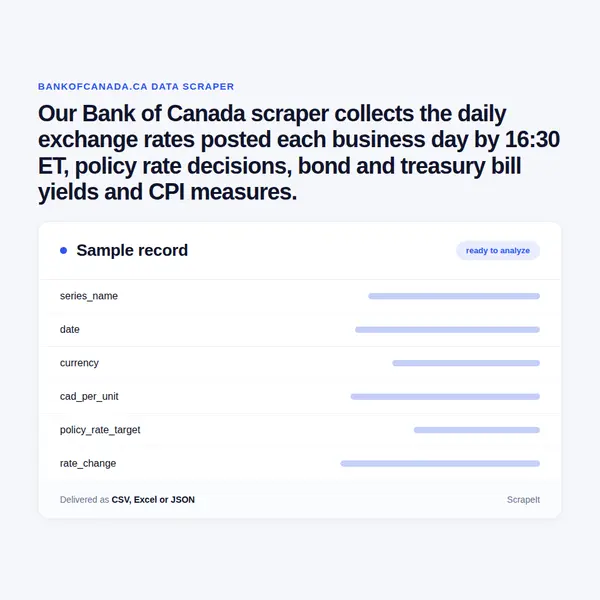
Our Bank of Canada scraper collects the daily exchange rates posted each business day by 16:30 ET, policy rate decisions, bond and treasury bill yields and CPI measures.
Plans from €169 a month · Free project assessment · Reply within 1 business day
CSV · Excel · JSON · XML · FTP · SFTP · Amazon S3 · Google Cloud
API, JSON feed or CSV, XLSX and JSON files
ScheduleOne-time, monthly, weekly, daily or 3 times a day
Bank of Canada pages, filters, fields and a schedule
Built, monitored and repaired by our team
API, JSON feed or CSV, XLSX and JSON files
You pick the scope - which currencies, which yield series, whether you need the decision record, CPI measures or staff research - and the frequency. We build the crawlers, time them to the Bank's daily update schedule and keep them working when bankofcanada.ca changes a page. Proxy rotation, pacing and page rendering are covered by the service.
The Bank's tables carry their own placeholders - Bank holiday in the exchange rate grid, NA in the bond table, a double dash for weeks without a treasury bill auction, an R beside some core CPI values - and these arrive as flags, never as invented numbers. Files come as CSV, XLSX or JSONLines, or by SFTP or Amazon S3. Plans start from EUR 169 a month, or EUR 199 for a one-time extract.
Bank of Canada statistics are dated series, so each row is one series, one date and one value, with the series name the Bank uses and, for CPI, the CANSIM vector shown on the page, such as v41690973. What we collect:
Values keep the decimals the Bank prints - four places for most currencies and six for the yen or the Indonesian rupiah - so nothing is rounded away on the way to your system.
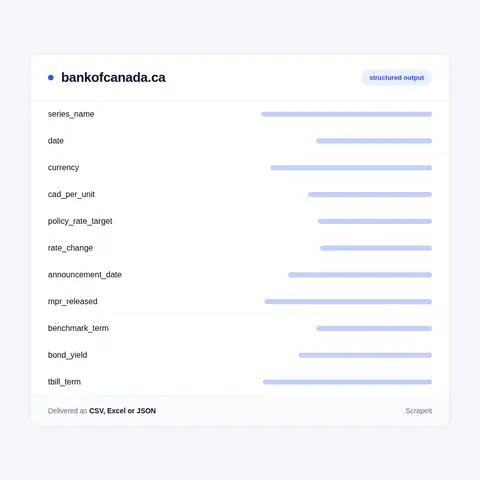
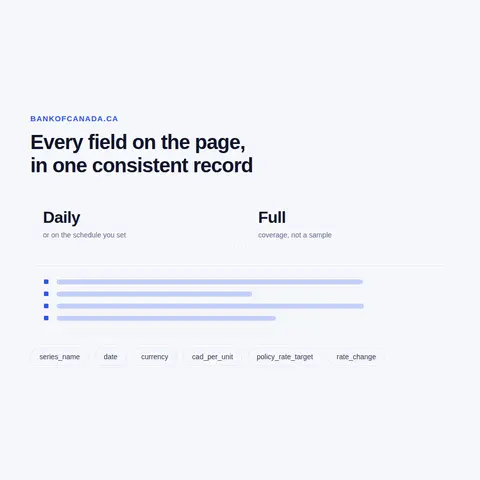
The exchange rate grid on the page shows the latest five business days, so continuity comes from repeated runs. Keyed on currency and date, they build a daily history that sits beside the monthly averages, posted on the last business day of each month, and the annual averages posted at year end. For the years before 2017 the Bank keeps legacy noon and closing rates calculated under its old methodology; we carry them as a separate series rather than splice them into the new one.
Policy decisions form their own record: eight fixed announcement dates a year, the next year's schedule published in advance, and the rule that since 2021 a change takes effect the day after its announcement. Around them sit the Monetary Policy Report, the Summary of deliberations, the Business Outlook Survey, the Canadian Survey of Consumer Expectations and the Senior Loan Officer Survey.
Staff research can be listed by content type - staff working papers, staff discussion papers, staff analytical notes, technical reports - with JEL codes, research themes and publication dates. Personal data is handled under GDPR, and author names are left out by default.
bankofcanada.ca is the bilingual site of Canada's central bank, in English with a French version one click away on every page. The Bank conducts monetary policy by adjusting the target for the overnight rate, issues bank notes, oversees payment systems and runs the Government of Canada securities auctions, which is why auction schedules and results sit next to the statistics.
The Statistics area is organised into exchange rates, interest rates, price indexes, indicators, and banking and financial statistics. Daily series follow a published update schedule: exchange rates by 16:30 ET, interest rates around midday, bond yields in the morning and treasury bills before noon. The exchange rates are indicative - averages of aggregated price quotes from financial institutions - and the currency list changes: in May 2026 the Bank added the Malaysian ringgit, Polish zloty and Thai baht and stopped the Russian ruble and Saudi riyal.
The Canadian Effective Exchange Rate index, CEER, weights the Canadian dollar against major trading partners, the BCPI follows the US dollar prices of commodities Canada sells abroad, and Official International Reserves are posted several times a month.
Delivery: CSV, JSON or XLSX files, our API or a JSON feed. MCP server on request.
Full plan detailsThe daily rate is a common reference for converting foreign-currency amounts into Canadian dollars. Accounting teams restate US dollar and euro invoices at it, online sellers set CAD prices from it, and treasury teams reconcile month-end positions against the monthly averages. Every currency in one file, with Bank holiday rows marked, keeps a ledger free of gaps, and FX desks get the same series without retyping a table.
Rates and yields serve lenders and fixed-income teams: the policy interest rate path and CORRA for floating-rate products, benchmark and marketable bond yields for curve work, treasury bill auction results for short-term funding. Economists pair the CPI-trim and CPI-median series with the decision dates to study how inflation readings line up with policy moves, and the commodity price index adds a terms-of-trade signal. Market moves are yours to judge; we supply the data.
Learn how to use web scraping to solve data problems for your organization

Web scraping automates the extraction and aggregation of financial data, makes it easier to find stocks, and allows you to predict the market based on the information.
Data and analytics are opening the door to uncovering ways to combat financial crime based on smart data. And advanced AI analytics and cognitive techniques, machine learning, and automation will improve the inefficiency of existing investigative processes.
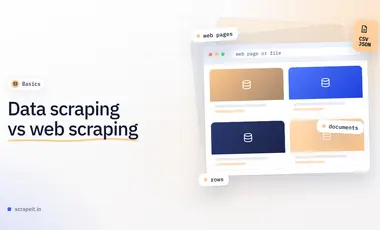
Data scraping is the wide term that includes documents, scans and old screens; web scraping is the part that works on websites. We compare sources, daily work, output and cost drivers, give a briefing checklist and walk through two of our projects.

ScrapeIt runs data collection as a service: we set up the crawlers, keep them running and deliver the result to your storage, so nobody on your side maintains a parser for a central bank page. Statistical sources such as bankofcanada.ca reward care with units, quoting direction and placeholders, and that is where our checks go. Start with a free project assessment, then order a sample of the currencies or yield series you track.
Still unsure? Write to info@scrapeit.io
Yes. The ScrapeIt Bank of Canada API returns currency, date, the rate in CAD per unit, benchmark bond yields and the overnight rate target as JSON from an endpoint we host, refreshed on the schedule you set - for example daily after the 16:30 ET posting. The same data also comes as CSV or XLSX files, over SFTP or straight into your database.
Yes. Exchange rates, interest rates, price indexes and staff publications are posted on bankofcanada.ca for anyone to read. We collect only publicly available data - everything a visitor can see on the Bank of Canada site - and we collect it legally.
The daily average exchange rates are published once each business day by 16:30 ET, and the Bank notes that extraordinary market conditions or technical issues can delay them. We schedule the run after that time and look again later if the grid has not moved, so a late posting still reaches you the same day.
Yes. Each record holds the announcement date, the target for the overnight rate, the change and whether a Monetary Policy Report came out the same day, which happens on four of the eight dates each year. Upcoming dates from the published schedule can be included, so your calendar fills itself in.
Daily rates under the current methodology start in 2017, and earlier years exist as the Bank's legacy noon and closing rates, which it no longer updates. We deliver both, labelled by methodology, and the new series keeps growing with every scheduled run.
You share your needs, expectations, and desired timeframe. We'll suggest the best solution based on your request and budget.
Our specialists configure the crawlers and extract a sample dataset for your review before proceeding with the full-scale extraction.
Once you approve the sample, we launch the project and start full data collection. We gather, filter, and structure the data for easy use, delivering it on time in your preferred format.
Our team manages ongoing processes, monitors website changes, and supports all data extraction cycles. We can also help integrate data into your systems or create dashboards to simplify analysis.
Tell us which sites, which fields and how often. A couple of lines is enough to start.
Bank of Canada data from €169/month. Free project assessment, reply within 1 business day.