How Can Web Scraping Technology Help the Finance Industry?
Web scraping automates the extraction and aggregation of financial data, makes it easier to find stocks, and allows you to predict the market based on the information.
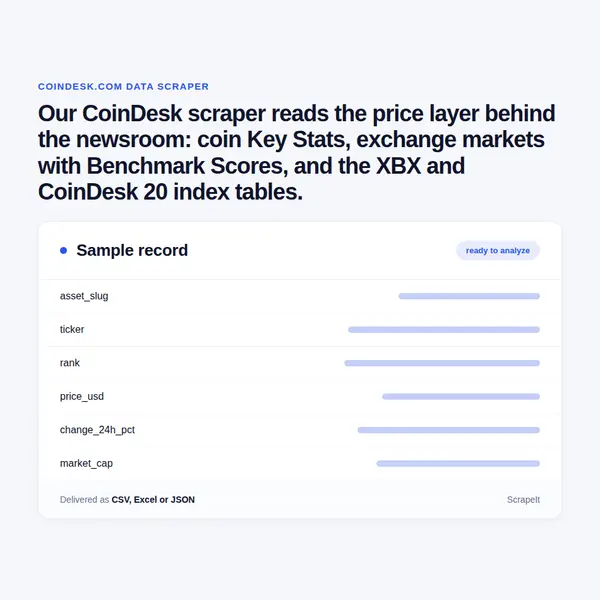
Our CoinDesk scraper reads the price layer behind the newsroom: coin Key Stats, exchange markets with Benchmark Scores, and the XBX and CoinDesk 20 index tables.
Plans from €169 a month · Free project assessment · Reply within 1 business day
CSV · Excel · JSON · XML · FTP · SFTP · Amazon S3 · Google Cloud
API, JSON feed or CSV, XLSX and JSON files
ScheduleOne-time, monthly, weekly, daily or 3 times a day
CoinDesk pages, filters, fields and a schedule
Built, monitored and repaired by our team
API, JSON feed or CSV, XLSX and JSON files
You name the scope - a coin list, one of the CoinDesk 5, 20 or 80 filters, the full Prices table, index pages or news sections - and the cadence. We build the crawlers, run them and repair them when CoinDesk.com reshapes a page. Its figures are drawn in by scripts after the page loads, so rendering, pacing, proxy rotation and CAPTCHA handling come with the service.
Every row carries the asset slug from the address and the capture time, so a quote taken on the hour never blends with one taken five minutes later. You receive CSV, XLSX or JSONLines files, or call the same rows from our API; Amazon S3, Google Cloud Storage and a load into your database are also available. Field documentation ships with the first delivery.
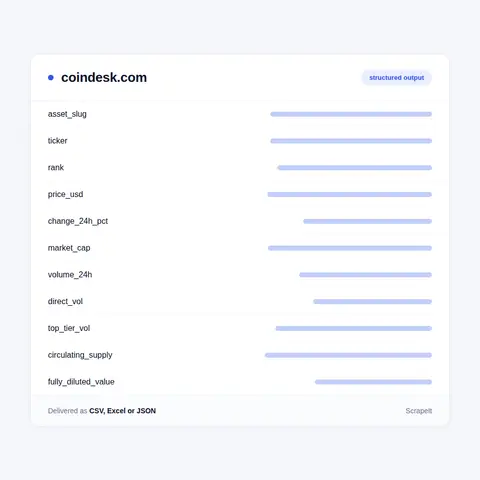
CoinDesk keeps one page per asset at /price/ plus a slug - /price/bitcoin, /price/ethereum, /price/xrp - with the rank, the live price and the daily move at the top, then a Key Stats block, an information panel and sections for Chart, News, Research, Markets and Similar. We read the whole page and key it on that slug.
Direct and top-tier volume sit beside total volume in the same row, and we keep all three as separate columns: the gap between them shows how much of a coin's turnover runs through exchanges that CoinDesk grades highly.
Index pages sit apart from the coin pages. The CoinDesk Bitcoin Price Index (XBX) - a USD reference rate for spot bitcoin that weights exchanges by trailing 24-hour liquidity - has its own page with Overview, News and Constituents tabs, and the CoinDesk 20 (CD20) page follows the same layout. We collect the index value and change, plus the constituents table with each asset's price, market cap, 24h volume and its 24h, 7d and 30d moves.
The Exchange Benchmark ranking covers the venue side: rank, spot or derivatives, final score, final grade from AA down to E, the ranking change against the previous edition and a score per category, from Market Quality and Security to KYC/Transaction Risk and Negative Events. Joined with the Markets tab, it shows how much of a coin's trading passes through venues graded AA or A.
Repeated runs turn these pages into series. A daily capture of Key Stats becomes a supply and market cap history; saved constituent lists show when the CoinDesk 20 changes members; Benchmark editions stored side by side show which exchanges climbed or slipped.
CoinDesk is a crypto newsroom first. The top menu runs News, Video, Prices, Research and Events; news is filed under Markets, Finance, Tech and Policy, and an article address carries the section, the year, month and day and a slug. The archive can therefore be cut by section and by date without opening every story.
An article page shows the section label, the headline and a one-line dek, a Summary box of bullet points, the publication time and reading time, tags such as Bitcoin News, and Related Assets and Related Stocks with their live prices. Bylines and the Edited by line name individual journalists; we leave those names out by default and keep the headline, section, tags and the assets each story touches.
The Prices section is the data layer: a ranked list with Cryptocurrency and Stocks tabs, category filters, CoinDesk 5, 20 and 80 index filters and a page for every listed asset. The site also runs language editions under paths such as /es/, /de/, /ja/, /ko/, /tr/ and /pt-br/, and index pages such as XBX appear in the Spanish edition as well as in English.
Delivery: CSV, JSON or XLSX files, our API or a JSON feed. MCP server on request.
Full plan detailsCoinDesk puts the story and the number on one site, which is the reason to collect both. News articles tagged with an asset, timestamped to the minute and linked to Related Assets let a research team line up headlines against the price and volume rows captured in the same hour - the raw material of an event study on how coins react to policy, exchange or macro news.
The volume split serves market-structure work. A coin with large 24h volume but small Top Tier Vol. trades mostly outside CoinDesk's top-graded venues; tracking that ratio for weeks, together with the Benchmark Score of each pair, flags assets whose liquidity is thinner than the headline figure suggests.
Index users have their own routine. Operations and reporting teams keep a CoinDesk price tracker for XBX and CoinDesk 20 levels and constituent lists, compare them with their own marks and archive the daily state. Product teams building a crypto screen reuse the category filters - DeFi, Meme, Stablecoin, Wrapped - as a ready-made taxonomy for the tokens they list.
Learn how to use web scraping to solve data problems for your organization

Web scraping automates the extraction and aggregation of financial data, makes it easier to find stocks, and allows you to predict the market based on the information.
Data and analytics are opening the door to uncovering ways to combat financial crime based on smart data. And advanced AI analytics and cognitive techniques, machine learning, and automation will improve the inefficiency of existing investigative processes.
Data scraping is the wide term that includes documents, scans and old screens; web scraping is the part that works on websites. We compare sources, daily work, output and cost drivers, give a briefing checklist and walk through two of our projects.

We are ScrapeIt, a managed web scraping team. We build and run crawlers for crypto and market sites where prices load after the page and change by the second, and we keep them working when layouts change. For CoinDesk that means coin pages, market tables, index pages and the news archive delivered in one schema. A free project assessment comes first and a sample follows; plans start from EUR 169 a month, or EUR 199 for a one-time extract.
Still unsure? Write to info@scrapeit.io
Yes. The ScrapeIt CoinDesk API returns price, market cap, Volume (24h), circulating supply, Benchmark Score and the per-exchange pair rows as JSON from an endpoint we host, refreshed on the schedule you set. The same data also arrives as CSV or XLSX files, a JSON feed or a load into your database.
Yes. Coin pages, the Prices list, index pages, the Exchange Benchmark table and news articles are open to every visitor. We collect only publicly available data - everything a visitor can see on CoinDesk - and we collect it legally. Journalist names are left out by default, and personal data is handled under GDPR.
Yes, from the first scheduled run onward. Each capture stores price, Key Stats, index levels and constituents with a timestamp, so hourly or daily runs turn into a time series you own. The news archive reaches further back, because every article address carries its publication date.
As often as the project needs: hourly or daily for a broad coin list, and more frequently for a short one. Prices move through the day, while index constituents and Benchmark editions change far less often, so we give those a slower schedule of their own.
Yes. Language editions run under paths such as /es/, /de/, /ko/ and /ja/, and every row is tagged with its edition so a translated headline stays linked to its section. The Stocks tab and the US stock pages listed under Latest US Stock Prices come as a separate table.
You share your needs, expectations, and desired timeframe. We'll suggest the best solution based on your request and budget.
Our specialists configure the crawlers and extract a sample dataset for your review before proceeding with the full-scale extraction.
Once you approve the sample, we launch the project and start full data collection. We gather, filter, and structure the data for easy use, delivering it on time in your preferred format.
Our team manages ongoing processes, monitors website changes, and supports all data extraction cycles. We can also help integrate data into your systems or create dashboards to simplify analysis.
Tell us which sites, which fields and how often. A couple of lines is enough to start.
CoinDesk data from €169/month. Free project assessment, reply within 1 business day.