How Can Web Scraping Technology Help the Finance Industry?
Web scraping automates the extraction and aggregation of financial data, makes it easier to find stocks, and allows you to predict the market based on the information.
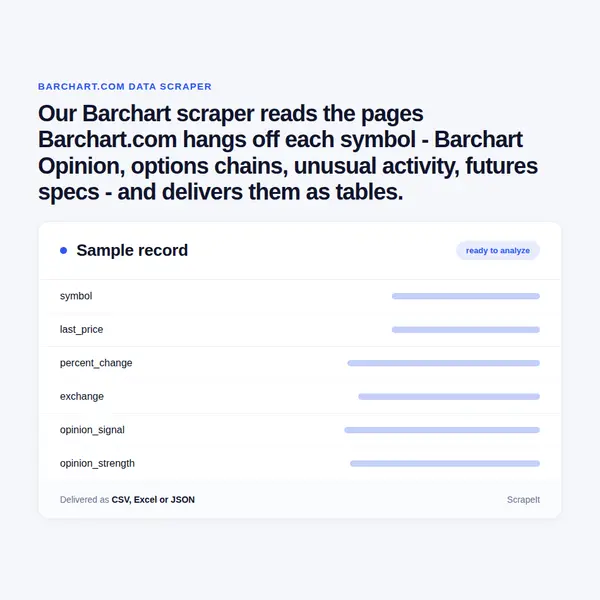
Our Barchart scraper reads the pages Barchart.com hangs off each symbol - Barchart Opinion, options chains, unusual activity, futures specs - and delivers them as tables.
Plans from €169 a month · Free project assessment · Reply within 1 business day
CSV · Excel · JSON · XML · FTP · SFTP · Amazon S3 · Google Cloud
API, JSON feed or CSV, XLSX and JSON files
ScheduleOne-time, monthly, weekly, daily or 3 times a day
Barchart pages, filters, fields and a schedule
Built, monitored and repaired by our team
API, JSON feed or CSV, XLSX and JSON files
You give us the universe - a ticker list, a commodity grouping such as Grains or Softs, every listed month of a futures root, or the rows of the Stock Screener - and the pages you need. We build the crawlers, run them on your schedule and fix them when Barchart.com moves a table. Most figures are drawn into the page after it loads, so rendering, pacing, proxy rotation and CAPTCHA handling are part of the service.
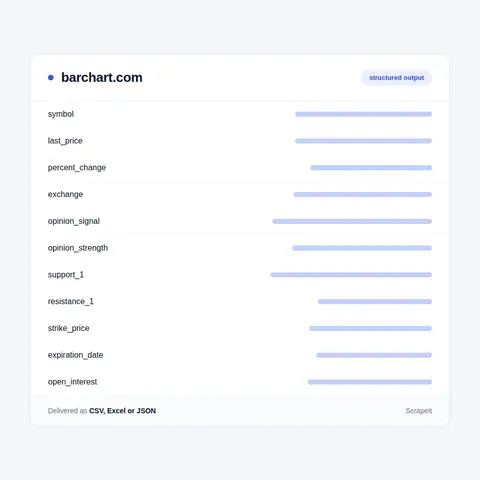
Every row carries the symbol exactly as Barchart writes it, the exchange tag printed beside the quote (NASDAQ, ICE/US, CME) and the session date of the page. Futures settlements keep the settlement marker Barchart adds to a final price, so a close is never mixed up with an intraday print. Results arrive as CSV, XLSX or JSONLines, through our API, on SFTP or in Amazon S3, with field documentation.
A stock symbol on Barchart.com opens a long Go To menu of pages - Price Overview, Barchart Opinion, Technical Analysis, Seasonal Returns, Options Prices, Volatility & Greeks, Unusual Options Activity, Analyst Ratings, Earnings Estimates, Insider Trades and the three financial statements among them. We map each page to its own table, keyed on symbol and session date.
Stocks without listed options or analyst coverage return fewer pages, and the dataset marks which pages existed for each symbol instead of leaving silent blanks.
Barchart files futures by commodity grouping - Currencies, Energies, Financials, Grains, Indices, Livestock, Metals and Softs - and by exchange, so a crawl can start from a whole complex rather than a symbol list. Contract symbols join a root, a month code and a year, as in KCH26 for March arabica coffee, which lets us walk every listed month of a curve. Each futures page also carries a Commitment of Traders panel with long and short positions and weekly changes for Commercials, Non-Commercials, Producers, Swap Dealers, Managed Money and Other Reportables, a Price Performance table with one-month, three-month and 52-week lows and highs, and a seasonal chart.
The Cash Markets section adds Corn Indexes and Soybean Indexes, a cash reference for grain prices beside the futures. On the stock side, lists such as Price Volume Leaders, Today's Price Surprises, New Highs & Lows and Industry Rankings change from session to session and are worth a daily snapshot.
History comes from repetition: settlements saved each evening become your own futures series, and Opinion readings saved daily show how the share of Buy signals behind a symbol rose or fell.
Barchart.com is a market data and news site covering futures, stocks, options, ETFs, mutual funds, currencies and crypto. A market switch moves between US, Canada, UK, Australia and Europe editions, and a European Futures area covers contracts such as Euro Bund, rapeseed and milling wheat. Each instrument has one address - /stocks/quotes/ plus the ticker, or /futures/quotes/ plus the contract code - and every page adds a segment such as /opinion, /options or /technical-analysis.
The pages run on different clocks. Quotes move through the session and futures end the day on a settlement price; the Barchart Opinion is computed per session date; Commitment of Traders positions are dated to their weekly report; analyst ratings are compared month by month. Futures pages count the days to first notice and to expiration, which tells a crawl when to roll to the next contract month.
Part of Barchart is a paid membership. A project covers the layer a visitor sees without paying, and views marked for members only stay out. That free layer is wide: quote pages, opinions, options chains, futures specifications and most market lists.
Delivery: CSV, JSON or XLSX files, our API or a JSON feed. MCP server on request.
Full plan detailsCommodity desks and agribusiness analysts work from the futures side: settlement prices across a whole curve of corn, coffee, cocoa or silver contracts, open interest by month, and the Commitment of Traders split that shows whether Managed Money is adding or cutting longs. Contract Specifications with first notice dates feed roll calendars, and the cash indexes give a spot reference to set against the board.
Options traders read Unusual Options Activity as a daily event list: contracts where volume runs far above open interest, with the strike, expiry, delta and implied volatility that make a trade readable. Kept for months, it becomes a per-ticker record of unusual flow that can be matched against later price moves.
Systematic and research teams treat the Barchart Opinion and the Technical Analysis table as features. Stored per symbol and session, the same moving average, crossover and stochastic values let a model test a signal on what the page showed at the time, without rebuilding Barchart's calculations.
Learn how to use web scraping to solve data problems for your organization
Web scraping automates the extraction and aggregation of financial data, makes it easier to find stocks, and allows you to predict the market based on the information.
Data and analytics are opening the door to uncovering ways to combat financial crime based on smart data. And advanced AI analytics and cognitive techniques, machine learning, and automation will improve the inefficiency of existing investigative processes.
Data scraping is the wide term that includes documents, scans and old screens; web scraping is the part that works on websites. We compare sources, daily work, output and cost drivers, give a briefing checklist and walk through two of our projects.

ScrapeIt is a managed web scraping service. We build and maintain crawlers for market data sites where one symbol fans out into many pages and the numbers render after load - Barchart.com, with separate trees for stocks and futures, is that kind of site. You name the symbols, contract roots, pages and schedule; we run the collection and send field documentation with the dataset. A free project assessment comes first, and a sample can be ordered before any subscription.
Still unsure? Write to info@scrapeit.io
Any contract listed under Barchart's commodity groupings: grains such as corn, wheat and soybeans, softs such as coffee, cocoa and sugar, metals such as gold and silver, energies and livestock. Each contract month comes with its last or settlement price, volume, open interest and Contract Specifications. Corn and Soybean Indexes from Cash Markets can be added as cash references.
Yes. The Price History page gives daily prices, the 52-week key points with Fibonacci levels and counts of new highs and lows by period, and every run of ours adds a dated copy of the quote or settlement. Contract months are stored separately, so a continuous series can follow your own roll rule.
Yes. The ScrapeIt Barchart API serves settlement prices, open interest, Vol/OI ratios, Barchart Opinion signals and Commitment of Traders positions as JSON from an endpoint we host, refreshed on the schedule you set. The same tables also arrive as CSV or XLSX files, a JSON feed or a load into your database.
Yes. The Unusual Options Activity list is rebuilt for each trading session, with separate tabs for stocks, ETFs and indices, and we save it at least once a day, with a mid-session snapshot on request to catch contracts that join late. Option chains and put/call ratios for your tickers can run on the same schedule.
Yes. Quote pages, option chains, futures contract pages, the Barchart Opinion and the market lists are open to any visitor of Barchart.com without a paid membership. We collect only publicly available data - everything a visitor can see on Barchart - and we collect it legally.
You share your needs, expectations, and desired timeframe. We'll suggest the best solution based on your request and budget.
Our specialists configure the crawlers and extract a sample dataset for your review before proceeding with the full-scale extraction.
Once you approve the sample, we launch the project and start full data collection. We gather, filter, and structure the data for easy use, delivering it on time in your preferred format.
Our team manages ongoing processes, monitors website changes, and supports all data extraction cycles. We can also help integrate data into your systems or create dashboards to simplify analysis.
Tell us which sites, which fields and how often. A couple of lines is enough to start.
Barchart data from €169/month. Free project assessment, reply within 1 business day.