How Can Web Scraping Technology Help the Finance Industry?
Web scraping automates the extraction and aggregation of financial data, makes it easier to find stocks, and allows you to predict the market based on the information.
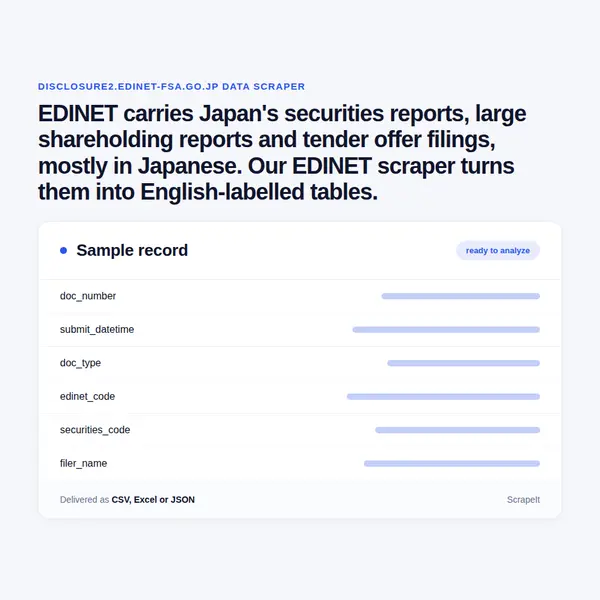
EDINET carries Japan's securities reports, large shareholding reports and tender offer filings, mostly in Japanese. Our EDINET scraper turns them into English-labelled tables.
Plans from €169 a month · Free project assessment · Reply within 1 business day
CSV · Excel · JSON · XML · FTP · SFTP · Amazon S3 · Google Cloud
API, JSON feed or CSV, XLSX and JSON files
ScheduleOne-time, monthly, weekly, daily or 3 times a day
EDINET pages, filters, fields and a schedule
Built, monitored and repaired by our team
API, JSON feed or CSV, XLSX and JSON files
You give us the scope - companies by EDINET code or securities code, the document types you need, a submission window or a standing daily pickup - and we set up the crawlers, operate them and keep them working when the viewing site changes. Search results and document views are assembled by scripts, so rendering, pacing and proxy rotation come with the service.
Most of what clients buy happens after collection: reading the inline XBRL inside each filing, mapping elements of the EDINET taxonomy to stable English column names, and lining up fiscal periods so one company's figures from different years sit in one table. Runs are one-off or scheduled; scoping is free, a sample comes before the first full run, and a field guide in English is part of every dataset.
Every filing on EDINET has a short header - who filed, about whom, what and when - and a body that, for most report types, is inline XBRL: a readable document with machine tags inside it. Our EDINET scraper keeps both levels.
Japanese labels are kept beside the English column names, so an analyst can always check a figure against the page it came from.
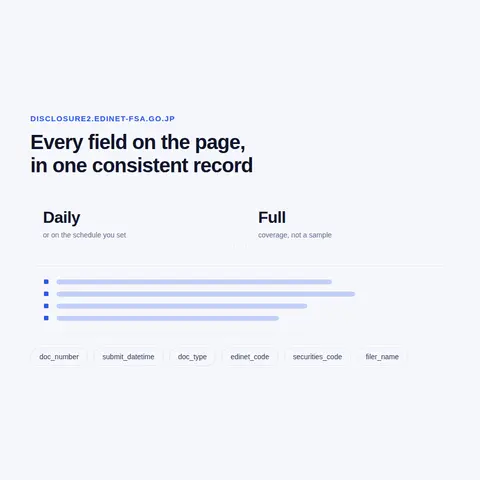
A single report is a lookup; a dataset needs coverage across companies and years, and EDINET shapes how that is built. The simple search matches an EDINET code or securities code exactly, finds companies under their former names as well as current ones, and orders results by submission time, then EDINET code, then fund code - a stable order for a daily pickup of everything filed that day. The detailed search narrows by filer, issuer, fund, fiscal period and submission period, and the full-text search reaches inside the documents.
Repeated runs keep what the site does not hold for ever. Each document type has a statutory inspection period - for an annual securities report, ten years from acceptance - after which it stays only for a limited time as an expired document, so an archive started now keeps every filing it collects. Every large shareholding report is followed by change reports (変更報告書) as the holding moves, so a run of them traces a stake being built or sold down. A company that disappeared in a merger stays searchable by its own code, so a history does not break there.
Holders in large shareholding reports and major shareholder tables can be private persons; their names are left out by default, while companies, funds and asset managers are kept as filed.
EDINET - Electronic Disclosure for Investors' NETwork - is the electronic disclosure system of Japan's Financial Services Agency (金融庁). Documents required under the Financial Instruments and Exchange Act are filed there: the annual securities report (有価証券報告書), the semiannual securities report and, for earlier periods, the quarterly securities report, extraordinary reports (臨時報告書), internal control reports, shelf registration documents, large shareholding reports (大量保有報告書), tender offer documents and share buyback reports, plus fund filings under the rules for specified securities. The quarterly report now belongs to the past - the system was abolished - yet the simple search still offers the three periodic reports side by side, so older quarterly filings stay findable.
The viewing site (閲覧サイト) is in Japanese, with an English version of the simple document search. Most documents exist in Japanese only; those filed in English carry an English stamp in the results. Each filing opens as a structured document whose table of contents follows the official form, and XBRL documents are submitted as inline XBRL built on the EDINET taxonomy, which gets a new version every year. Filers are identified by EDINET code, listed companies also by securities code, and funds by fund code.
EDINET also keeps lists of companies granted an extended filing deadline and of withdrawn shelf registration statements.
Delivery: CSV, JSON or XLSX files, our API or a JSON feed. MCP server on request.
Full plan detailsEDINET is the primary source for Japanese company figures, and the reasons to collect it follow from what sits inside the filings.
Learn how to use web scraping to solve data problems for your organization

Web scraping automates the extraction and aggregation of financial data, makes it easier to find stocks, and allows you to predict the market based on the information.
Data and analytics are opening the door to uncovering ways to combat financial crime based on smart data. And advanced AI analytics and cognitive techniques, machine learning, and automation will improve the inefficiency of existing investigative processes.
Data scraping is the wide term that includes documents, scans and old screens; web scraping is the part that works on websites. We compare sources, daily work, output and cost drivers, give a briefing checklist and walk through two of our projects.

ScrapeIt is a managed data extraction service. We build and run the crawlers and hand over the data in the shape your analysts already use. Filing systems like EDINET are a particular kind of work: the content is published, but it arrives as long Japanese documents with tagged figures inside, and the value is in the parsing. Plans start from EUR 169 a month, or EUR 199 for a one-time extract. Delivery is CSV, Excel (XLSX), JSON or JSONLines to Amazon S3, Google Cloud Storage or your database.
Still unsure? Write to info@scrapeit.io
Yes. EDINET is the public disclosure site of Japan's Financial Services Agency, and every filing in its listings opens for any visitor without registration. We collect only publicly available data - everything a visitor can see on EDINET - and we collect it legally. Individual holders are not named by default, and any personal data is treated under GDPR.
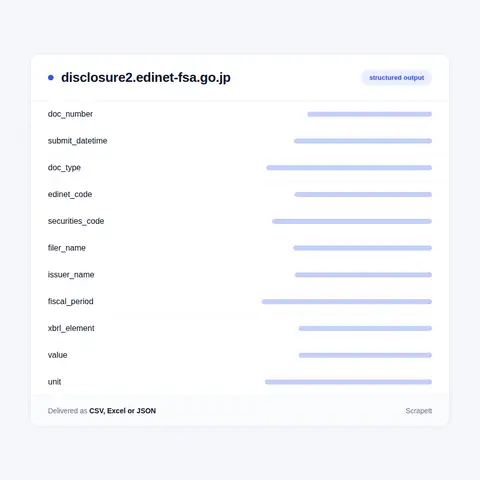
Yes. The ScrapeIt EDINET API gives you submission date and time, document type, EDINET code, securities code and the XBRL values of each filing under English column names, served as JSON from an endpoint we host and refreshed on your schedule. If files suit you better, the same records arrive as CSV or XLSX, as a JSON feed or loaded into your database.
Yes, and it is the core of most projects. Each value in the inline XBRL comes with its element, period and unit, so we deliver it in long form, one value per row, or pivoted to one row per company and fiscal year with English names for the elements you choose. Companies reporting under IFRS and under Japanese GAAP keep their own element sets, mapped to a common layout when you need one.
An annual securities report stays on EDINET for ten years from the day it was accepted, and other document types have inspection periods of their own. Once the period ends a document may linger for a while as an expired document and then leaves the listings, so we backfill what is still there and keep everything we collect from then on.
Yes. We pick every large shareholding report and change report filed about that issuer, with filer, holding ratio, purpose of holding and acquisitions and disposals, ordered by submission time. Reports filed from March 2008 can also be found by the joint holders named in a joint filing, so related funds do not slip through.
You share your needs, expectations, and desired timeframe. We'll suggest the best solution based on your request and budget.
Our specialists configure the crawlers and extract a sample dataset for your review before proceeding with the full-scale extraction.
Once you approve the sample, we launch the project and start full data collection. We gather, filter, and structure the data for easy use, delivering it on time in your preferred format.
Our team manages ongoing processes, monitors website changes, and supports all data extraction cycles. We can also help integrate data into your systems or create dashboards to simplify analysis.
Tell us which sites, which fields and how often. A couple of lines is enough to start.
EDINET data from €169/month. Free project assessment, reply within 1 business day.