How Can Web Scraping Technology Help the Finance Industry?
Web scraping automates the extraction and aggregation of financial data, makes it easier to find stocks, and allows you to predict the market based on the information.
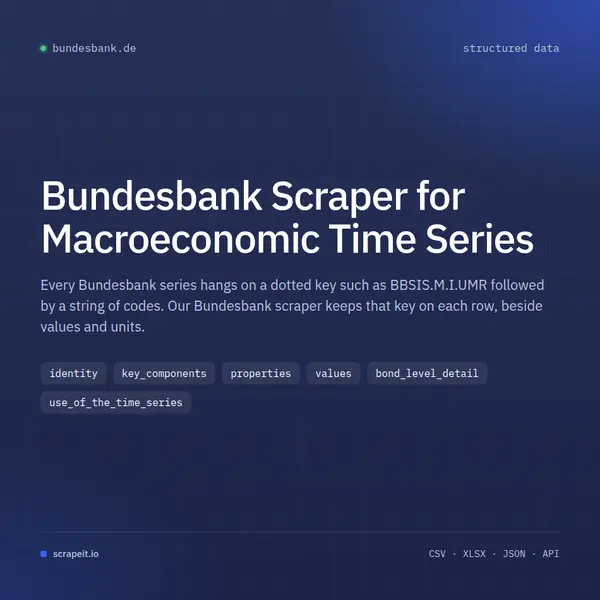
Every Bundesbank series hangs on a dotted key such as BBSIS.M.I.UMR followed by a string of codes. Our Bundesbank scraper keeps that key on each row, beside values and units.
Plans from €169 a month · Free project assessment · Reply within 1 business day
CSV · Excel · JSON · XML · FTP · SFTP · Amazon S3 · Google Cloud
API, JSON feed or CSV, XLSX and JSON files
ScheduleOne-time, monthly, weekly, daily or 3 times a day
Deutsche Bundesbank pages, filters, fields and a schedule
Built, monitored and repaired by our team
API, JSON feed or CSV, XLSX and JSON files
You give us a list of series keys, a topic such as Interest rates and yields, or a description in words - German Federal bond yields by residual maturity, euro reference rates against every currency - and we turn it into a list of keys. We build the crawler for the statistics portal, run it and repair it when the portal changes. The search pages load their results in the browser, so rendering, pacing and retries are part of the service.
Runs follow the release rhythm you need: daily for yields and exchange rates, monthly for banking and balance of payments series, or on demand. Every delivery carries field documentation and lands as CSV, XLSX or JSONLines files, behind our API or as a load into your database. We start with a free project assessment and a sample of the series you named.
The single view of a Bundesbank series is a small fact sheet. The key sits at the top, under the label Zeitreihenschlüssel on the German side (time series key), and an Interpretation button spells out what each of its codes means. Our rows keep the key exactly as published, so a series can be traced back to the portal at any time.
The portal writes numbers with a decimal comma in German views; we deliver them as plain decimals, with unit and multiplier in their own columns so a value in millions is never read as one in units.
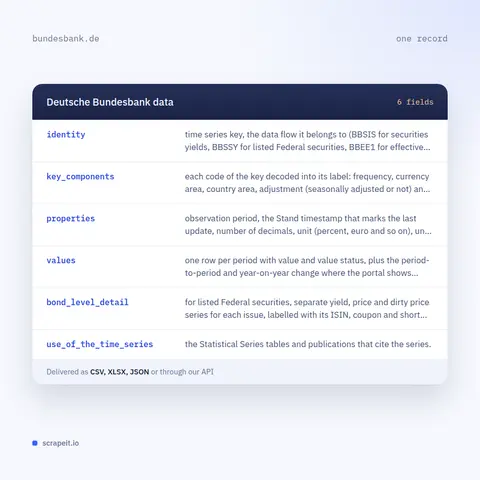
Beside the macroeconomic time series, the portal keeps a real-time database: indicators such as gross domestic product as they were first published and as every later revision restated them. Each vintage is a column headed by its publication date in yyyy-mm-dd form. We turn that matrix into long rows of vintage date, reference period and value, which is the shape a nowcasting or backtesting model expects.
Coverage can be set by topic rather than by key. The series sit in eleven topics - External sector, Banks and other financial corporations, Financial accounts, Money and capital markets, Sets of indicators, Economic activity and prices, Public Finances, Enterprises and households, National accounts, Exchange rates, Interest rates and yields - and each topic splits into categories such as Money market rates, Term structure of interest rates or Central bank interest rates. A topic run picks up new series as the Bundesbank adds them.
Repeated runs keep the Stand timestamp of every series, so you can see when a figure was revised. The statistical release calendar tells us when tables are due, and scheduled runs can follow it.
The Deutsche Bundesbank is Germany's central bank, based in Frankfurt am Main and part of the Eurosystem. Beside monetary policy and banking supervision it is one of the main producers of German financial statistics: it compiles banking statistics and monetary aggregates, the balance of payments and the international investment position, financial accounts, securities issues and yields, and it publishes exchange rates, money market rates and the term structure of interest rates.
The figures live on a statistics portal at statistiken.bundesbank.de, published in German as Statistiken der Bundesbank and in English as Bundesbank statistics. Its own labels tell the structure: Makroökonomische Zeitreihen (macroeconomic time series), the Zeitreihensuche (time series search) that filters by topic, category and key components, and a real-time data area for revised indicators. The text search reads German and English titles alike, so Umlaufsrenditen and yields on debt securities outstanding lead to the same series.
The main bundesbank.de site holds the Statistical Series - tables on banking, capital markets and the external sector - and a table page lists the corresponding time series behind it, key by key. That link between a published table and the keys behind it is what we use to rebuild a table as data.
Delivery: CSV, JSON or XLSX files, our API or a JSON feed. MCP server on request.
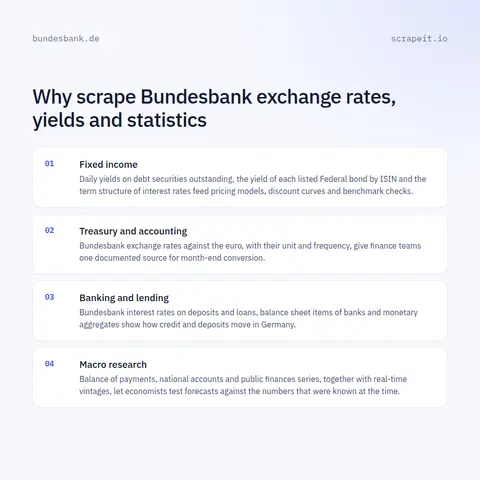
Full plan detailsBundesbank figures are the reference that German banks, insurers, auditors and researchers quote, and they often need them as columns beside their own data rather than as a chart on a portal.
Learn how to use web scraping to solve data problems for your organization

Web scraping automates the extraction and aggregation of financial data, makes it easier to find stocks, and allows you to predict the market based on the information.
Data and analytics are opening the door to uncovering ways to combat financial crime based on smart data. And advanced AI analytics and cognitive techniques, machine learning, and automation will improve the inefficiency of existing investigative processes.
Data scraping is the wide term that includes documents, scans and old screens; web scraping is the part that works on websites. We compare sources, daily work, output and cost drivers, give a briefing checklist and walk through two of our projects.

ScrapeIt is a managed web scraping company: we build the crawlers, keep them running and deliver the dataset with documentation for every column. Statistical portals are a particular kind of source - few pages, many series, keys that must survive every refresh - and we design the run around the keys and topics you name. Bundesbank series carry no personal data; on other sources personal data is handled under GDPR.
Still unsure? Write to info@scrapeit.io
Yes. The ScrapeIt Bundesbank API returns the time series key, title, unit, unit multiplier, period and value of each observation as JSON from an endpoint we host, refreshed on the schedule you set. The same series also arrive as CSV or XLSX files, through a JSON feed or as a load into your database.
Yes. Series titles, keys, properties and values on the Bundesbank statistics portal are shown to any visitor without an account. We collect only publicly available data - what anyone can open on the Bundesbank portal - and we collect it legally.
Yes. Exchange rate and yield series with daily frequency carry the time format code P1D, and a daily run picks up each new observation. Monthly series such as interest rates on deposits and loans are collected after their release, following the statistical release calendar.
It depends on the series: daily for market yields, monthly or quarterly for banking, balance of payments and national accounts. Each series shows a Stand timestamp of its last update, which we store with every run. For revised indicators we collect the real-time vintages, so earlier releases stay available next to the latest one.
Yes. The portal publishes every series with an English and a German title, and both go into the dataset next to the key. Decoded key components come in English, and German labels such as Stand or Kommentar are mapped to documented English column names.
You share your needs, expectations, and desired timeframe. We'll suggest the best solution based on your request and budget.
Our specialists configure the crawlers and extract a sample dataset for your review before proceeding with the full-scale extraction.
Once you approve the sample, we launch the project and start full data collection. We gather, filter, and structure the data for easy use, delivering it on time in your preferred format.
Our team manages ongoing processes, monitors website changes, and supports all data extraction cycles. We can also help integrate data into your systems or create dashboards to simplify analysis.
Tell us which sites, which fields and how often. A couple of lines is enough to start.
Deutsche Bundesbank data from €169/month. Free project assessment, reply within 1 business day.