Deliveroo Scraper - Menus, Prices and Fees in Seven Markets

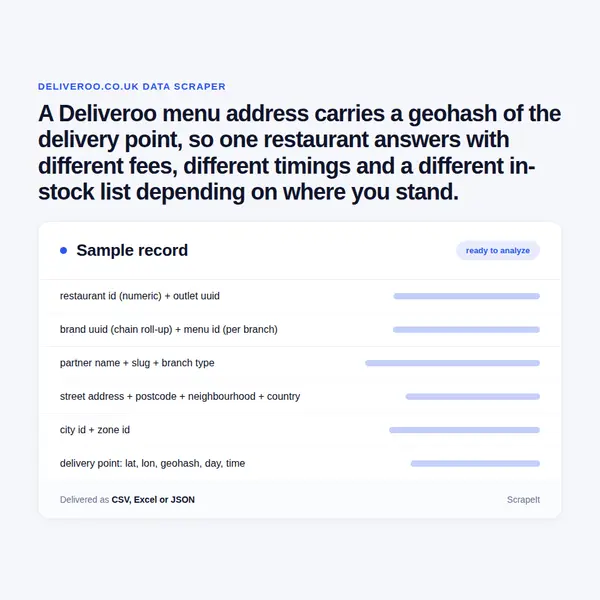
A Deliveroo menu address carries a geohash of the delivery point, so one restaurant answers with different fees, different timings and a different in-stock list depending on where you stand.

Deliveroo Scraper
Solutions

What a managed Deliveroo scraping job looks like

You give us the markets, the delivery points or the restaurant slugs, the fields you need and a cadence. We design the schema, build and run the Deliveroo scraper, watch it and repair it when the site moves, and you receive files instead of code: CSV, JSON, XLSX, a Google Sheet, a direct database load, or a Deliveroo API endpoint we host and you call, delivered over email, S3, SFTP or webhook.

Anti-bot handling, proxy rotation and CAPTCHA solving are part of the service and never become your problem. Coverage is planned as a grid of geohashes rather than one call per city, because the catalogue and the fees answer to the point, not to the town. We stay on public pages, never touch basket, checkout, payment or account areas, and leave the names of reviewers and riders out by default as personal data; ratings and counts arrive as plain numbers.

Every field on a Deliveroo store card and its menu

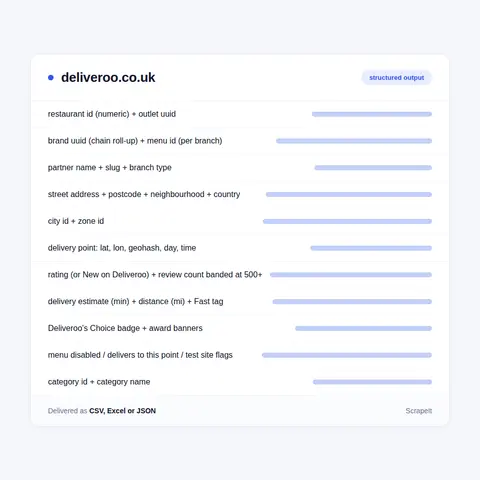
A store card in a Deliveroo listing carries the partner name; a rating that is either a number or the phrase New on Deliveroo; a review count that stays exact into the hundreds and then bands into 500+; the distance in miles; the delivery estimate in minutes; an optional Fast tag; the Deliveroo's Choice badge; the promotion line in full, such as a spend threshold that zeroes the delivery fee; and a sponsored flag for paid placement.

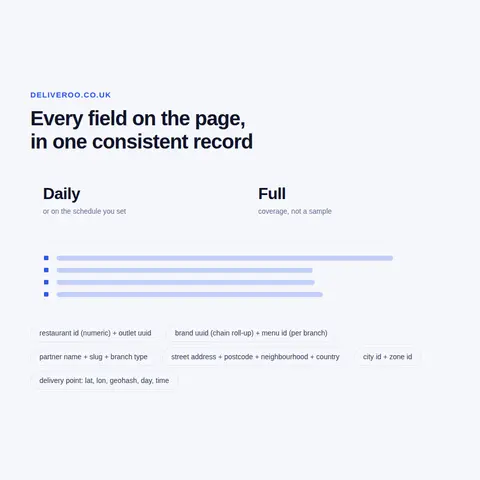
Open the restaurant and the payload names itself. There is a numeric restaurant id, a pair of uuids for the outlet, a brand uuid that rolls the branches of one chain together, a menu id that belongs to the branch rather than the brand, the slug, a branch type of RESTAURANT, ON_DEMAND_CONVENIENCE or ON_DEMAND_CONVENIENCE_RAPID, a fulfilment type, a currency code with its symbol, numeric city and zone ids, the street address with postcode and country, and flags for menu disabled, delivers to customer location and test site. Beside it sits the delivery point that produced the page: latitude, longitude, geohash, city, neighbourhood, city id and zone id.

The menu is categories and items. Each item ships an id and a uuid, its category id, name, description, image, a price object of currency code plus minor-unit integer plus formatted string, an optional discounted price, popular and available flags, stock count and maximum selection, restrictions for age-gated goods, a Signature exclusive mark, an item rating line, an allergy banner that opens with the word Contains, and a nutrition object holding a kilocalorie figure wherever the chain is large enough for British calorie labelling - on one national burger chain about 979 of 987 lines carried one. Modifier groups arrive as their own objects with minimum and maximum selection and a multiselect flag, and each option has its own id, price and availability and can open a further group. To extract Deliveroo price data safely, read the minor-unit integer with its currency code and never the printed string: the same euro amount prints with the symbol trailing in France and leading in Ireland and Belgium, and Kuwaiti dinar runs to three decimal places rather than two.

Every field on a Deliveroo store card and its menu
Editions dark kitchens, Hop rapid grocery and the shopping aisles

Editions dark kitchens, Hop rapid grocery and the shopping aisles

Editions are Deliveroo's own kitchen sites, and they show from outside because the hub replaces the neighbourhood in the address. Fifteen hubs are published in the British catalogue - Ordsall, Battersea, Islington, Acton, Canning Town, Maida Vale, Wandsworth, Brent Cross, Bermondsey and Palmers Green among them - carrying 205 kitchen listings across London, Manchester and Leeds. Inside one hub, five separate restaurant ids share a single South Bermondsey street address. That is a clean dark kitchen dataset: brands with no dining room, trading on delivery alone, each with its own menu and rating behind one shared postcode.

Deliveroo Hop is the rapid grocery arm and declares itself in the data as its own branch type. The Waitrose site sits in railway arches rather than a shop, lists 353 products in 54 aisles, and prints a unit price such as a pack weight and a per-kilo rate beside every line. Supermarket and pharmacy partners look different again: Co-op, Tesco, Sainsbury's, Asda, Morrisons and Boots run twenty to forty aisles with member-price and store-price-match sections, and their products carry pack size, unit price and a packaging disclaimer where a restaurant would carry kilocalories.

Two more strands sit off to the side. Non-food shopping has its own tab and its own collection pages, running from DIY and stationery to beauty, toys and pet. Table booking runs as about 3,025 venue pages that publish a street address and a cuisine but hang off a third-party reservations key, a separate id space from the delivery estate - a venue you can book is frequently not a restaurant you can order from.

Seven Deliveroo storefronts, one catalogue engine

Deliveroo runs seven live consumer storefronts, and its own country switcher names them: United Kingdom, Ireland, France, Italy, Belgium, United Arab Emirates and Kuwait. They are not seven websites. A single build serves all of them, so a Deliveroo scraper written against the British catalogue reads the Emirati one without new parsing rules - the same field names, the same page shapes, a different currency and a different language.

The address grammar is fixed at three segments: city, neighbourhood, restaurant slug. The British sitemap set alone publishes 145,227 restaurant addresses across 75 cities and 4,562 neighbourhoods, with London holding about 56,785 of them (September 2026). France adds about 73,371, Italy 56,112, the Emirates 24,165, Belgium 9,720, Kuwait 7,741 and Ireland 5,076. Around that core sit roughly 19,954 cuisine landing pages built from 113 cuisine slugs such as chicken-takeaway, halal-takeaway and gluten-free-takeaway, plus 7,015 city pages, 1,287 brand pages and 3,025 bookable venues. About 7,900 British slugs open with a numeric branch code, which is how supermarkets and fast-food chains keep their own store numbering inside the URL.

Retired markets are still visible from outside. The Hong Kong, Singapore and Qatar domains answer with a farewell notice instead of a catalogue, and the Spanish, Dutch and Australian domains land on the British site. A coverage plan that trusts an old country list burns half its budget on markets that no longer trade, so we start from the live switcher and the published sitemaps and rebuild the target list on every run.

Get a Quote

dev_w
25

Developers

customers
500+

Customers worldwide

pages
1 500 000 000+

Pages extracted

stime
15000+

Hours saved for our clients

Plans

Airplane

€199 / one-time

setup fee - included

Data limits100,000
Frequencyone-time
Run timeup to 5 days
Data storing7 days

Helicopter

€169 / mo

setup fee €499

Data limits250,000
Frequencymonthly
Run timeup to 5 days
Data storing14 days

Glasses

€229 / mo

setup fee €499

Data limits1,000,000
Frequencyweekly
Run timeup to 5 days
Data storing30 days

DNA

€549 / mo

setup fee €799

Data limits3,000,000
Frequency3 times daily
Run timesame day
Data storing90 days

Deliveroo price monitoring: dish, fee stack, Plus tier

Take only the dish price and the number is wrong. Deliveroo itself lists the layers: a delivery fee that moves with distance, with the partner, with how busy the network is and with membership; a service fee that is either a flat amount or a percentage of the basket before promotions; a small order fee below a spend threshold, usually capped; a statutory bag charge; a Priority Delivery fee; and a rider tip. Bundling items from several stores shifts some of them again.

Membership then splits the answer in two. Plus Gold costs GBP 4.99 a month, zeroes delivery above a GBP 10 restaurant basket or a GBP 15 shop basket, and cuts the service fee by up to sixty percent; Plus Silver, sold only through partners, moves those thresholds to GBP 15 and GBP 25; Gold and Diamond members see the discounted service fee on the same menu everyone else reads. An honest Deliveroo data feed therefore carries two totals for one basket rather than one.

Branch beats brand as well. Two outlets of the same burger chain a mile apart share a brand uuid but hold different menu ids, so a chain price check has to run branch by branch. Menus are time-gated on top of that: one large outlet listed 987 items with 840 marked unavailable at that hour, which is breakfast and late-night structure, not a broken crawl. Deliveroo even publishes a claim worth auditing - the Deliveroo's Choice badge is granted partly on an average zero percent gap against in-store prices on up to twenty popular lines.

Our Blog

Reads Our Latest News & Blog

Learn how to use web scraping to solve data problems for your organization

How Artificial Intelligence Is Used In Web Scraping

How Artificial Intelligence Is Used In Web Scraping

Leveraging advances in technology, the AI-powered web scraper has skyrocketed in demand and is helping to expand capabilities by automating tedious daily tasks and speeding up data collection from thousands of websites several times over.

What is Web Scraping and What is it Used For?

What is Web Scraping and What is it Used For?

Web scraping is a method of obtaining web data by extracting it from pages of web resources with the help of a program, that is, in automatic mode. It is used to syntactically convert web pages into more usable forms.

Web Scraping for Machine Learning

Web Scraping for Machine Learning

If you specialize in machine learning, you need to feed large amounts of data to the algorithms. Web scraping is the easiest and the most efficient method of collecting the data from all over the Internet.

scrapeit logo

ScrapeIt as your Deliveroo data supplier

ScrapeIt is a managed web scraping agency. We are not a library and not a self-serve tool: we build the crawler, run it on your schedule, monitor it and repair it when a page changes, so what you keep is a data feed rather than a codebase. A sample lands before sign-off, which lets you check the minor-unit prices, the kilocalorie lines and the modifier tree against live Deliveroo pages yourself. Every row carries the geohash and the capture time behind it, so successive deliveries stack into one series. We have no affiliation with Deliveroo.

FAQ

Is there a Deliveroo API that gives an outside buyer menu data?

There is a Deliveroo developer portal, but it faces merchants rather than data buyers. Its Order, Menu, Site, Catalogue, Picking, Promotions and Refunds APIs let a restaurant or retailer push its own menu, stock, prices, point-of-sale ids and allergen information into Deliveroo and pull its own orders back. None of them return another partner's catalogue, and the site's robots file closes the internal API and GraphQL paths to crawlers. A buyer who wants Deliveroo menu data for a whole city has no public endpoint to call, which is why the feed has to be collected from the public pages instead.

Which Deliveroo countries can you actually cover?

The seven that still trade: United Kingdom, Ireland, France, Italy, Belgium, United Arab Emirates and Kuwait. Because one build serves all of them, the schema is identical everywhere and only the currency, the language and the city and zone ids change. Hong Kong, Singapore and Qatar have closed and their domains now show a farewell notice, while the Spanish, Dutch and Australian domains redirect to the British site, so nothing can be collected there. Within a live market we can scope by country, by city, by neighbourhood, by cuisine slug or by brand.

Do Deliveroo menus and prices change with the delivery address?

Yes, and the platform is explicit about it. A menu address carries a geohash of the delivery point plus a day and a time, and the page is built for that point: the restaurant list, the delivery estimate, the fee and the availability of individual dishes all answer to it. Move the point far enough and the same restaurant reports that it does not deliver to you and offers pickup instead. That is why we plan coverage as a grid of points and stamp every row with the geohash and capture time it came from, rather than crawling one page per restaurant.

How often can a Deliveroo data feed refresh, and in which formats?

Cadence follows the question. Menu structure and store attributes are stable enough for a daily or weekly pass; prices, promotions and the fee stack are worth a daily run; availability and delivery estimates change through the day, so those are collected hourly or on a schedule tied to service hours. Output comes as CSV, JSON, XLSX, a Google Sheet, a direct database load or an endpoint we host, pushed over email, S3, SFTP or webhook. Full snapshots and change-only deltas are both available, keyed on outlet id and item id.

Is it legal to scrape Deliveroo, and what will you not collect?

Deliveroo's terms of use carry no explicit ban on automated collection, but they do restrict site content to personal, non-commercial use and forbid interfering with the service, and the robots file disallows the internal API and GraphQL paths. We work inside that: public pages only, disallowed paths respected, polite rates, nothing behind a login, and no basket, checkout or payment activity. Reviewer names, rider names and any other personal data are left out by default; we take menu, price, fee, availability and store attributes, which are facts about the trade. Legal advice for your own use case remains yours to take.

How does it Work?

Step 1 - Make a Request

You share your needs, expectations, and desired timeframe. We’ll suggest the best solution based on your request and budget.

Step 2 - Configuring Custom Web Crawlers

Our specialists configure the crawlers and extract a sample dataset for your review before proceeding with the full-scale extraction.

Step 3 - Collect and Deliver

Once you approve the sample, we launch the project and start full data collection. We gather, filter, and structure the data for easy use, delivering it on time in your preferred format.

Step 4 - Maintain and Support

Our team manages ongoing processes, monitors website changes, and supports all data extraction cycles. We can also help integrate data into your systems or create dashboards to simplify analysis.

Request a Quote

Tell us more about you and your project information.
Which sites, which fields, how often. A couple of lines is enough.

We reply within 1 business day. No obligation.

scrapiet

Scrapeit Sp. z o.o.
10/208 Legionowa str., 15-099, Bialystok, Poland
NIP: 5423457175
REGON: 523384582