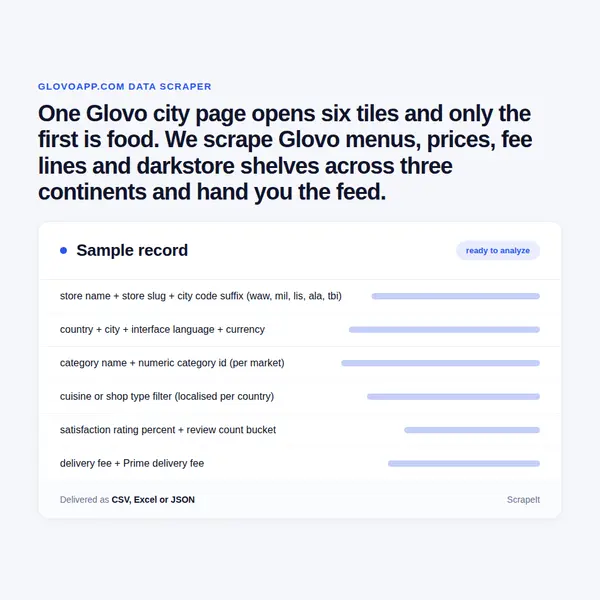
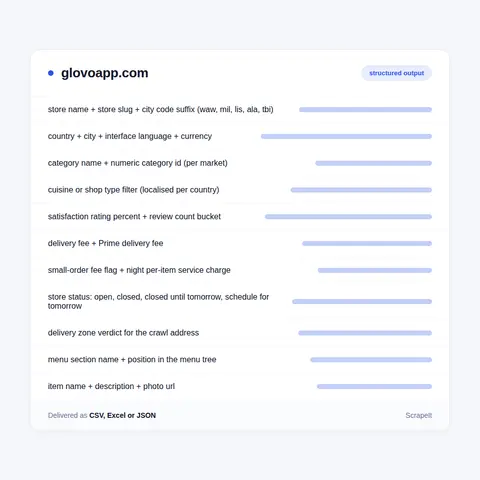
Glovo store data across Europe, Africa and Central Asia
Glovo began in Barcelona as a courier app for anything you could point at, and it still behaves that way: one order screen where a restaurant, a supermarket, a pharmacy, a florist and a phone shop sit next to each other. That breadth is what separates Glovo data from a purely restaurant marketplace - a city page opens on six tiles, and only the first of them is food.
The country picker lists 21 markets: Spain, Italy, Portugal, Poland, Romania, Ukraine, Moldova, Bulgaria, Croatia, Serbia, Montenegro, Georgia, Armenia, Kazakhstan, Kyrgyzstan, Morocco, Tunisia, Ivory Coast, Kenya, Nigeria and Uganda. Three continents on one codebase, with prices in the local money of each - euro in Spain, Italy and Portugal, zloty in Poland, hryvnia in Ukraine, tenge in Kazakhstan, dirham in Morocco, shilling in Kenya and Uganda. The interface ships in 18 languages, Basque, Catalan, Georgian, Kazakh, Kyrgyz and Armenian among them, and the same store answers on 18 addresses because of it.
Addresses follow one grammar everywhere: language, country, city, then either a store or a category. A Glovo scraper written for Madrid runs in Tbilisi once the city slug is swapped. The engine is shared; the identifiers are not. Category numbers are handed out per market, so restaurants are category 1 in Spain and Italy and category 394 in Nairobi, and the cuisine filters are rewritten country by country - Jollof and Suya in Lagos, Laghman and Khachapuri in Almaty. Older country-first links survive in the sitemap and pass through a legacy handler, and a few of them still point at cities the company has left - so a coverage plan starts from the live country list, never from the sitemap alone.
Get a Quote