HelloFresh Scraper for Weekly Menus and Recipe Data

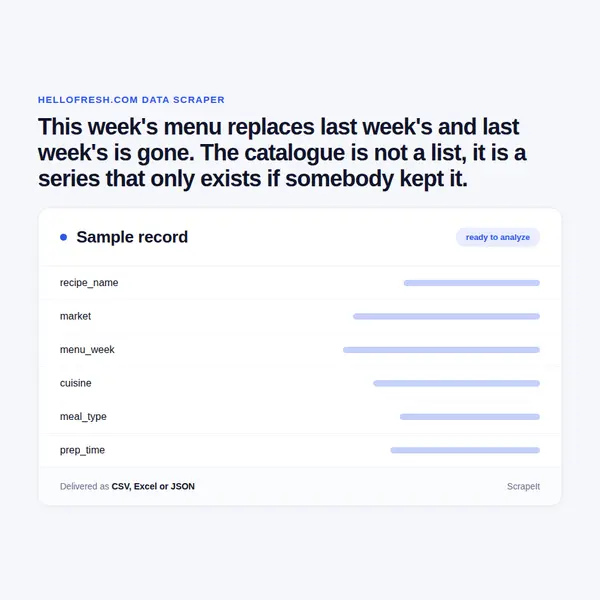
This week's menu replaces last week's and last week's is gone. The catalogue is not a list, it is a series that only exists if somebody kept it.

HelloFresh Scraper
Solutions

Managed meal kit data, run end to end by us

ScrapeIt runs the collection as a managed service. You name the markets and menu scope; we build the pipeline with ingredients as parsed rows, market and week as fields, nutrition where published, and hand back CSV, JSON, Excel or a push into your warehouse.

Because the menu rotates, this is a weekly collection by nature and the value compounds. We say plainly that history starts when collection does rather than implying an archive exists.

We collect published menu and recipe data, honour the crawl rules and pace requests. No subscriber data, no account access. Recipe content is copyrighted, so the dataset is for analysis rather than republication, and your counsel should see the use case before the project starts.

HelloFresh fields in every export

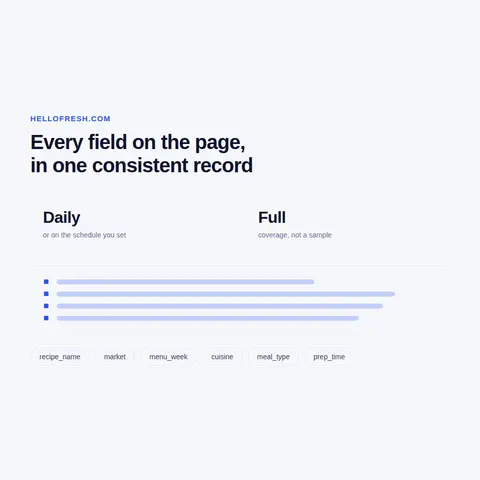
Recipe records carry the recipe name, market, week where determinable, cuisine, meal type, preparation time, difficulty, nutritional values where published, allergens, ingredient list with quantities, and the address.

Market is a first class field. The same company runs different menus in different countries, and a recipe available in Germany may never appear in the United States. Merging markets produces a menu for nowhere.

Ingredients are delivered as rows rather than a text list, with quantity and unit parsed. An ingredient list as prose cannot answer which ingredients recur across a menu, how often a protein appears, or how a market's cuisine profile differs - which is most of what anyone wants from this data.

Week identification is recorded where the site exposes it, and where it does not, the collection date stands in with that fact noted rather than presented as a menu week.

Every row carries the collection timestamp, which on a rotating menu is the field that makes the series possible at all.

HelloFresh fields in every export
Ingredient demand, market profiles and rights

Ingredient demand, market profiles and rights

Ingredient frequency analysis is the distinctive output: which ingredients recur, how often, in which markets, and how that shifts seasonally. For suppliers it is a demand signal from an operator buying at scale, and it needs ingredients as rows to exist at all.

Market cuisine profiling compares how the same company frames its menu for different audiences - portion sizes, cuisine mix, preparation times - which is a direct read on how a global operator localises.

Nutrition trend analysis works because values are published per serving with consistent conventions inside a market, which is more than can be said for most consumer food data.

On rights: recipes and their text are copyrighted. Structured analysis of ingredients and menu composition is measurement; reproducing recipe text to end users is republication and needs a licence. We raise it at scoping rather than leaving it in the delivered file.

A menu that rotates rather than a catalogue that sits

HelloFresh is the largest meal kit company, operating across Europe, North America and Asia-Pacific. Customers subscribe and choose from a menu that changes weekly, receiving pre-portioned ingredients and a recipe.

As data it behaves unlike anything else in this category. A delivery platform has a catalogue that persists; a meal kit has a menu that rotates. This week's selection replaces last week's, and last week's is simply gone from the site.

That makes the interesting dataset a time series by construction. What was offered, in which week, in which market, at what price, with which ingredients - none of it can be recovered retrospectively, and all of it is straightforward to accumulate from the point collection starts.

Recipe sections respond directly with a very large amount of content. Crawl rules are published and disallow the box-week paths, the parameterised recipe search and the account area, leaving the recipe content open.

Get a Quote
dev_w
25

Developers

customers
500+

Customers worldwide

pages
1 500 000 000+

Pages extracted

stime
15000+

Hours saved for our clients

Plans

Airplane

€199 / one-time

setup fee - included

Data limits100,000
Frequencyone-time
Run timeup to 5 days
Data storing7 days

Helicopter

€169 / mo

setup fee €499

Data limits250,000
Frequencymonthly
Run timeup to 5 days
Data storing14 days

Glasses

€229 / mo

setup fee €499

Data limits1,000,000
Frequencyweekly
Run timeup to 5 days
Data storing30 days

DNA

€549 / mo

setup fee €799

Data limits3,000,000
Frequency3 times daily
Run timesame day
Data storing90 days

Why the archive has to be built forward

Every brief on this source eventually asks for history, and history is the one thing that cannot be bought here.

Rotating menus leave no archive. A client who wants to know how protein mix, cuisine distribution or price per serving moved over two years needs somebody to have been collecting for two years. We say that at the first conversation rather than after a hopeful search for a back catalogue.

What can be built immediately is the forward series, and it accumulates quickly because the menu changes weekly - a quarter of collection produces thirteen distinct menus per market, which is already enough to see a pattern.

The second reason this source is worth the work is the ingredient structure. Meal kits publish quantities per serving, which makes them one of the few consumer food sources with genuinely comparable portion data. For anyone studying food composition, ingredient demand or nutrition trends, that precision is rare.

The third is multi-market comparison. One operator, many countries, weekly menus - the same controlled comparison argument that makes any single-operator multi-market source valuable, applied to food.

The fourth is that recipes are copyrighted content. Measurement and structure are the deliverable; reproducing recipes is a licensing matter and we say so up front.

Our Blog

Reads Our Latest News & Blog

Learn how to use web scraping to solve data problems for your organization

How Artificial Intelligence Is Used In Web Scraping

How Artificial Intelligence Is Used In Web Scraping

Leveraging advances in technology, the AI-powered web scraper has skyrocketed in demand and is helping to expand capabilities by automating tedious daily tasks and speeding up data collection from thousands of websites several times over.

What is Web Scraping and What is it Used For?

What is Web Scraping and What is it Used For?

Web scraping is a method of obtaining web data by extracting it from pages of web resources with the help of a program, that is, in automatic mode. It is used to syntactically convert web pages into more usable forms.

Web Scraping for Machine Learning

Web Scraping for Machine Learning

If you specialize in machine learning, you need to feed large amounts of data to the algorithms. Web scraping is the easiest and the most efficient method of collecting the data from all over the Internet.

scrapeit logo

Who builds and keeps your meal kit feed

ScrapeIt is a managed extraction company, not a tool you have to learn. Our team builds the pipeline, maintains ingredient parsing as recipe formats change, and repairs the collector before a menu week goes unrecorded and unrecoverable.

You see a sample first, in your format, over the markets you actually follow, with ingredients parsed into rows so you can judge the extraction on real recipes.

FAQ

Can I get last year's menus?

No. Rotating menus leave no archive - last week's selection is simply gone from the site. History starts when collection starts, which is why we raise it in the first conversation rather than after a hopeful search for a back catalogue.

How quickly does the series become useful?

Faster than most. The menu changes weekly, so a quarter of collection gives thirteen distinct menus per market - already enough to see cuisine mix, protein frequency and price movement rather than a single snapshot.

Why parse ingredients into rows?

Because an ingredient list as prose cannot answer which ingredients recur, how often a protein appears, or how one market's profile differs from another - which is most of what anyone actually wants from this source.

Can I compare markets?

Yes, and it is one of the better uses. One operator running weekly menus in many countries is a controlled comparison of how a global business localises portion sizes, cuisine mix and preparation times.

Can I republish the recipes?

No. Recipe content is copyrighted. Structured analysis of ingredients and menu composition is measurement; reproducing recipe text for your users is republication and needs a licence, which we raise at scoping rather than leaving in the delivered file.

How does it Work?

Step 1 - Make a Request

You share your needs, expectations, and desired timeframe. We’ll suggest the best solution based on your request and budget.

Step 2 - Configuring Custom Web Crawlers

Our specialists configure the crawlers and extract a sample dataset for your review before proceeding with the full-scale extraction.

Step 3 - Collect and Deliver

Once you approve the sample, we launch the project and start full data collection. We gather, filter, and structure the data for easy use, delivering it on time in your preferred format.

Step 4 - Maintain and Support

Our team manages ongoing processes, monitors website changes, and supports all data extraction cycles. We can also help integrate data into your systems or create dashboards to simplify analysis.

Request a Quote

Tell us more about you and your project information.
Which sites, which fields, how often. A couple of lines is enough.

We reply within 1 business day. No obligation.

scrapiet

Scrapeit Sp. z o.o.
10/208 Legionowa str., 15-099, Bialystok, Poland
NIP: 5423457175
REGON: 523384582