iFood Scraper for Restaurants, Menus and Markets

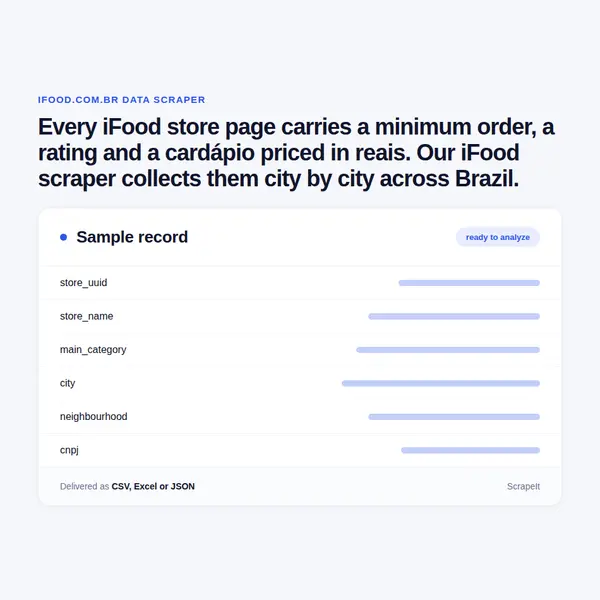
Every iFood store page carries a minimum order, a rating and a cardápio priced in reais. Our iFood scraper collects them city by city across Brazil.

Plans from €169/month · Free project assessment · Reply within 1 business day

iFood Scraper
Solutions

iFood Web Scraping as a Managed Service

You name the cities, the verticals - restaurants, markets, drinks, pharmacies, pet shops - and any chains or store lists, and you set the cadence. We build the iFood crawler, run it and fix it when iFood ships a new version of its web app. The site is protected against automated traffic, so pacing, proxy rotation, browser rendering and CAPTCHA handling are included, and so is the work of turning Portuguese labels into documented columns.

Each store keeps its UUID as the key, and every row carries the city and vertical it came from. Deliveries go out as CSV, Excel, JSON or JSONLines, over SFTP or to Google Drive, or through our API. Start with a free project assessment and a sample of the cities you care about.

iFood Data from Restaurant and Store Pages

Every iFood store has an address of the form /delivery/ plus the city with its state code (rio-branco-ac, maceio-al), a slug ending in the neighbourhood, and a UUID that identifies the store. Names and slugs change; the UUID does not, so it is the row key.

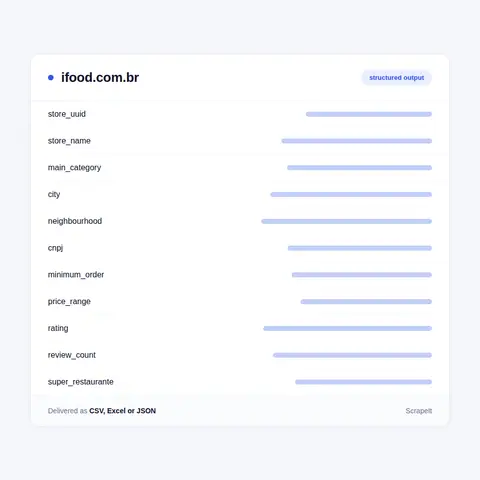
  • Store - UUID, URL, name, the main category as iFood labels it (Doces & Bolos, Cozinha Rápida), city, neighbourhood, street address and the CNPJ, the company registration number the store page carries.
  • Ordering terms - Pedido mínimo, the minimum order in reais; the price range band; opening hours for each day of the week; and whether the store takes delivery, takeout and scheduled orders.
  • Reputation - average rating, review count, the Super Restaurante flag and the flag for stores new to the app.
  • Cardápio - menu categories in the restaurant's own order, including the sections restaurants build for their best sellers, and for each of the menu items its name, description, portion note, price, the lowest price when choices change it, and the add-on groups where the dish has them.
  • Item tags - the dietary tags a dish carries where the restaurant has set them (vegan, vegetarian, organic, lactose-free, sugar-free, diet, zero, natural) and the portion size tag, such as serves 1.
  • Market items - on market pages, the product name with its pack size, the regular and the promotional price, and produce sold by weight.

Delivery fee and estimated delivery time are calculated against the shopper's address, so they sit outside the public store layer; the dataset keeps to what the page shows every visitor.

iFood Data from Restaurant and Store Pages
iFood Reviews, Market Aisles and Price History

iFood Reviews, Market Aisles and Price History

Each store page carries its reviews together with the number of reviews for that store. Each review carries a star rating, a date, the comment when the customer wrote one and the restaurant's reply. We deliver rating, date, text and reply; customers' first names are personal data and stay out by default.

Market pages are built differently. Instead of a cardápio they list products by aisle, starting from the whole store (Loja toda), so a market dataset takes the aisle as its category column.

Repeated runs on the same UUIDs turn a cardápio into price history: price changes, dishes that disappear, promotional prices that start and end, ratings that drift. Coverage starts from the city pages iFood publishes, down to small towns, and from its sections for restaurants, markets, drinks, pharmacies and pet shops.

How iFood Is Organised

iFood is the Brazilian food and grocery delivery app, with a web version at ifood.com.br. The site and app are in Portuguese, prices are in reais, and the catalogue is organised by city: each city has its own page under /delivery/ with the state code in the slug, from state capitals to small towns in Acre or Alagoas. Above the cities sit the verticals - restaurantes, mercados, bebidas, farmácia and petshop - each with its own section.

Stores range from national chains to neighbourhood lanchonetes and pizzarias, and every outlet is a store of its own with its own UUID, rating, minimum order and cardápio, so one chain appears once per branch. Markets, drinks shops, pharmacies and pet shops use the same store pages but present their range as aisles and shelves instead of menu categories. Standout partners carry the Super Restaurante flag.

Much of what makes an order cheap or expensive - delivery fee, delivery time and coupons - depends on the shopper's address or account. The public store page holds the stable part: menu, prices, minimum order, opening hours and reputation, which is what a dataset can follow over time.

Get a Quote
dev_w
25

Developers

customers
500+

Customers worldwide

pages
1 500 000 000+

Pages extracted

stime
15000+

Hours saved for our clients

Plans

iFood Scraping Plans and Pricing

Airplane

€199 / one-time

setup fee - included

Data limits100,000
Frequencyone-time
Run timeup to 5 days
Data storing7 days

Helicopter

€169 / mo

setup fee €499

Data limits250,000
Frequencymonthly
Run timeup to 5 days
Data storing14 days

Glasses

€229 / mo

setup fee €499

Data limits1,000,000
Frequencyweekly
Run timeup to 5 days
Data storing30 days

DNA

€549 / mo

setup fee €799

Data limits3,000,000
Frequency3 times daily
Run timesame day
Data storing90 days

Delivery: CSV, JSON or XLSX files, our API or a JSON feed. MCP server on request.

Full plan details →

Why Scrape iFood Menus and Prices

An iFood store page is a priced, categorised statement of what a Brazilian restaurant or shop sells, published in the same format for chains and corner shops alike.

  • Menu price benchmarking - price per dish across chains and independents in a city, outlet by outlet, with add-on prices and portion notes for a fair comparison.
  • Price change tracking - repeated runs show price rises, removed dishes and the promotional prices each store runs.
  • Market mapping - stores per city and neighbourhood with main category, price range band, opening hours and new arrivals, for expansion and franchise planning.
  • Reputation analysis - rating, review count, the Super Restaurante flag, review text and how restaurants reply.
  • Grocery shelf checks - market aisles, pack sizes, regular against promotional price and weight-based produce show how a brand is priced across supermarkets on the app.
  • Menu trends - vegan, vegetarian and lactose-free tags counted per city and category.

Our Blog

Reads Our Latest News & Blog

Learn how to use web scraping to solve data problems for your organization

How Artificial Intelligence Is Used In Web Scraping

How Artificial Intelligence Is Used In Web Scraping

Leveraging advances in technology, the AI-powered web scraper has skyrocketed in demand and is helping to expand capabilities by automating tedious daily tasks and speeding up data collection from thousands of websites several times over.

What is Web Scraping and What is it Used For?

What is Web Scraping and What is it Used For?

Web scraping is a method of obtaining web data by extracting it from pages of web resources with the help of a program, that is, in automatic mode. It is used to syntactically convert web pages into more usable forms.

Web Scraping for Machine Learning

Web Scraping for Machine Learning

If you specialize in machine learning, you need to feed large amounts of data to the algorithms. Web scraping is the easiest and the most efficient method of collecting the data from all over the Internet.

scrapeit logo

About ScrapeIt

ScrapeIt builds and runs crawlers for clients who need data, not tools. Delivery platforms are a regular part of our work, and iFood brings its own conditions: Portuguese labels, prices in reais, one store per outlet and menus with add-on groups. The field documentation explains every column in English while the data keeps iFood's own wording. Restaurants and their CNPJ are business records; customer names in reviews are personal data, handled under GDPR and left out by default.

FAQ

Do you offer an iFood API for restaurants and menus?

Yes. The ScrapeIt iFood API returns the store UUID, name, main category, Pedido mínimo, rating and every cardápio item with its price as JSON, served from an endpoint we host and refreshed on the schedule you choose. The same records also come as XLSX or CSV files, over SFTP or loaded into your database.

Is it legal to scrape iFood?

Yes. Store pages with their address, minimum order, rating, cardápio and reviews are open to any visitor of ifood.com.br. We collect only publicly available data - everything a visitor can see on iFood - and we collect it legally. Customer names in reviews are not delivered.

Does iFood scraping export the full cardápio with add-ons?

Yes. Each menu category comes in the restaurant's own order with every item, its description, portion note, price and the lowest price when choices change it, and add-on groups are kept as linked rows. Dietary tags such as vegan, vegetarian or lactose-free travel with the item where the restaurant has set them, so a cardápio export can be filtered without reading descriptions.

Can the iFood dataset include markets, pharmacies and pet shops?

Yes. These stores share the restaurant page format but list products by aisle, with pack size, regular and promotional price, and items sold by weight. Every row is tagged with its vertical - restaurant, market, drinks, pharmacy or pet shop - so one dataset can hold all of them or just one.

How often do iFood menus and prices change?

Restaurants edit their own cardápio, promotional prices start and end, and stores open and close by shift, so prices can move on any day. A weekly run suits menu benchmarking, daily runs suit promotion tracking, and reviews build up steadily enough for a weekly pass.

How does it Work?

Step 1 - Make a Request

You share your needs, expectations, and desired timeframe. We’ll suggest the best solution based on your request and budget.

Step 2 - Configuring Custom Web Crawlers

Our specialists configure the crawlers and extract a sample dataset for your review before proceeding with the full-scale extraction.

Step 3 - Collect and Deliver

Once you approve the sample, we launch the project and start full data collection. We gather, filter, and structure the data for easy use, delivering it on time in your preferred format.

Step 4 - Maintain and Support

Our team manages ongoing processes, monitors website changes, and supports all data extraction cycles. We can also help integrate data into your systems or create dashboards to simplify analysis.

Request a Quote

Tell us more about you and your project information.
Which sites, which fields, how often. A couple of lines is enough.

This form is protected by Google reCAPTCHA, which loads when you start filling it in. If you prefer not to use it, email us at info@scrapeit.io. Privacy & Cookie Policy

We reply within 1 business day. No obligation.

iFood data from €169/month. Free project assessment, reply within 1 business day.

scrapiet

Scrapeit Sp. z o.o.
10/208 Legionowa str., 15-099, Bialystok, Poland
NIP: 5423457175
REGON: 523384582