Talabat Scraper - Menus, Prices and Stock in Seven Markets

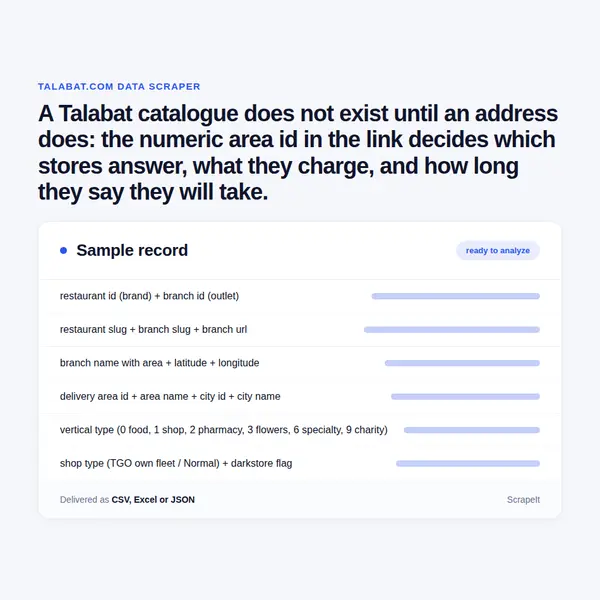
A Talabat catalogue does not exist until an address does: the numeric area id in the link decides which stores answer, what they charge, and how long they say they will take.

Talabat Scraper
Solutions

How we run a managed Talabat scraping job for you

You give us the markets, the delivery areas or store slugs, the fields you need and a cadence. We design the schema, build and run the Talabat scraper, watch it and repair it when the site moves, and you receive files instead of code: CSV, JSON, XLSX, a Google Sheet, a direct database load, or a Talabat API endpoint we host and you call, delivered over email, S3, SFTP or webhook.

Anti-bot handling, proxy rotation and CAPTCHA solving are part of the service and never become your problem. Coverage is planned as a grid of area ids rather than one pass per city, because the store list, the fee and the delivery estimate all answer to the area and not to the town, and rows are deduplicated on branch id because the listing repeats stores across its own pages. We stay on public pages, never touch cart, checkout or payment areas, and leave reviewer names out by default as personal data; ratings and counts arrive as plain numbers.

Fields on a Talabat store card, menu item and mart product

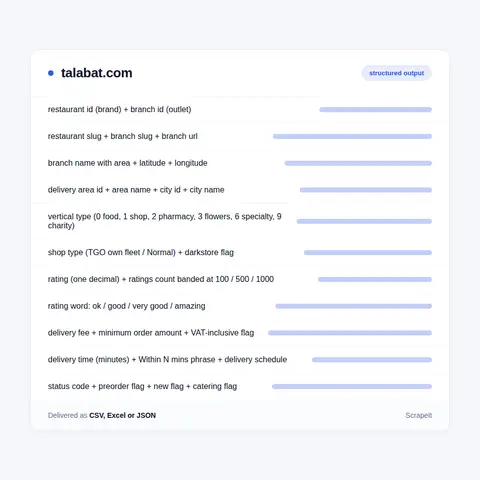
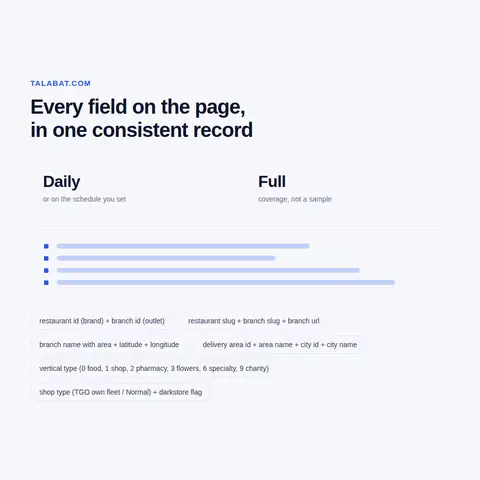
A store row in a Talabat listing is a wide object rather than a card with four labels. It carries a restaurant id for the brand and a separate branch id for the outlet that actually cooks, both slugs, the branch name with its area appended, latitude and longitude, a cuisine string plus a cuisines array of id, name and slug, a hero image and a logo, the rating, the ratings count, the delivery fee, the minimum order amount, the average delivery time written twice - once as an integer of minutes and once as the phrase Within 27 mins - the delivery schedule, a status code, a preorder flag, a new flag, a catering flag, a VAT-inclusive flag, card and cash acceptance flags, a payment-methods array, a vertical type, a shop type such as TGO for own-fleet delivery, and a sponsored block with a campaign category, a cpc marker and a signed token.

Open a branch and the menu arrives whole. Categories carry an id and a name, and merchandised ones use negative ids, because Picks for you and Offers are assembled rather than authored. Each item ships an id, name, description, price, an old price that sits at minus one when nothing is discounted, an item-discount flag, a rating, an image and an original image, a section id and section name, a with-image flag, a top-rated flag and a hasChoices flag. Where that flag is set the modifier tree is its own object: a choice section with a name, a minimum and a maximum quantity, a selection string, and options that each hold an id, name, price, old price, a discount and a marker saying whether the option opens a second level of choices. Section ids and item ids are identical across the Arabic and English renderings of one branch, so to extract Talabat data in both languages you join on the id and never on the name.

Grocery and mart products use a third shape: a uuid, a Delivery Hero vendor uuid, title, slug, a long marketing description, original price, price, discount and discount percentage, an image list, a live stock amount, a merchant sku, and an attribute bag holding barcodes, pack size, gross weight, unit of measure, per-unit price and a returns policy, alongside a small localisation object keyed ar, en and ku.

Fields on a Talabat store card, menu item and mart product
talabat mart darkstores, pharmacy, flowers and charity shops

talabat mart darkstores, pharmacy, flowers and charity shops

Verticals are not tabs laid over one catalogue; they are a numeric type on the store itself. Zero is a restaurant, one a grocery or shop, two a pharmacy, three flowers and gifts, six a specialty store such as perfume and cosmetics, and nine a charity. UNHCR, Dubai Cares and the World Food Programme sit in the same store feed as burger branches under a shop type of 9C, and Talabat publishes a separate donations sitemap for them. One Dubai area alone answered with about 329 grocery stores, 157 flower shops and 153 pharmacies.

talabat mart is the darkstore arm, and in the address space it is a store like any other, with a branch id, a Delivery Hero vendor uuid and a darkstore flag set true. The Downtown Burj Khalifa mart published 32 top categories and 198 subcategories holding roughly 15,385 lines, running from Fruit and Veg through Deli, Ready To Eat and Baby Corner to Stationery, Electronics and International Market. The delivery promise is stored per country: twenty minutes in the Emirates, Bahrain, Jordan and Egypt, thirty in Kuwait and Qatar. Category and item ids are uuids, and every line carries a live stock amount, a merchant sku and a barcode list, which is why a Talabat scraper earns its keep on availability work and not only on price work.

Two smaller strands matter. Supermarket chains trade under a powered by talabat label with their own aisles, and the mart stocks a talabat own-brand line. And the pharmacy and flower verticals do not exist everywhere: Egypt publishes grocery areas but no pharmacy or flower ones, so a coverage plan copied from the Emirates quietly returns nothing there.

Seven live Talabat storefronts and one area-first catalogue

Talabat is the Delivery Hero brand for the Middle East, and its own help pages name nine markets: Kuwait, Saudi Arabia, UAE, Bahrain, Oman, Qatar, Jordan, Egypt and Iraq. Only seven of them publish a web catalogue anyone can read. Iraq lives on its own subdomain as an app-only landing page in Arabic and Kurdish with no store list at all, and the Saudi path answers with a shell that carries a footer but no city block and no sitemap. A Talabat scraper written against a nine-country list therefore spends part of its budget on pages that never held a catalogue.

Every live market is a separate entity inside the group and says so in its own configuration: TB_AE for the Emirates, TB_KW for Kuwait, TB_BH for Bahrain, TB_QA for Qatar, TB_OM for Oman, TB_JO for Jordan, and HF_EG for Egypt, which arrived through a different lineage and still carries the odd code. Money precision follows the market rather than a global default: three decimals for the Kuwaiti, Bahraini and Omani units, two for the dirham, the Qatari riyal, the Jordanian dinar and the Egyptian pound, and none at all for the Iraqi dinar.

The address grammar is short, and it is the whole story. A store page is two segments, country plus brand slug. A catalogue page is country, vertical, numeric area id, area slug - and the slug is decorative, because the id alone decides what loads. The published English sitemaps hold about 84,443 store pages, roughly 29,056 of them in the Emirates and 16,857 in Egypt, plus about 3,811 delivery areas, 1,109 cuisine pages and 81 city pages in September 2026, and the Arabic mirror repeats all of it behind an ar prefix. Cuisine and city pages carry no stores whatsoever: they ask for an address and stop there.

Get a Quote
dev_w
25

Developers

customers
500+

Customers worldwide

pages
1 500 000 000+

Pages extracted

stime
15000+

Hours saved for our clients

Plans

Airplane

€199 / one-time

setup fee - included

Data limits100,000
Frequencyone-time
Run timeup to 5 days
Data storing7 days

Helicopter

€169 / mo

setup fee €499

Data limits250,000
Frequencymonthly
Run timeup to 5 days
Data storing14 days

Glasses

€229 / mo

setup fee €499

Data limits1,000,000
Frequencyweekly
Run timeup to 5 days
Data storing30 days

DNA

€549 / mo

setup fee €799

Data limits3,000,000
Frequency3 times daily
Run timesame day
Data storing90 days

Talabat price monitoring starts with the delivery area

The number you want is not a property of the restaurant. It is a property of the pair restaurant plus delivery area. One Dubai area listed about 7,452 stores while a coastal area in Oman listed twelve and a district of Jerash listed sixty-two, and neighbouring areas in Dubai, Sharjah and Abu Dhabi shared no store at all at the top of their listings. There is no city-wide price list to lift; there is a grid of area ids, and honest Talabat price data means one row per store per area.

Fees answer to the market, not to the platform. Delivery charges run from nothing to eighty Egyptian pounds, ten Qatari riyals or 0.85 Kuwaiti dinar, and minimum order values stretch from ten to roughly a thousand in local units. Egypt marks its branches VAT inclusive and labels the line VAT, while the Emirates leaves the same flag off, so a straight total-to-total comparison across two markets compares different things.

Two traps sit inside the numbers. Prices arrive as raw floats carrying binary noise, so a dinar item priced at 2.24 can be served as a long tail of nines and every figure has to be rounded to the decimal count its market declares. And the ratings count is banded: exact below one hundred, then flattened onto a hundred, five hundred and a thousand, so a store sitting in the top band may have many times that. The rating itself is honest to one decimal and is doubled by a word - ok, good, very good, amazing - with Exceptional offered as a listing filter beside Rating 4.0 plus, Free delivery, Under 30 mins, Newly added, Offers, Pickup and Veg only.

Our Blog

Reads Our Latest News & Blog

Learn how to use web scraping to solve data problems for your organization

How Artificial Intelligence Is Used In Web Scraping

How Artificial Intelligence Is Used In Web Scraping

Leveraging advances in technology, the AI-powered web scraper has skyrocketed in demand and is helping to expand capabilities by automating tedious daily tasks and speeding up data collection from thousands of websites several times over.

What is Web Scraping and What is it Used For?

What is Web Scraping and What is it Used For?

Web scraping is a method of obtaining web data by extracting it from pages of web resources with the help of a program, that is, in automatic mode. It is used to syntactically convert web pages into more usable forms.

Web Scraping for Machine Learning

Web Scraping for Machine Learning

If you specialize in machine learning, you need to feed large amounts of data to the algorithms. Web scraping is the easiest and the most efficient method of collecting the data from all over the Internet.

scrapeit logo

ScrapeIt as your Talabat data supplier

ScrapeIt is a managed web scraping agency. We are not a library and not a self-serve tool: we build the crawler, run it on your schedule, monitor it and repair it when a page changes, so what you keep is a data feed rather than a codebase. A sample lands before sign-off, which lets you check the rounded prices, the modifier trees and the mart stock counts against live Talabat pages yourself. Every row carries the area id and the capture time behind it, so successive deliveries stack into one series. We have no affiliation with Talabat or Delivery Hero.

FAQ

Is there a Talabat API that returns menu and price data?

Talabat runs a developer portal, but it faces merchants rather than data buyers. Its Partner API covers catalogue management, promotion management and order management, with an SFTP route for partners who would rather upload CSV templates, and all of it moves one way: a store pushes its own products, stock and prices into Talabat and pulls its own orders back. Nothing there returns another vendor's menu, and the endpoints the site uses for menus, choices and reviews are internal to the app rather than published or documented. A buyer who wants Talabat data across a city has no public endpoint to call, which is why the feed has to be collected from public pages instead.

Which Talabat countries can you actually cover?

The seven that publish a web catalogue: the Emirates, Kuwait, Bahrain, Qatar, Oman, Jordan and Egypt. Each is a separate entity with its own currency and its own decimal precision, yet the page shapes and field names are identical, so one Talabat scraper reads all seven without new parsing rules. Iraq is app-only on its own subdomain, in Arabic and Kurdish, with no store list to read, and the Saudi path answers with a shell rather than a catalogue. Inside a live market we scope by delivery area, by city, by cuisine, by vertical or by brand slug, and both the English and the Arabic rendering of the same store can be delivered side by side.

Do Talabat menus and prices change with the delivery address?

Yes, and without an address nothing loads at all. A menu link that carries no area id falls back to the country home page, so the address is not a filter placed over a catalogue, it is the key that creates one. The store list, the delivery fee, the minimum order, the delivery estimate and the availability of individual items all answer to that area. Neighbouring areas in Dubai, Sharjah and Abu Dhabi share no store at all at the top of their listings, and one Dubai area answers with thousands of stores while a coastal Omani area answers with a dozen. That is why we crawl a grid of area ids and stamp every row with the area and the capture time it came from.

How often can a Talabat data feed refresh, and in which formats?

Cadence follows the question. Store attributes and menu structure are stable enough for a daily or weekly pass; prices, discounted lines and minimum order values are worth a daily run; mart stock counts, opening status and delivery estimates move through the day, so those are collected hourly or on a schedule tied to trading hours. Output comes as CSV, JSON, XLSX, a Google Sheet, a direct database load or an endpoint we host, pushed over email, S3, SFTP or webhook. Full snapshots and change-only deltas are both available, keyed on branch id, item id and area id.

Is it legal to scrape Talabat, and what will you not collect?

The robots file is short and closes nothing: it names two sitemaps and sets no disallowed path. The terms of use run the other way and ask for explicit authorisation before any automated access, so the two documents do not agree, and the honest answer is that this is a commercial risk to weigh rather than a settled permission. We work conservatively: public pages only, polite rates, nothing behind a login, and no cart, checkout or payment activity. Reviews carry a reviewer's first and last name, and we leave those out by default; we take menu, price, fee, stock and store attributes, which are facts about the trade. Legal advice for your own use case remains yours to take.

How does it Work?

Step 1 - Make a Request

You share your needs, expectations, and desired timeframe. We’ll suggest the best solution based on your request and budget.

Step 2 - Configuring Custom Web Crawlers

Our specialists configure the crawlers and extract a sample dataset for your review before proceeding with the full-scale extraction.

Step 3 - Collect and Deliver

Once you approve the sample, we launch the project and start full data collection. We gather, filter, and structure the data for easy use, delivering it on time in your preferred format.

Step 4 - Maintain and Support

Our team manages ongoing processes, monitors website changes, and supports all data extraction cycles. We can also help integrate data into your systems or create dashboards to simplify analysis.

Request a Quote

Tell us more about you and your project information.
Which sites, which fields, how often. A couple of lines is enough.

We reply within 1 business day. No obligation.

scrapiet

Scrapeit Sp. z o.o.
10/208 Legionowa str., 15-099, Bialystok, Poland
NIP: 5423457175
REGON: 523384582