CORDIS Scraper for EU-Funded Research Projects

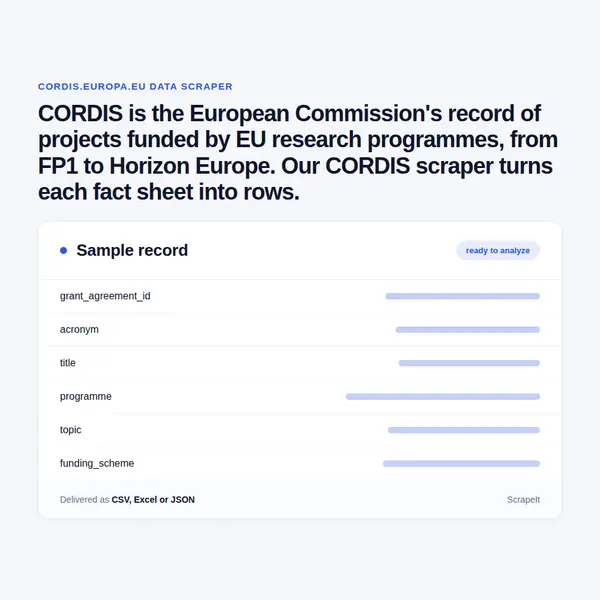
CORDIS is the European Commission's record of projects funded by EU research programmes, from FP1 to Horizon Europe. Our CORDIS scraper turns each fact sheet into rows.

Plans from €169 a month · Free project assessment · Reply within 1 business day

CSV · Excel · JSON · XML · FTP · SFTP · Amazon S3 · Google Cloud

cordis.europa.eu
CORDIS Scraper for EU-Funded Research Projects
cordis.europa.euwhat you get
Typical fields for public registers
record_identity_namestatusregistered_ataddressdocument_url
Delivery

API, JSON feed or CSV, XLSX and JSON files

Schedule

One-time, monthly, weekly, daily or 3 times a day

How Our CORDIS Data Service Works

  1. You send

    CORDIS pages, filters, fields and a schedule

  2. We run the scrapers

    Built, monitored and repaired by our team

  3. You receive the data

    API, JSON feed or CSV, XLSX and JSON files

You give us the scope - programmes, topics, calls, fields of science, countries, organisation types or a list of grant agreement IDs - and we build the CORDIS crawler, run it and keep it working when the fact sheet layout changes. A CORDIS project spreads over a fact sheet, a Reporting tab and a Results tab, and every participant sits in its own collapsible block, so we read all three and stitch them into one record per project. Pacing, retries and proxy rotation are part of the job, not something you set up.

Runs are one-off, for a funding landscape study, or recurring - weekly or monthly - to pick up new grants and new reports. Field documentation comes with the first file, and a free project assessment confirms the coverage before you order.

CORDIS Dataset: Project, Funding and Participant Fields

A CORDIS fact sheet is built around the grant agreement ID - the number in the page address and the key every other field hangs on. We keep the labels CORDIS uses as column names.

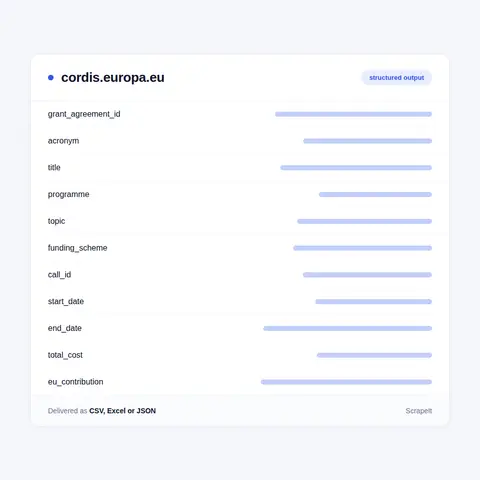
  • Project identitygrant agreement ID, project acronym and full title, the project DOI shown on Horizon 2020 and Horizon Europe fact sheets, project website, status such as Project closed, and the date of the last update.
  • DatesEC signature date, start date and end date.
  • Fundingtotal cost and EU contribution in euros and, for Horizon Europe grants, the EU policy priority trackers that tag the spend as a share for climate action, biodiversity, digital agenda, artificial intelligence and clean air.
  • Programme structureframework programme, programme codes such as HORIZON.1.3 or H2020-EU.3.1., the topic, the call for proposal and the funding scheme, for example HORIZON-RIA or RIA.
  • Contentproject description and objective, the Fields of science path from EuroSciVoc, and the keywords the coordinator supplied.
  • Coordinator and participantsfor every organisation: name, country, role (coordinator, participant, third party linked to a participant, or partner that does not sign the grant agreement), net EU contribution, total cost, address, NUTS region, activity type - higher or secondary education, research organisation, private for-profit entity, public body or other - and the SME flag.

One project becomes a project row plus one row per organisation, joined on the grant agreement ID, so funding can be summed by country, region or institution without reshaping anything.

CORDIS Dataset: Project, Funding and Participant Fields
CORDIS Horizon Europe Dataset, H2020 and Earlier Programmes

CORDIS Horizon Europe Dataset, H2020 and Earlier Programmes

Two more tabs record what a project produced.

  • Periodic reportingeach reporting period with its dates and three narrative sections: context and overall objectives, work performed and main results so far, and progress beyond the state of the art with the expected impact.
  • Resultsdeliverables grouped by type, such as Documents, reports or Demonstrators, pilots, prototypes, each with a title and a short summary, and publications such as peer reviewed articles with journal, year, ISSN, publisher and DOI.
  • Results in Briefplain-language summaries of the main outcomes once a project ends.

Coverage starts from the CORDIS search, which filters by programme, field of science, start and end date, total cost, EU contribution, call ID and topic ID, and by organisation name, country and region. A Horizon Europe extract is cut by topic or call, an H2020 or FP7 one by programme code; projects of programmes closed for more than ten years move to the CORDIS archive and are included when you ask. Repeated runs keyed on the grant agreement ID show what arrived since the last pass: a new reporting period, new deliverables, new publications.

Publication authors and researchers named in results are persons, so they are left out by default; organisations come as CORDIS writes them.

About the CORDIS Database

Source
cordis.europa.eu
Category
public registers
Delivery
API, JSON feed, CSV, XLSX
Plans
From €169 a month
Get a quote

CORDIS, the Community Research and Development Information Service, is the European Commission's primary source for the results of projects funded by the EU framework programmes for research and innovation. The Publications Office of the European Union manages it on behalf of the Commission's research and innovation Directorates-General, executive agencies and joint undertakings. It complements the Funding and tender opportunities website: applications and partner searches happen there, while CORDIS records the funded projects and what they produced.

For anyone who needs its data, CORDIS is organised around the project: a fact sheet, a Reporting tab and a Results tab, plus News and Multimedia where CORDIS has covered the work. Around the projects sit editorial layers - Results in Brief, news, Results Packs and other Thematic Packs, videos and podcasts - grouped by domain of application such as Health, Energy, Space or Transport and Mobility.

The interface runs in English, French, German, Italian, Spanish and Polish, with machine translation for other languages, and a fact sheet can switch its project description between those six. Organisation names are written in capitals and usually in the organisation's own language - JYVASKYLAN YLIOPISTO, not University of Jyvaskyla - which matters when you match participants to your own records.

25Developers
500+Customers
1.5BPages extracted
15,000+Hours saved for our clients

CORDIS scraping plans and pricing

Airplane

€199one-time

Setup fee included

100,000
One-time
Up to 5 days
7 days

Helicopter

€169/ mo

Setup fee €499

250,000
Monthly
Up to 5 days
14 days

Glasses

€229/ mo

Setup fee €499

1,000,000
Weekly
Up to 5 days
30 days

Microscope popular

€349/ mo

Setup fee €499

2,000,000
Daily
Same day
60 days

DNA

€549/ mo

Setup fee €799

3,000,000
3 times daily
Same day
90 days

Delivery: CSV, JSON or XLSX files, our API or a JSON feed. MCP server on request.

Full plan details

Why Scrape CORDIS Project Data

CORDIS answers who received EU research money, for what, and with whom.

  • Funding landscapesnet EU contribution by country, NUTS region, institution and programme, for a research office, a ministry or a regional development agency.
  • Partner and competitor searchwhich organisations coordinate projects under a topic, which SMEs keep joining consortia in a field, and who an applicant will compete with in the next call.
  • Technology scoutingEuroSciVoc fields, keywords, deliverable titles and publications point to the projects working on a technology, with the companies and labs behind them.
  • Benchmarkinga university or research organisation compared with its peers on participations, coordinator roles and funding scheme mix.
  • Policy analysisHorizon Europe spending tagged by the climate, biodiversity, digital and artificial intelligence trackers, summed over a programme.

About ScrapeIt

ScrapeIt collects data from websites as a managed service: we build the crawlers, run them on your schedule and fix them when a source changes. Research and funding sources such as CORDIS need more than a page copy - a project has to be joined to its participants, reports and results before anyone can count with it. We hand that over as CSV, Excel, JSON or JSONLines, through our API, or into Google Cloud Storage or your database.

FAQ

Still unsure? Write to info@scrapeit.io

Do you offer a CORDIS API for project and participant data?

Yes. The ScrapeIt CORDIS API serves grant agreement ID, acronym, programme and topic, start and end dates, EU contribution and the participant list with net contributions in JSON from a ScrapeIt-hosted endpoint, refreshed as often as you choose. You can take the same data as CSV, JSONLines or XLSX files instead, or have it loaded into your database.

Is it legal to scrape CORDIS?

Yes. Fact sheets, participant lists, reporting summaries and results are published on CORDIS for every visitor; signing in only adds features such as suggesting a field of science. We collect only publicly available data - everything a visitor can see on CORDIS - and we collect it legally. Researchers named in results are left out by default.

Can you extract CORDIS project participants by country?

Yes. Every participant block carries a country and most carry a NUTS region, so the filter works at organisation level: all projects with a Polish participant, or every Horizon Europe grant coordinated from Finland. The result has one row per organisation per project, with its role, net EU contribution and activity type.

How often is CORDIS updated?

Each fact sheet shows its own Last update date, and a record keeps growing after the grant is signed as reporting periods, deliverables and publications are added. A weekly run is usually enough to catch new grants and new results; a one-time programme study works as a single extract with a refresh before you publish.

Does the dataset cover Horizon 2020 and FP7 as well as Horizon Europe?

Yes. CORDIS holds projects from FP1 to Horizon Europe. H2020 and Horizon Europe fact sheets share one layout and differ in their programme codes, while FP7 fact sheets are leaner, with no DOI or EC signature date. The EU policy priority trackers appear on Horizon Europe projects only, so we leave those columns empty for earlier programmes rather than guess.

How it works

  1. 1

    Make a request

    You share your needs, expectations, and desired timeframe. We'll suggest the best solution based on your request and budget.

  2. 2

    We configure the crawlers

    Our specialists configure the crawlers and extract a sample dataset for your review before proceeding with the full-scale extraction.

  3. 3

    Collect and deliver

    Once you approve the sample, we launch the project and start full data collection. We gather, filter, and structure the data for easy use, delivering it on time in your preferred format.

  4. 4

    Maintain and support

    Our team manages ongoing processes, monitors website changes, and supports all data extraction cycles. We can also help integrate data into your systems or create dashboards to simplify analysis.

Request a quote

Tell us which sites, which fields and how often. A couple of lines is enough to start.

  • We reply within 1 business day
  • A sample dataset before the full run
  • We sign an NDA on request
  • Delivery by API, JSON feed or files
Which sites, which fields, how often. A couple of lines is enough.

This form is protected by Google reCAPTCHA, which loads when you start filling it in. If you prefer not to use it, email us at info@scrapeit.io. Privacy & Cookie Policy

We reply within 1 business day. No obligation.

CORDIS data from €169/month. Free project assessment, reply within 1 business day.