EUR-Lex Scraper for EU Legal Acts and Case Law

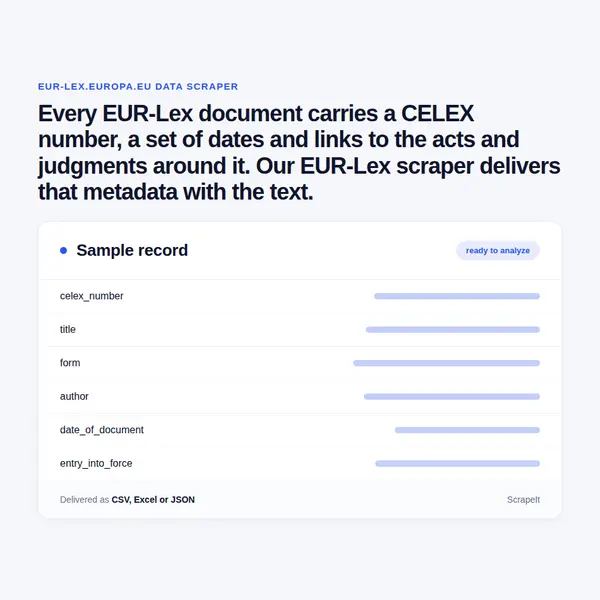
Every EUR-Lex document carries a CELEX number, a set of dates and links to the acts and judgments around it. Our EUR-Lex scraper delivers that metadata with the text.

Plans from €169 a month · Free project assessment · Reply within 1 business day

CSV · Excel · JSON · XML · FTP · SFTP · Amazon S3 · Google Cloud

eur-lex.europa.eu
EUR-Lex Scraper for EU Legal Acts and Case Law
eur-lex.europa.euwhat you get
Typical fields for public registers
record_identity_namestatusregistered_ataddressdocument_url
Delivery

API, JSON feed or CSV, XLSX and JSON files

Schedule

One-time, monthly, weekly, daily or 3 times a day

EUR-Lex Data Extraction, Built and Run by Us

  1. You send

    EUR-Lex pages, filters, fields and a schedule

  2. We run the scrapers

    Built, monitored and repaired by our team

  3. You receive the data

    API, JSON feed or CSV, XLSX and JSON files

You define the slice of EU law you need - document types, a date range, EuroVoc descriptors, authors, directory codes, a list of CELEX numbers or everything that amends one act - and we build the EUR-Lex crawler, run it and maintain it. EUR-Lex sits behind bot protection that challenges unfamiliar traffic before a page loads, so anti-bot handling, rendering, pacing and proxy rotation are included rather than left to you.

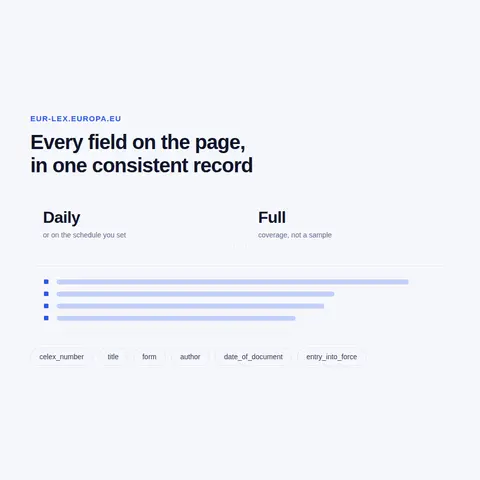
Deliveries are one-off, for a corpus of one policy area, or scheduled - daily to follow the Official Journal, weekly to watch consolidations and new case law. Each row is keyed on the CELEX number and the language, and the first file arrives with field documentation.

EUR-Lex Dataset: Fields of a Legal Act

A EUR-Lex document page opens on the text and carries a Document information tab with the metadata analysts filter on. We extract both, under the labels EUR-Lex uses.

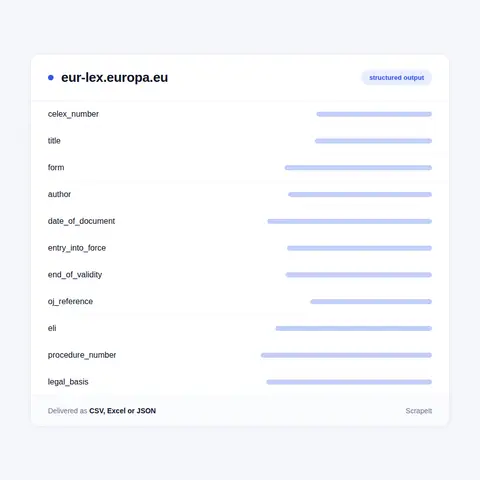
  • Identitythe CELEX number, which encodes sector, year, document type and number (32016R0679 is a regulation of 2016; sector 3 holds legal acts, 6 case law, and a leading 0 marks a consolidated version), the full title, the ELI identifier and the Official Journal reference with series, issue and pages.
  • Datesdate of document, each date of effect with its basis, such as entry into force or application, date of signature, deadlines, and date of end of validity, which reads No end date for an act still in force.
  • Miscellaneous informationauthor, for example the European Parliament and the Council of the European Union, the responsible body, and the form: regulation, directive or decision.
  • Procedurethe procedure number, such as 2012/0011/COD, that ties the act to its lawmaking file.
  • Relationship between documentstreaty, legal basis, the Commission proposal, the acts it repeals or modifies, Modified by with corrigenda and amendments, subsequent related instruments, and Affected by case, which pairs an article with the judgment that interpreted it.
  • ClassificationsEuroVoc descriptors, subject matter and the directory code with its full path.
  • Status and versionsthe In force line and the date of the current consolidated version.
  • Languageswhich language versions exist, in HTML and PDF.

The text itself comes whole or split into recitals, articles and annexes, with the CELEX number on every fragment.

EUR-Lex Dataset: Fields of a Legal Act
EUR-Lex Database Coverage: Case Law, OJ and Transposition

EUR-Lex Database Coverage: Case Law, OJ and Transposition

Legislation is one sector of many, and a useful dataset usually crosses several.

  • Case lawjudgments of the Court of Justice with case number, ECLI identifier, date of document and date lodged, the authentic language, the procedure (a reference for a preliminary ruling, for example), the country or body the request came from, the Member States and institutions that submitted observations, subject matter and the case-law directory code. Parties who are private persons are left out by default.
  • Official Journalthe OJ L series and C series, listed day by day and act by act, so a run can collect everything published since the previous one.
  • National transpositionfor each directive, the measures each Member State has communicated, with transposition deadlines and the number of measures per country; EUR-Lex updates this collection weekly.
  • Consolidated versions and summariesconsolidated texts with their dates, Summaries of EU legislation, preparatory documents such as Commission proposals, international agreements and EFTA documents.

Search, the OJ issue lists and the Browse by EuroVoc and Browse by EU institutions pages set the coverage, and the CELEX number joins regulations, directives, decisions, judgments and transposition measures into one dataset. Repeated runs show amendments as they arrive: a new Modified by line, a new consolidated version, a new judgment interpreting an article.

About EUR-Lex

Source
eur-lex.europa.eu
Category
public registers
Delivery
API, JSON feed, CSV, XLSX
Plans
From €169 a month
Get a quote

EUR-Lex - Access to European Union law, as its header reads - is managed by the Publications Office of the European Union. It is where the Official Journal of the European Union appears, and it gathers around the journal what is needed to read an act in context: its history, its amendments, the rulings on it and the national laws that carry it out.

The home page shows the structure. EU law covers treaties, legal acts, consolidated texts, international agreements, preparatory documents, EFTA documents, lawmaking procedures and summaries of EU legislation. EU case-law covers case-law, reports of cases and the directory of case-law. National law and case-law covers national transposition, national case-law and JURE case-law. Every document belongs to a CELEX sector, which is why the CELEX number works as a key across all of them.

Documents are published in the EU languages, and a document page lists which language versions exist and can show up to three side by side. Pages run long: the Document information tab of the General Data Protection Regulation alone lists a long run of judgments under Affected by case, each tied to the article it interprets. That depth makes EUR-Lex slow to copy by hand and useful as structured data.

25Developers
500+Customers
1.5BPages extracted
15,000+Hours saved for our clients

EUR-Lex scraping plans and pricing

Airplane

€199one-time

Setup fee included

100,000
One-time
Up to 5 days
7 days

Helicopter

€169/ mo

Setup fee €499

250,000
Monthly
Up to 5 days
14 days

Glasses

€229/ mo

Setup fee €499

1,000,000
Weekly
Up to 5 days
30 days

Microscope popular

€349/ mo

Setup fee €499

2,000,000
Daily
Same day
60 days

DNA

€549/ mo

Setup fee €799

3,000,000
3 times daily
Same day
90 days

Delivery: CSV, JSON or XLSX files, our API or a JSON feed. MCP server on request.

Full plan details

Why Scrape EUR-Lex

EUR-Lex data feeds work that has to know the current state of EU law, not last year's.

  • Regulatory monitoringnew acts in the OJ L series filtered by EuroVoc descriptor, directory code or author, delivered to compliance teams the day they are published.
  • Amendment historythe Modified by and consolidated version records of one act, dated, so a team sees what changed and from when it applies.
  • Legal research and knowledge basesacts linked to the judgments that interpret them through Affected by case, article by article, with ECLI identifiers.
  • Transposition trackingdeadlines and communicated measures per Member State for the directives a business depends on.
  • Parallel textsthe same act in several languages, aligned on the CELEX number, for legal translation and terminology work.
  • Policy analysiscounts of regulations, directives and decisions by subject matter and year.

About ScrapeIt

ScrapeIt builds and operates crawlers for clients who need web data on a schedule, from public registers to legal databases. Legal sources reward care with identifiers: we keep the CELEX number, the ECLI and the language code on every row so that legislation, case law and transposition can be joined later. Files arrive as CSV, JSON or XML, through our API or a JSON feed, or on SFTP or Dropbox; an MCP server is available on request.

FAQ

Still unsure? Write to info@scrapeit.io

Do you offer a EUR-Lex API for legislation and case law?

Yes. The ScrapeIt EUR-Lex API returns the CELEX number, title, form, key dates, EuroVoc descriptors and the Modified by relations of each document as JSON through an endpoint that we host, updated on the schedule you pick. The same records can be delivered as CSV, XML or XLSX files, or loaded into your database.

Is it legal to scrape EUR-Lex?

Yes. Legal acts, the Official Journal, case law, consolidated texts and transposition pages are open to every EUR-Lex visitor. We collect only publicly available data - everything a visitor can see on EUR-Lex - and we collect it legally. Private parties named in judgments are left out by default.

Can you track amendments to an EU regulation in EUR-Lex?

Yes. Each act lists its Modified by relations with the amending act, a comment, the subdivision concerned and the date from which the change applies, and a new consolidated version follows. A scheduled run records each new line, so you get a dated amendment history for every act you follow.

Which languages does EUR-Lex cover?

The EU's 24 official languages, from Bulgarian to Swedish, with HTML and PDF versions where they exist. We collect the languages you name and put the language code on every row, so the versions of one act join on its CELEX number.

How often should EUR-Lex be scraped?

It depends on what you follow. New acts appear in the OJ L and C series day by day, so regulatory monitoring runs daily; consolidated versions and case law move more slowly and suit a weekly run, which also matches the weekly update of the national transposition collection.

How it works

  1. 1

    Make a request

    You share your needs, expectations, and desired timeframe. We'll suggest the best solution based on your request and budget.

  2. 2

    We configure the crawlers

    Our specialists configure the crawlers and extract a sample dataset for your review before proceeding with the full-scale extraction.

  3. 3

    Collect and deliver

    Once you approve the sample, we launch the project and start full data collection. We gather, filter, and structure the data for easy use, delivering it on time in your preferred format.

  4. 4

    Maintain and support

    Our team manages ongoing processes, monitors website changes, and supports all data extraction cycles. We can also help integrate data into your systems or create dashboards to simplify analysis.

Request a quote

Tell us which sites, which fields and how often. A couple of lines is enough to start.

  • We reply within 1 business day
  • A sample dataset before the full run
  • We sign an NDA on request
  • Delivery by API, JSON feed or files
Which sites, which fields, how often. A couple of lines is enough.

This form is protected by Google reCAPTCHA, which loads when you start filling it in. If you prefer not to use it, email us at info@scrapeit.io. Privacy & Cookie Policy

We reply within 1 business day. No obligation.

EUR-Lex data from €169/month. Free project assessment, reply within 1 business day.