EUIPO Scraper for EU Trade Mark and EU Design Register Data

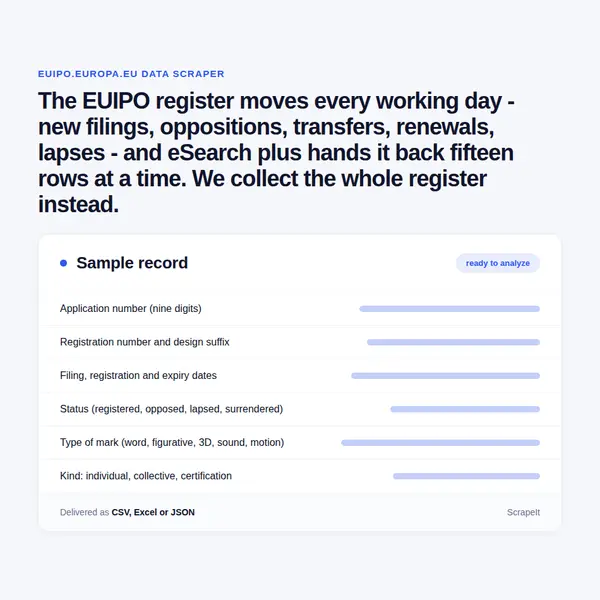
The EUIPO register moves every working day - new filings, oppositions, transfers, renewals, lapses - and eSearch plus hands it back fifteen rows at a time. We collect the whole register instead.

EUIPO Scraper
Solutions

Scoping an EUIPO scraping project: pick the register, then the join key

A scoping call answers two questions. Which register - EU trade marks, EU designs, or both plus the decisions layer - and what should it be keyed on: application number, owner number, representative number, Nice or Locarno class, or the standard identifier tying a seniority claim to its earlier national right. From there we set cadence: a daily pass over new publications and status changes, a slower full refresh, images fetched once and cached.

The Office reserves text and data mining on its own site and points machine users at the EUIPO API Portal, so we agree the route before anything runs. Anti-bot handling, proxy rotation and CAPTCHA solving are part of the service where a route needs them. We extract EUIPO data only from what is open to any visitor, and EUIPO scraping is priced by volume and cadence. Delivery is CSV, JSON, XLSX, a database drop or your own endpoint.

What one EUIPO record holds: mark type, Nice classes, owner, oppositions, renewals

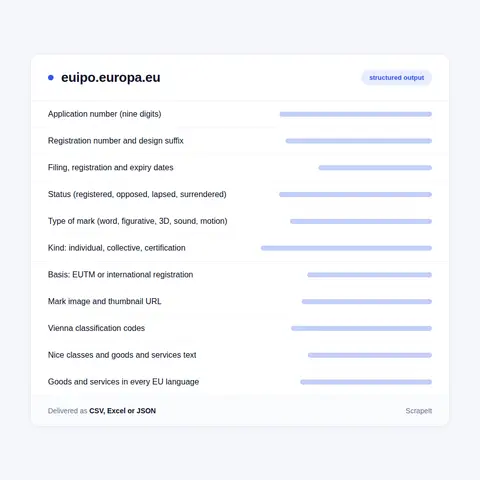
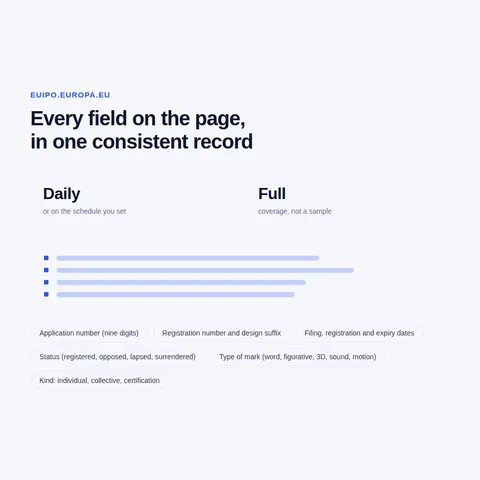
A trade mark file opens with identity and clock: application number, filing date, date received, registration date, expiry date, the current status date, the applicant's own reference, and the first and second language of the file. Status is a controlled list, not free text - application filed, under examination, published, opposed, refused, withdrawn, registration pending, registered, appeal pending, cancelled, expired, surrendered.

Then the mark itself. Type of mark comes from a fixed vocabulary: word, figurative, three-dimensional shape, colour, sound, motion, multimedia, hologram, pattern, position, olfactory and other. Kind separates individual marks from collective and certification marks, basis separates a direct filing from an international registration designating the EU, and a flag records any claim to acquired distinctiveness. Figurative marks carry Vienna codes for their graphic elements, the representation arrives as full image plus thumbnail, and there are slots for sound, video and 3D models.

Goods and services sit under Nice class numbers with their full wording, translated into every official EU language, so one class-12 bicycle list exists in twenty-three parallel versions. Around it sit the parties and the procedure: applicant with postal address, nationality, legal form, company size and activity sector; representative with an office number and a kind such as lawyer or association; opposition start and end dates; publication entries with a bulletin number and a section code such as A.1 for the application or B.1 for the registration; priority; seniority naming the earlier national right by country, number and filing date; oppositions with case number, grounds and opponent; cancellations, appeals, decisions with their PDF, recordals, renewals and a dated event trail.

A design file swaps the mark for the drawing. It carries a Locarno class, a product indication phrased in every official EU language current at publication, the designer's name or an entry recording a waiver of the right to be cited, a representation means of static, video or three-dimensional, and its views, protected and non-protected kept apart. Design status has its own list: registered and fully published, registered and subject to deferment, expiring, lapsed, surrendered, declared invalid, invalidity pending, lack of effects.

What one EUIPO record holds: mark type, Nice classes, owner, oppositions, renewals
Register snapshots, recordals, daily Bulletins and the EUIPO decisions layer

Register snapshots, recordals, daily Bulletins and the EUIPO decisions layer

The register is not only its current state. eSearch plus keeps dated register snapshots for a right, and the entry types read like a corporate history: application under examination, application published, registered, renewal, change of name and address of owner or representative, correction of relative errors. Pull them in sequence and you have who owned what and when.

Recordals have a vocabulary worth naming, because they are the events people actually chase: claims and cancellations of seniority, licence creation, licence and sublicence transfer, right in rem, levy of execution, insolvency, partial transfer, division, conversion, replacement, alteration to the representation of a mark, change of name of a designer.

The Office also publishes a daily EU Trade Marks Bulletin and an EU Designs Bulletin, laid out in WIPO INID codes - 210 for the application number, 220 for the filing date, 541 for the mark in standard script - so a bulletin entry parses the same way year after year. Office decisions, Boards of Appeal rulings and General Court judgments live in eSearch case law with keyword sets of their own: likelihood of confusion, overall impression, informed user, density of the design corpus.

Owners and representatives are searchable entities in their own right, each with an office number joining back to every file they touch, and the Union register of geographical indications for craft and industrial products is published through GIview. Marks from national offices are not in the EUIPO register - those sit in the shared TMview and Designview services, a separate source.

Inside eSearch plus: the two registers EUIPO keeps and publishes

EUIPO is the European Union Intellectual Property Office, an EU agency in Alicante that examines and registers the EU trade mark and the registered EU design, and keeps the Union register of geographical indications for craft and industrial products. Two registers carry the data buyers want: the Register of European Union trade marks, whose contents are fixed by Article 111 EUTMR, and the Register of EU designs, fixed by Article 104 EUDR. Both are open to public inspection, and both are published through eSearch plus.

eSearch plus is the Office's own search front end. Results split across four tabs - Trade marks, Designs, Owners, Representatives - with Office decisions and the daily Bulletins alongside them. The interface runs in every official EU language, takes asterisk and question-mark wildcards, ignores case and diacritics, and carries image search: one image for a mark, up to seven views for a design, with the system proposing the Vienna codes and Locarno classes it thinks it sees.

Numbering tells you what era a file belongs to. EUTM application numbers are nine digits in one unbroken sequence that starts at 000000001, the AIPPI mark filed on the day the system opened, and currently runs past 019420000. A design carries its application number plus a four-digit suffix marking its place in a multiple filing. Vocabulary moved too: what the market still calls a registered Community design appears as a registered EU design in the Office's own screens after the design reform, and eSearch plus labels its statuses that way.

Get a Quote
dev_w
25

Developers

customers
500+

Customers worldwide

pages
1 500 000 000+

Pages extracted

stime
15000+

Hours saved for our clients

Plans

Airplane

€199 / one-time

setup fee - included

Data limits100,000
Frequencyone-time
Run timeup to 5 days
Data storing7 days

Helicopter

€169 / mo

setup fee €499

Data limits250,000
Frequencymonthly
Run timeup to 5 days
Data storing14 days

Glasses

€229 / mo

setup fee €499

Data limits1,000,000
Frequencyweekly
Run timeup to 5 days
Data storing30 days

DNA

€549 / mo

setup fee €799

Data limits3,000,000
Frequency3 times daily
Run timesame day
Data storing90 days

Clearance, watching and enforcement: what buyers do with EUIPO data

Teams scrape EUIPO for three jobs. The first is clearance. Before a name, a logo or a package goes to market, somebody has to know whether an identical or confusable right already covers the same Nice classes, whether it is live or lapsed, and whether its owner has a record of opposing. The register answers all three - but only if you can hold a whole class at once instead of paging through it fifteen rows at a time.

The second is watching. The opposition window opens on publication and closes three months later, and both dates sit in the record. A rival's new filing, a change of proprietor, a licence recorded against a mark you license yourself, a renewal that quietly went unpaid - each is a register event with a date on it, and each is worth knowing in days rather than at the next audit.

The third is enforcement. Counterfeit work starts from a portfolio: the marks and designs you own, their classes, their images, their proprietors of record. Matching customs seizure lists, marketplace listings or domain registrations against EUIPO data means holding those images and class lists locally, not clicking through them one file at a time.

Around those sit the quieter uses: renewal calendars built from expiry dates, filing trends broken down by Nice class and country of owner, IP due diligence on an acquisition target, and labelled image sets for similarity work.

Our Blog

Reads Our Latest News & Blog

Learn how to use web scraping to solve data problems for your organization

How Artificial Intelligence Is Used In Web Scraping

How Artificial Intelligence Is Used In Web Scraping

Leveraging advances in technology, the AI-powered web scraper has skyrocketed in demand and is helping to expand capabilities by automating tedious daily tasks and speeding up data collection from thousands of websites several times over.

What is Web Scraping and What is it Used For?

What is Web Scraping and What is it Used For?

Web scraping is a method of obtaining web data by extracting it from pages of web resources with the help of a program, that is, in automatic mode. It is used to syntactically convert web pages into more usable forms.

Web Scraping for Machine Learning

Web Scraping for Machine Learning

If you specialize in machine learning, you need to feed large amounts of data to the algorithms. Web scraping is the easiest and the most efficient method of collecting the data from all over the Internet.

scrapeit logo

Who builds and runs your EUIPO data feed

ScrapeIt runs the whole job as a managed service. We design the collectors, schedule them per register, watch the runs and repair them when a status label, a section code or a field name changes. Your side receives files or an endpoint and keeps no scraping engineers of its own.

We are not affiliated with EUIPO or any EU institution. Nothing behind the User Area login is touched. Some proprietors and representatives are natural persons, and we carry their names exactly as the register prints them, as a detail of the right itself rather than a profile of a person.

FAQ

Does EUIPO have a public API, and what does it actually return?

Yes, through the EUIPO API Portal, and it is not a free-for-all. The catalogue includes Trademark search and Design search, which return the full record for a given right; Goods and Services over the TMclass taxonomy; Product Indications over the Locarno and DSClass taxonomy; and Persons, which searches applicants and representatives. The filing, portfolio and mailbox products only touch your own cases. Access runs account, sandbox with test data, then approval for production - there is no anonymous key and no bulk dump of the whole register. eSearch plus itself stays open to any visitor, which is where most collection actually happens.

Which fields come back with one EU trade mark record?

Application and registration numbers, filing, receipt, registration, expiry and status dates, first and second language, applicant reference, status from the controlled list, type of mark and its sub-type, kind (individual, collective, certification), basis, acquired distinctiveness flag, Vienna codes for figurative elements, image and thumbnail, Nice classes with the full goods and services wording in every official EU language, applicant and representative with address and office number, opposition start and end dates, publication entries with bulletin number and section, priority, seniority, oppositions, cancellations, appeals, decisions, recordals, renewals and the event trail.

Do you cover national trade marks too, or only EU-wide rights?

The EUIPO register holds EU-wide rights only: an EU trade mark or a registered EU design covers all Member States as one unitary right, and international registrations designating the EU appear alongside them with their own basis flag. Marks and designs registered at national offices in Spain, Germany, Poland and the rest are not in this register - they are published through the shared TMview and Designview services, and we scope those separately. If you need EU and national coverage in one table, say so at scoping and we key both to the same schema.

How fresh is EUIPO data, and how often can a feed be refreshed?

The register changes every working day. New applications appear from filing, publication entries land with the daily Trade Marks and Designs Bulletins, and recordals - transfers, licences, seniority claims, representative changes, renewals, surrenders - are entered as they are processed. A daily pass over new publications and changed statuses is the normal cadence, with a slower full refresh behind it to catch retrospective corrections. For a watch on a defined slice, such as one Nice class or one owner portfolio, a tighter schedule is straightforward.

Is EUIPO register data free to reuse, and what about names in it?

Both registers are public by law and open to inspection, and the Office allows reproduction of published information when it is credited as the source and changes are marked. It also reserves text and data mining on its website and routes machine users to its API Portal, so we agree the collection route with you first rather than assuming one. Proprietors and representatives are sometimes natural persons; their names, office numbers and correspondence addresses are published register particulars, and we pass them through as such without enriching them into personal profiles.

How does it Work?

Step 1 - Make a Request

You share your needs, expectations, and desired timeframe. We’ll suggest the best solution based on your request and budget.

Step 2 - Configuring Custom Web Crawlers

Our specialists configure the crawlers and extract a sample dataset for your review before proceeding with the full-scale extraction.

Step 3 - Collect and Deliver

Once you approve the sample, we launch the project and start full data collection. We gather, filter, and structure the data for easy use, delivering it on time in your preferred format.

Step 4 - Maintain and Support

Our team manages ongoing processes, monitors website changes, and supports all data extraction cycles. We can also help integrate data into your systems or create dashboards to simplify analysis.

Request a Quote

Tell us more about you and your project information.
Which sites, which fields, how often. A couple of lines is enough.

We reply within 1 business day. No obligation.

scrapiet

Scrapeit Sp. z o.o.
10/208 Legionowa str., 15-099, Bialystok, Poland
NIP: 5423457175
REGON: 523384582